
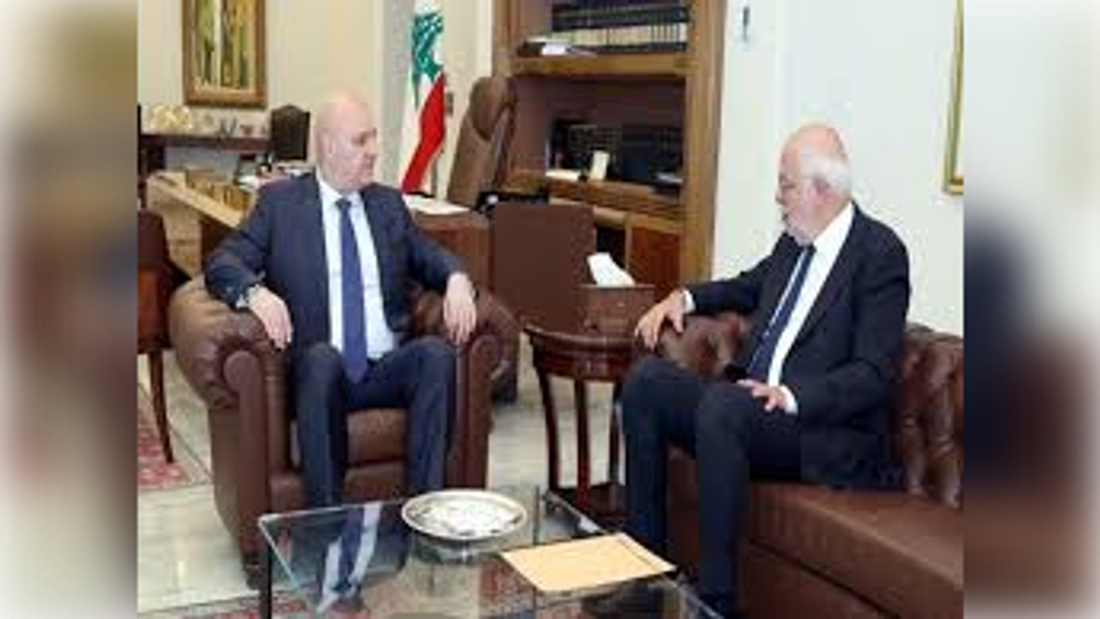
The Dahr al-Baidar truck case was not closed when the proposal to refer it to the Judicial Council was withdrawn from discussion at last Thursday’s Cabinet session. Instead, it entered a more ambiguous phase. The failure to raise the referral did not mean it had been definitively dropped, just as the understanding reached between President Joseph Aoun, Prime Minister Nawaf Salam, and Parliament Speaker Nabih Berri, in coordination with Hezbollah, did not resolve the underlying dispute. Rather, it prevented the disagreement from turning into an open internal confrontation at that moment.
In this sense, the settlement was not an agreement on how to address the case so much as an agreement to postpone it. The escalation was contained following political contacts that, according to reports, included the Saudi side through envoy Yazid bin Farhan. Berri played a key role in preventing the dispute from exploding within the government. The immediate objective was to overcome the impasse and get past the critical moment, without implying that the parties pushing for the referral had abandoned their goal.
While information published by Al-Akhbar indicates that Justice Minister Adel Nassar does not consider the failure to raise the case at the latest session a retreat from the referral option, he reportedly told those who asked him that he would raise it again. A meeting between Lebanese Forces MP Sami Gemayel and the president shortly before Thursday’s session had prevented Nassar from withdrawing from the meeting. In a televised interview yesterday, the justice minister said he had not withdrawn from the session so that his action would not be interpreted as questioning the judiciary. He confirmed that he would raise the referral again at the Cabinet session in two weeks.
Clearly, the dispute has gone beyond differences within the government over a judicial procedure and has become a vehicle for political one-upmanship within the Christian arena. Lebanese Forces leader Samir Geagea’s insistence on the referral, along with the withdrawal of his ministers from the session in protest at its omission, turned a hard-line stance into a measure of political presence and representation. De-escalation was consequently portrayed as a concession, while insisting on the referral became a means of demonstrating the ability to confront Hezb0llah and its allies.
Accordingly, the debate is no longer limited to the merits and timing of referring the case to the Judicial Council. It is now shaped by calculations surrounding competition for the Christian electorate, as each side fears that its rivals will use any step toward de-escalation against it, even if such a step is necessary to prevent an internal government crisis. In this context, when Salam described the ministers’ withdrawal as populist, he was indicating that the dispute was no longer merely a difference in the assessment of a legal procedure, but had become part of the struggle over the Christian street and political representation.
The situation is particularly sensitive for the presidency, amid reports that Aoun does not want to appear to have a lower political ceiling than Geagea or other Christian leaders. Thus, the president, whose position should theoretically give him greater room to contain divisions, finds himself facing sectarian pressure that narrows his room for maneuver. As a result, de-escalation becomes a position that requires justification, while a hard-line stance is presented as evidence of steadfastness.
Nevertheless, domestic political calculations are not the only factor behind the postponement. According to the available information, there is also a bet that regional developments—particularly the possibility of a war against Iran and its repercussions for Hezb0llah—could alter the terms of the confrontation.


