
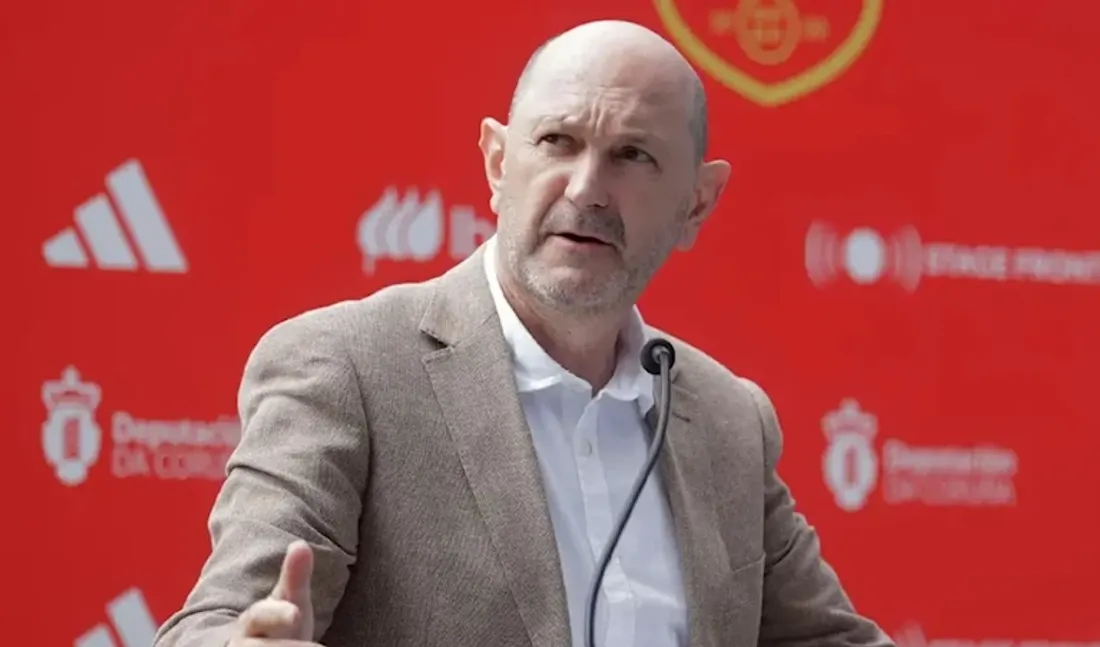
Spanish Football Federation president Rafael Louzán reaffirmed on Tuesday that his country remains determined to host the 2030 World Cup final, despite competition from Morocco to stage the tournament’s most prestigious match. He made the remarks while participating in the “Expansión and Marca Business and Sports Forum,” during a session examining the 2030 World Cup and the role of sport as a global economic force.
“I have no doubts about where the final should be held,” Louzán said, adding: “There can only be three potential stadiums to host the final: Santiago Bernabéu Stadium, Spotify Camp Nou, and the Grand Stadium of Casablanca.”
He continued: “It would have been better to settle this matter earlier, but this is a tournament that belongs to the European continent. Therefore, the final must be held in Spain, and it will be held in Spain.”
His comments come as Morocco seeks to host the final at the Grand Stade Hassan II, which is currently under construction near Casablanca and is expected to have a capacity of approximately 115,000 spectators.
𝗗𝗲𝗰𝗶𝘀𝗶𝗼𝗻 𝗣𝗼𝘀𝘁𝗽𝗼𝗻𝗲𝗱
Louzán explained that the decision on which stadium will host the final may not be made until 2028. He noted that the bids submitted by cities and stadiums seeking to host tournament matches are still being assessed.
He said Spain initially put forward 11 candidate cities before reducing the number to nine, while efforts are underway to reinstate Vigo and Valencia. Morocco has proposed six cities, while Portugal has put forward three.
He stressed that being nominated does not necessarily mean all the cities will ultimately be selected, citing the 2026 World Cup, whose matches will be hosted by just 16 cities.
𝗠𝗮𝗷𝗼𝗿 𝗜𝗻𝘃𝗲𝘀𝘁𝗺𝗲𝗻𝘁𝘀
Louzán revealed that investments approaching €2.5 billion are planned to develop stadiums and sports facilities across Spain. The funding will come from local entities, including municipalities, clubs, regional governments, and provincial councils, rather than directly from the central government.
He said hosting the tournament represents an opportunity to modernize sports infrastructure and strengthen the global standing of the Spanish league.
Regarding ticket prices, he expressed hope that they would be more affordable for fans than those at the 2026 World Cup, confirming that he had discussed the issue with FIFA.
𝗔 𝗚𝗼𝗹𝗱𝗲𝗻 𝗬𝗲𝗮𝗿
In another context, Louzán described 2026 as a “golden year” and “the best year in the history of Spanish football.” He pointed to Spanish national teams and clubs winning six or seven world titles and two European titles, attributing these achievements to teamwork, the quality of coaches, and talent development programs.
Spain, Portugal, and Morocco will jointly host the 2030 World Cup, an edition that will coincide with the centenary of the tournament’s inaugural edition in Uruguay in 1930. FIFA has not yet announced which stadium will host the final.


