
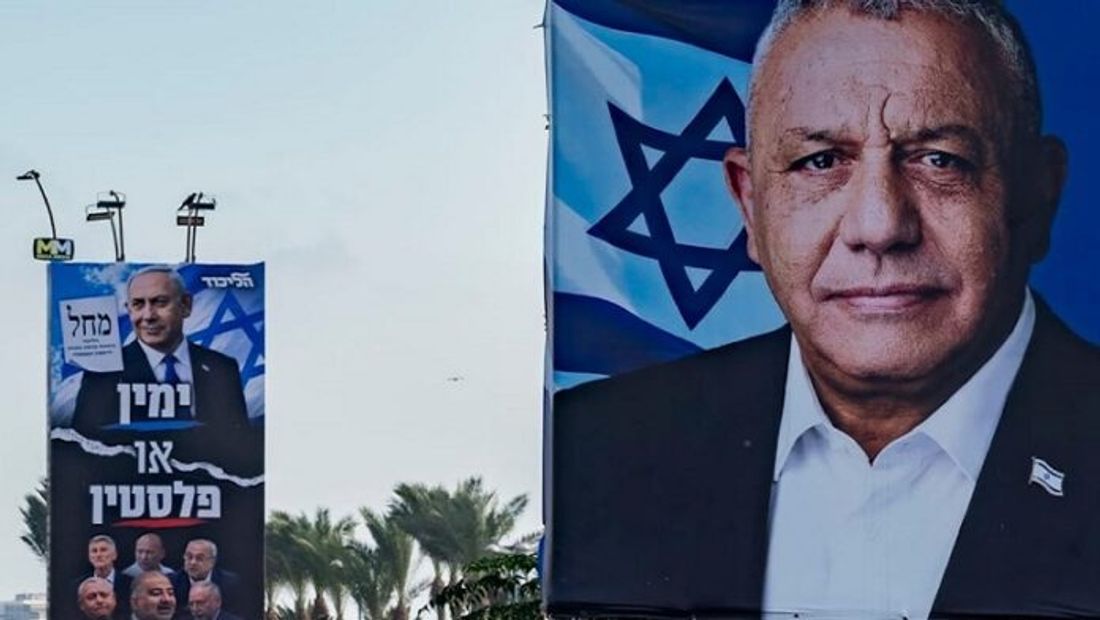
The British newspaper The Guardian published a report on the Israeli elections from the town of Kafr Qasim. It said that as the sun was setting over the town, Palestinian citizens gathered to eat hot knafeh and sip strong cardamom-flavored coffee, listening to an urgent appeal urging them to vote.
The report noted that Palestinian citizens of Israel make up around 20% of the population of the Israeli state, and their votes are likely to prove decisive in efforts to oust Benjamin Netanyahu and his far-right coalition in elections scheduled for next week.
“We are determined to do everything possible to bring down this government,” said Ahmad Tibi, a member of the Knesset for more than two decades. “High turnout within the Arab community is an important tool for achieving this goal.”
Most opinion polls show that Netanyahu’s coalition will lose its majority in the 120-seat Knesset. However, the Jewish Israeli opposition bloc is also expected to fall short of the 61 seats required to form a government.
Palestinian citizens of Israel are expected to win between 12 and 15 seats, divided between the United Arab List party, known as Ra’am, and the Joint List alliance, comprising Hadash and the Arab Movement for Change, along with other smaller parties.
The Guardian emphasized that the political arithmetic is clear, even though most of the Jewish Israeli opposition has ruled out forming a coalition with Arab politicians. Netanyahu and his allies have done everything they can to portray such an alliance as political poison.
The fear-driven, racist campaigns include posters bearing the slogan “Either the Right or Palestine,” while others on the right have adopted the phrase “Bibi [Netanyahu’s nickname] or Tibi,” despite the very slim possibility that Tibi would even hold a minor ministerial position.
The report pointed out that, throughout the history of the Israeli state, there have been only two Palestinian ministers: Ghaleb Majadale, who held the sports portfolio for two years, and Issawi Frej, who served as minister for regional cooperation for just over a year.
Nevertheless, there is a recent precedent for breaking promises not to work with Palestinian politicians. In 2021, Mansour Abbas, leader of the United Arab List, brought his party into a historic coalition government with Naftali Bennett, who is now part of the opposition bloc. Netanyahu himself had previously held coalition negotiations with Abbas.
The report quoted a potential voter named Mohammed, who works at a high-tech company where he manages both Jewish and Arab employees. He sees this workplace as “a model for a different future for Israel.”
Mohammed said he understands the political calculations and expects attitudes to change as soon as the election results become clear.
“At the end of the day, it’s all mathematics, isn’t it? One plus one equals two. They can’t do anything without those seats. So they’ll have to make some kind of deal, and they will,” he said.
According to the report, he plans to vote and encourage all his friends, both Jewish and Palestinian, to do the same.
“You can say, ‘Okay, they don’t like me, and I want to move away.’ But if you want to stay here, you have to vote. You have to do it. Because if this government stays in power, it will be a catastrophe,” he said.
For Palestinian politicians, however, any alliance with the Jewish Israeli opposition also presents a challenge. None of the parties advocates a two-state solution, most strongly oppose the establishment of a Palestinian state, and most support the settlement movement in the occupied West Bank.
Tibi said: “It’s a choice between bad and worse. No new government would be my preferred option, whether we’re talking about Netanyahu, [Bezalel] Smotrich, Itamar Ben-Gvir or the opposition.”
The report stressed that the scale of death and destruction in Gaza, the violence carried out by armed settlers and ethnic cleansing in the West Bank, along with rising racism and discrimination within Israel, have left deep-rooted fears about what another four years under far-right ministers could bring.
Sami Abu Shehadeh, a party leader, said: “The biggest motivation is fear. It is more effective and important than our political parties, our campaigns or anything else.”
He added: “People are highly politicized and understand the danger of what will happen if these criminals return to power.”
Voter turnout has declined in the past because some voters have lost faith in a system they believe is biased against Palestinians and their representatives.
The report said there is a renewed sense of urgency to vote this year because a return to power by a far-right coalition would give it a fresh mandate to accelerate policies of ethnic cleansing and annexation, according to Amjad Iraqi, a senior analyst on Israeli-Palestinian affairs at the International Crisis Group.
The Guardian noted that in Kafr Qasim, the election date serves as a reminder of Palestinian vulnerability. Two days after the vote, the town will commemorate one of the worst massacres in Israel’s history, when Israeli Border Police killed around 49 men, women and children in 1956 after opening fire on them for violating a curfew they had not known was in effect.


