
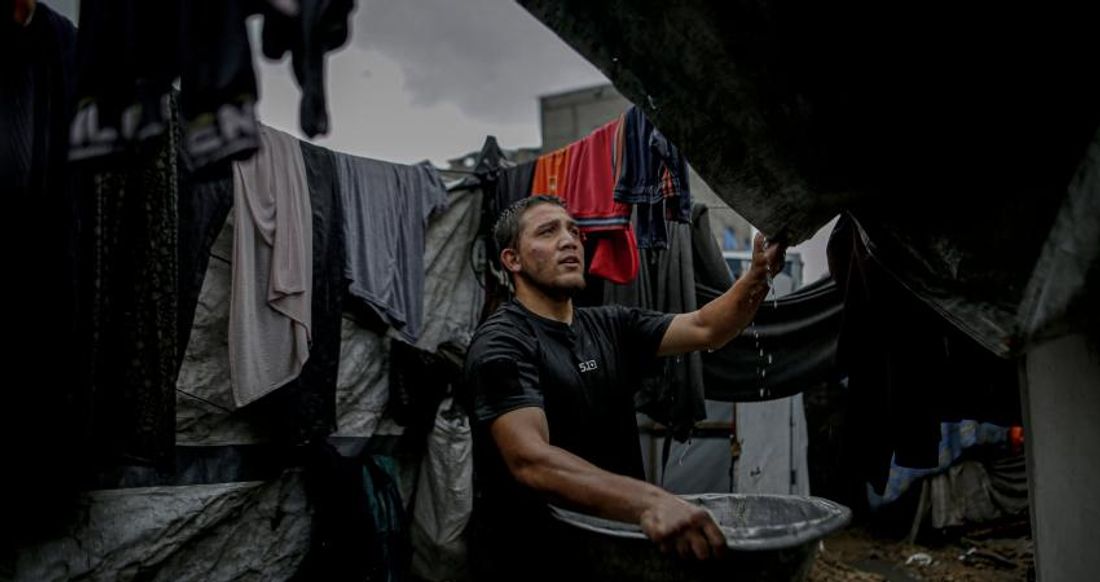
As though the earth had not endured enough after more than two years of the fires of war and the brutality of bombardment, the skies have now poured the first rains of winter onto bodies exhausted by prolonged displacement and ongoing forced expulsion. With the first severe weather system to hit the Gaza Strip, the fragile-walled displacement camps stretching from the north to the south of the territory have turned into vast pools of contaminated mud. Within just a few hours, floods and fierce winds swept away what little shelter and basic necessities remained for grieving families.
Just five minutes of heavy rain were enough to expose the failures of the conscience of a silent world and leave hundreds of thousands of families facing a merciless, bitter winter. During those few minutes, rushing rainwater swallowed at least 70,000 tents whose fabric had worn out and whose threads had deteriorated under the prolonged summer heat and continuous exposure to the elements, without maintenance or replacement. Thousands of families awoke to floodwaters sweeping through their miserable shelters, soaking their few remaining belongings and their children's worn-out clothes.
These frail, slender bodies, which miraculously survived the missiles of death and the devastating bombardment over the past months, now find themselves alone in the face of another enemy: the freezing winter and floods that have swept away mattresses and blankets, leaving children crying from the cold and wet, with no heating equipment or alternative shelter available.
The cries of mothers and fathers rose in desperation from inside tents that have become completely incapable of keeping out the raindrops seeping through their torn roofs. Winter, which the world welcomes as a season of warmth, rain, and abundance, has turned into a terrifying nightmare and a renewed tragedy, drowning displaced people in mud, suffering, and uncertainty.
The disaster has never been caused by a few raindrops or ordinary seasonal weather. Rather, it lies in the suffocating and tightly enforced Israeli blockade, which, through political and military decisions, prevents the entry of insulating plastic sheeting, durable rain-resistant tents, and prefabricated housing units (caravans).
What is happening in displacement camps today is a deliberate and systematic process of drowning and freezing, unfolding before the eyes of the international community and UN institutions, which limit themselves to monitoring figures and issuing statements without taking concrete action to break the siege and stop the ongoing crime of genocide, now extending through the changing seasons and the forces of nature.
Today, the Gaza Strip is not drowning solely in the water falling from the sky. Above all, it is drowning in a world that has failed it and conspired against it through silence, abandoning the most basic principles of humanity and leaving nearly two million displaced people to struggle against fierce winds and raging floods with exposed bodies, empty stomachs, and broken hearts, searching for the safety they have lost amid the rubble of homes and the open graves of martyrs.
Pools of Mud and Tents Without Roofs
In the early hours of dawn, as the cold air front arrived, displaced residents in the camps of Deir al-Balah, Khan Younis, and the overcrowded al-Mawasi area awoke to the sound of powerful winds that uprooted hundreds of tents made from nylon, worn-out clothing, and empty flour sacks. The dirt roads separating the tents turned into channels of stagnant wastewater and mud, leaving families trapped inside their shelters as water seeped in from above and below.
In the al-Mawasi camps, which are crowded with nearly one million displaced people, residents were forced out into the open amid heavy rain to watch their tents being blown away. Fathers desperately tried using bricks and sand to raise the edges of their tents and prevent water from flowing inside. However, the intensity of the storm was stronger than these primitive efforts. Children who woke up terrified found themselves surrounded by water on their foam mattresses, which had become completely soaked with cold rainwater.
Two Years of Deterioration and Systematic Restrictions
The main problem that has magnified the scale of this disaster is that the vast majority of tents currently in the Gaza Strip have been standing for nearly two years, with some erected during the first weeks of the Israeli war. Throughout this period, the fabric has been exposed to scorching sunlight during two consecutive summers, causing it to lose its strength and become fragile and easily torn by even a single gust of wind or shower of rain.
Gaza's Civil Defense and relief organizations confirm that the occupation forces regularly prevent the entry of new, usable tents and impose strict restrictions on bringing in nylon and waterproof sheeting that could protect families from the rain.
This systematic denial falls within a policy of deepening humanitarian suffering and pushing residents to the brink of despair and continued displacement, leaving displaced people without any shelter to protect them from the summer heat or winter cold.
The Combined Threat of Cold and Disease
The suffering does not stop at being soaked and exposed to the cold. It extends into a serious health threat endangering thousands of lives, particularly children, the elderly, and people with chronic illnesses.
The mixing of rainwater with overflowing sewage, caused by the destruction of infrastructure by the occupation army, has resulted in foul odors and contaminated water flowing between the tents. This increases the risk of outbreaks of intestinal and skin diseases, as well as acute respiratory infections.
The remaining hospitals and field medical teams, operating with only minimal resources, have issued repeated emergency appeals. Since the first hours of the storm, they have received hundreds of cases of severe colds and pneumonia among children who have been unable to find dry clothes after their clothing was completely soaked.
The shortage of essential medicines, antibiotics, and medical solutions due to the blockade further compounds the crisis, making even a minor illness under these conditions potentially fatal.
A Struggle for Survival
A tour through the flooded tents reveals heartbreaking human stories. Mothers carry their infants on their shoulders for hours, standing in the corners of tents that have not yet been reached by the water. Fathers search through the rubble of the camp for a few pieces of dry firewood or plastic to light a small fire to warm their shivering children, but to no avail, as everything is soaked.
The meager food portions that displaced people receive through aid or local community kitchens have also been spoiled by the water, leaving families without food, shelter, or blankets.
These scenes capture the tragic reality experienced by more than two million Palestinians, who have, in a matter of moments, become displaced people within their own displacement, searching for lost hope in an international arena that has turned its back on their suffering.
The Failure of International Institutions
Government and humanitarian agencies in the Gaza Strip have issued urgent and repeated appeals to the Arab and Islamic nations and the international community, calling for immediate intervention to save the lives of displaced people before further deterioration in the coming weather systems.
These agencies have called for genuine pressure on the occupation forces to open the crossings and allow the entry of thousands of tents, prefabricated housing units, medical supplies, and fuel needed to operate sewage pumps and drain rainwater from streets and camps.
However, the international response remains confined to verbal condemnations and expressions of concern, while the Israeli blockade continues to strangle the Strip and prevent the entry of the basic necessities of human life.
Today, Gaza is facing a new chapter in the ongoing war of extermination—a chapter in which gunpowder is not the only weapon. Nature and its freezing cold are also being used as instruments of killing, enabled by shameful global complicity and silence.


