
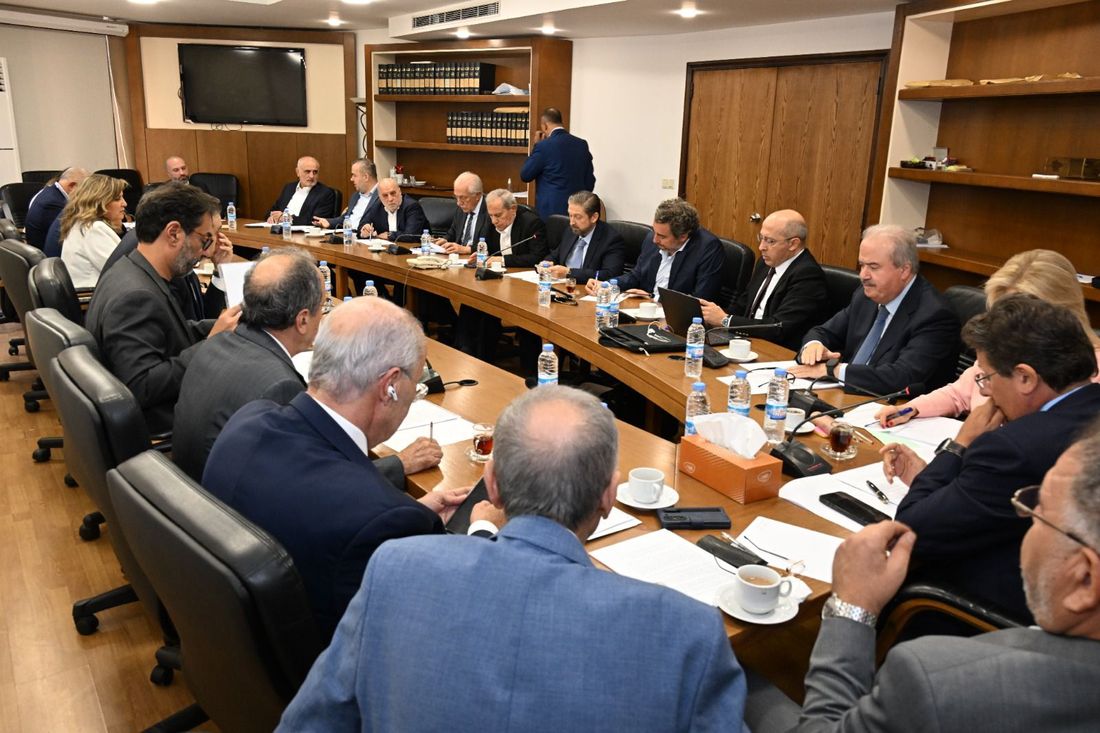
The Finance and Budget Committee held a session attended by Finance Minister Yassine Jaber, several members of Parliament, Electricité du Liban Chairman Nassib Nasr, and the institution's Director General Kamal Hayek.
Following the session, committee chairman MP Ibrahim Kanaan said that the agenda included the anticipated additional funding aimed at resolving the issue of electricity cuts affecting public administrations.
He said that debts accumulated over many years had led Electricité du Liban to gradually cut off power to public institutions and administrations that provide essential services to citizens, including water facilities, the airport and public hospitals.
“Is it reasonable for the state to waste, delay and fail to pay what it owes, only for citizens to ultimately bear the consequences?” Kanaan asked.
Regarding the failure of public institutions to pay their electricity bills, he said that the burden had ultimately fallen on citizens, making it necessary for the state to resolve the issue and assume its responsibilities.
Kanaan explained that there is a surplus in the state treasury and that the $100 million appropriation is neither a loan, an advance nor a grant, but funds to be borne by the Lebanese state.
He said the $100 million represents part of the $248 million owed by public institutions and administrations. With exemptions included, the total amount could reach $428 million, meaning the $100 million allocation may cover less than 23 percent of the required funds.
The committee therefore decided to conduct an audit to determine the full figures and take into account institutions that have already begun paying their dues, in order to determine the remaining balance and develop a comprehensive solution for the electricity sector.
Kanaan stressed the need for a long-term approach to prevent the problem from recurring every two years, noting that budgets already include appropriations for public institutions to meet their obligations to the state treasury and that compliance must be strict.
He added that public hospitals and municipalities would be given priority because they are in direct contact with citizens, although this would not mean exempting them from their obligations.
The committee agreed with the Finance Minister and Electricité du Liban that priorities would be determined according to people's needs for public services. Kanaan said several questions were raised, including why revenue-generating institutions such as the telecommunications sector and the airport had not paid their outstanding bills.
He noted that the issue is now on the table and expressed hope that the law would be approved during Thursday's legislative session, helping to end the power cuts and address the concerns of citizens across Lebanon who are suffering from disruptions to essential services.
Additional Funding for Solar Energy
Regarding solar energy, Kanaan said the committee also approved an additional $10 million allocation for individuals and small businesses in cooperation with Kafalat.
He said the mechanisms for implementing the funding still require clarification and that amendments were introduced to the explanatory memorandum to include individuals alongside small businesses.
He added that $20 million from the World Bank is also available to help meet people's solar energy needs and expressed hope that the Finance Ministry would present an amended formula


