
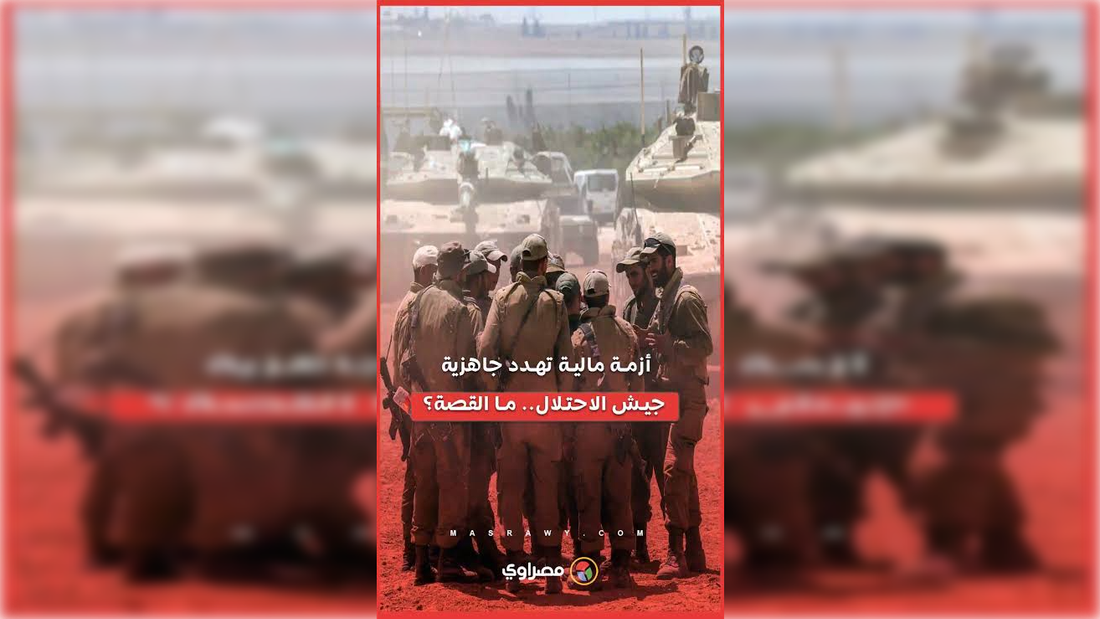
The Israeli newspaper Yedioth Ahronoth, in a new report, revealed a financial crisis facing Israel’s security establishment, including a funding gap estimated at around 25 billion shekels ($7.9 billion) in the 2026 budget, in addition to outstanding debts to military industries approaching 20 billion shekels ($6.3 billion).
The crisis has raised concerns about its potential impact on arms deals, military production and preparations for a possible confrontation with Iran in 2027.
According to the newspaper, the crisis is linked to the absence of an approved budget for 2026, forcing the security establishment to operate under a temporary spending mechanism based on the previous year's allocations. This limits its ability to launch new projects or adjust spending priorities according to military needs.
The report indicated that the accumulation of debts owed to military industries could affect the regularity of production operations and the implementation of arms deals, at a time when the Israeli army needs to strengthen its stockpiles and develop its military capabilities.
In this context, a report published by Ynet, affiliated with Yedioth Ahronoth, revealed that the repercussions of the financial crisis have extended to soldiers' living conditions and the infrastructure of military sites, particularly in border areas.
The report explained that some military sites along the northern border are suffering from shortages of heating equipment and basic supplies as winter approaches. The army is also facing difficulties in determining the investments needed to develop these sites due to uncertainty over how long forces will remain deployed there.
Meanwhile, some military bases in southern areas still lack properly equipped kitchens, forcing soldiers to rely on meals transported from outside the sites daily or every other day.
According to the report, building kitchens inside these bases could help improve soldiers' living conditions and reduce transportation and supply costs. However, implementing such projects requires additional funding and decisions regarding the future of the military sites.
The report also addressed the needs of the Israeli army in its areas of deployment inside Lebanon and the Gaza Strip, noting that projects to develop infrastructure and military transportation routes have yet to be implemented.
In southern Lebanon, the Israeli army needs, according to the report, to develop and expand military roads and routes around Beaufort Castle (Qalaat al-Shaqif) and the Wadi al-Salouqi area, with the aim of facilitating troop movements and improving supply operations.
In the Gaza Strip, there is also a need to develop roads and infrastructure in areas where Israeli forces are deployed, particularly those adjacent to what is known as the “Yellow Line.”
The report noted that some sites rely on transporting fuel by trucks to provide heating instead of establishing permanent systems, amid continued uncertainty regarding the nature and duration of the military deployment.
The implementation of these projects is linked to decisions by Israel’s political leadership regarding the future of its military presence in Lebanon and Gaza, as establishing permanent facilities requires investments different from those needed to equip temporary sites.


