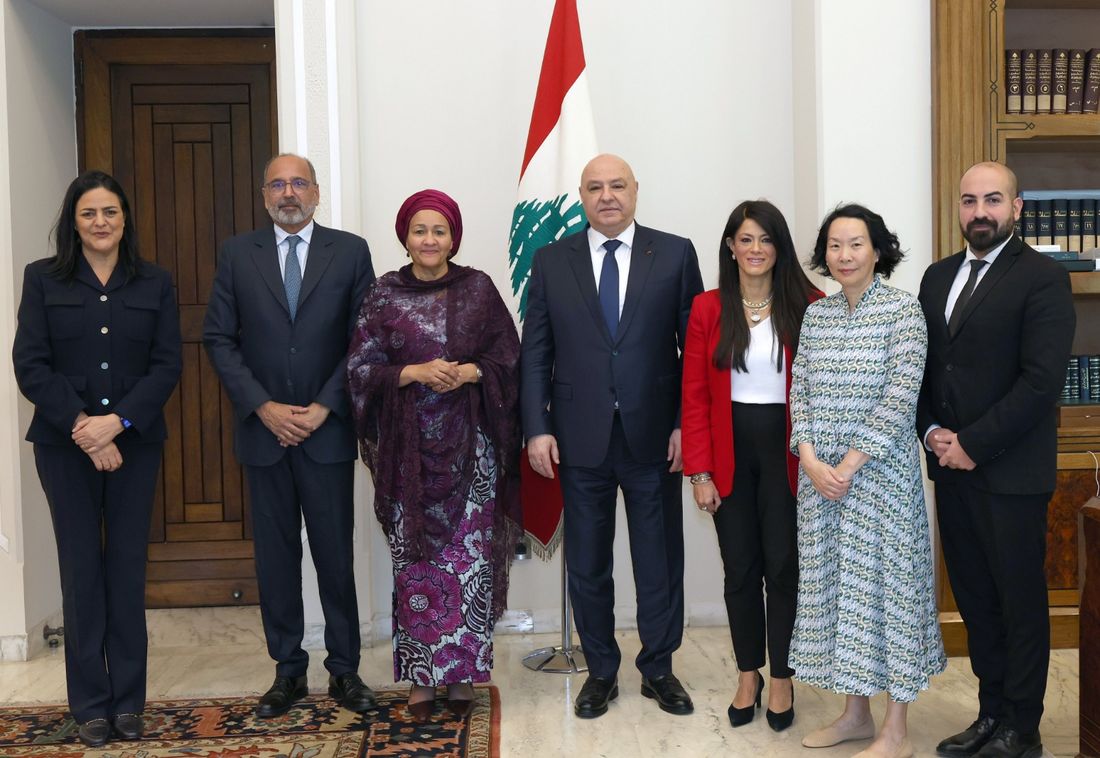
President of the Republic, General Joseph Aoun, received at Baabda Palace before noon today the Deputy Secretary-General of the United Nations and Chair of the United Nations Sustainable Development Group, Ms. Amina Mohammed. She conveyed to him the greetings of UN Secretary-General António Guterres and his wishes for Lebanon to overcome the difficult circumstances it is going through, affirming that "her visit comes as an expression of the United Nations' solidarity with Lebanon and its people amid the current crisis."
President Aoun thanked Mohammed for her visit, particularly during this delicate phase, praising "the United Nations' standing alongside Lebanon and its role in supporting stability and assisting the Lebanese people."
Mohammed affirmed that "the United Nations will remain by Lebanon's side," stressing "the importance of keeping the conditions it is experiencing at the forefront of international attention and closely following developments, especially in light of the transitional phase related to the future of the United Nations Interim Force in Lebanon (UNIFIL)."
In this context, President Aoun stressed that "the Lebanese priority remains the continuation of UNIFIL's mission and the renewal of its mandate, with openness to discussing the development of its scope of work in a manner that takes into account field requirements and emerging circumstances." He emphasized "the importance of the role played by these forces in the South, not only at the security level, but also through their logistical and engineering capabilities and their relations with local communities."
He explained that "Lebanon, should the continuation of the mission in its current form prove difficult during the year 2027, insists on the necessity for UNIFIL to continue carrying out its tasks throughout the designated transitional phase for its withdrawal, or to work on finding an alternative mechanism under the UN umbrella, so as to ensure no security or institutional vacuum occurs in the South."
The President of the Republic affirmed that "Resolution 1701 must remain the legal reference and foundation for any future international arrangements in the South," calling on the United Nations to support Lebanon in preserving this framework and ensuring the continuity of an effective international presence.
For her part, the UN Deputy Secretary-General stressed that "a vacuum in the South cannot be allowed to occur, due to the direct repercussions that could result for the residents and stability," affirming "the United Nations' commitment to the return of residents to their areas, supporting recovery and reconstruction, and strengthening Lebanese state institutions and their capacity to extend their authority and provide services to their citizens."
The meeting also addressed international efforts made to support Lebanon on the political, economic, and humanitarian levels, in light of the engagement of the World Bank, the International Monetary Fund, and other international partners in recovery and reform tracks. There was an emphasis on the importance of working in parallel on the political, security, economic, humanitarian, and reconstruction tracks, and not linking progress in one to the completion of the others.
In this context, President Aoun pointed to "the importance of Article 10 of the Tripartite Framework, which constitutes a fundamental entry point for addressing the issue of the exclusivity of arms in the hands of the state through a comprehensive approach—one that is not limited to the military aspect, but also includes political, social, economic, humanitarian, and developmental dimensions." He stressed that "addressing this issue sustainably requires providing conditions that bolster citizens' trust in the state and its institutions, and guarantee them security, services, and opportunities for a decent living," noting that "focusing on military solutions alone is not sufficient to achieve the desired goals."
Within this framework, President Aoun pointed to "the possibility of reconstructing three areas partially damaged by the attacks," noting that "the financial cost of rehabilitating them remains relatively limited, whereas the impact of this step could be significant in encouraging the return of residents and enhancing their trust in the state, by demonstrating its ability to respond to their needs and solidifying the presence of its institutions as the primary reference for citizens."
Mohammed affirmed "the importance of adopting an integrated approach that addresses the root causes of crises and their humanitarian and social repercussions," reviewing international experiences that demonstrated that limiting efforts to security and military approaches—without accompanying them with developmental, humanitarian, and institutional efforts—leads to the continued suffering of the population. She stressed "the necessity of learning from the lessons of past experiences and not repeating mistakes, and the importance of moving forward on various treatment tracks in parallel."
The Deputy Secretary-General also presented the initiative the United Nations is working on to support mental health and respond to the psychological and social needs resulting from the crisis in Lebanon, emphasizing "the importance of strengthening international support in this field, and encouraging more international officials and partners to visit Lebanon and see firsthand the scale of the challenges facing the Lebanese."
At the conclusion of the meeting, President Aoun reiterated his appreciation for the United Nations' support, affirming that "Lebanon looks forward to continued close cooperation with it, not only to maintain stability and prevent any vacuum in the South, but also to support the return of the displaced, reconstruction, economic recovery, the strengthening of state institutions, and building a more stable future for the Lebanese."
The meeting was attended by Mohammed's accompanying delegation, which included ESCWA Executive Secretary Rania Al-Mashat, UN Deputy Special Coordinator for Lebanon and Humanitarian Coordinator Imran Riza, Executive Director of the UN Office for Partnerships Annemarie Hou, and Director of the Sustainable Development Unit Karima El Korri.