
President of the Republic Joseph Aoun met with a delegation from the International Finance Corporation (IFC), which included Imad Fakhoury, Thomas Jacobs, Enrique Blanco Armas, and Linda Lemti. The meeting covered ways to enhance cooperation between Lebanon and the Corporation, particularly in private sector financing, attracting investments, and supporting development and infrastructure projects.
At the beginning of the meeting, the delegation outlined the role played by the IFC in Lebanon, both through providing advisory services and offering direct financing and investment in the private sector. The delegation members affirmed that Lebanon constitutes a priority country for the Corporation, which seeks to expand the scale of its investments and activities there during the coming period, in parallel with supporting the necessary economic and financial reforms to restore confidence and improve the business environment.
The delegation highlighted a number of projects and initiatives the Corporation is working on, including providing advisory support in the energy and airport sectors, in addition to existing investments and new investment opportunities across various economic sectors.
The delegation also touched upon the significant challenges facing small and medium-sized enterprises (SMEs) in obtaining financing amid the banking crisis. They confirmed that the Corporation is exploring alternative financing mechanisms and solutions to support these enterprises, given their essential role in job creation and driving economic activity.
Furthermore, the delegation informed the President of the ongoing work within the World Bank Group to prepare a new 5-year Country Partnership Framework for Lebanon, ahead of submitting it to the Group’s Board of Executive Directors.
For his part, President Aoun emphasized the crucial role the IFC can play in supporting the recovery of the Lebanese economy. He stressed that Lebanese institutions and companies, particularly SMEs, suffer from an acute shortage of financing, and that providing funds—even in limited amounts—can create a significant economic impact by ensuring business continuity, expanding operations, preserving existing jobs, and creating new ones. He called on the Corporation to expand its role in Lebanon, transitioning from a focus on advisory support to enhancing actual financing and investment, including for SMEs and major projects in infrastructure sectors—especially energy, transport, and other vital sectors—to stimulate economic growth and attract capital.
He also stressed the importance of Lebanon benefiting from the capacity of the IFC and the World Bank Group to mobilize international investors, promote available investment opportunities, and help mitigate the risks hindering investment flows, including through guarantee instruments and political risk coverage available within the World Bank Group.
The President affirmed that Lebanon possesses human potential and a private sector with immense capabilities, and that what is needed today is to translate international interest in Lebanon into concrete projects and investments, alongside pursuing reforms and restoring confidence in the Lebanese economy.
At the conclusion of the meeting, both sides affirmed the importance of continued coordination between relevant Lebanese authorities and the IFC to accelerate the development of bankable projects and expand investment opportunities in alignment with Lebanon's economic and development priorities.
On another note, Aoun affirmed that "Lebanon is an independent and sovereign state, and we will not accept anyone sharing our sovereignty so that we do not pay the price of past mistakes once again," calling on anyone "who draws strength from abroad against their fellow countrymen to instead draw strength from their own people against foreign forces." President Aoun considered that "positive neutrality is a necessity to distance Lebanon from regional conflicts, as this nation has suffered enough up to this day and is no longer capable of bearing further axis disputes, ambitions, and desires for hegemony."
He added: "Distancing Lebanon from foreign ambitions and fortifying national unity protect the Lebanese entity during a time when the region is passing through a phase of disorientation as a result of accelerating military and political developments."
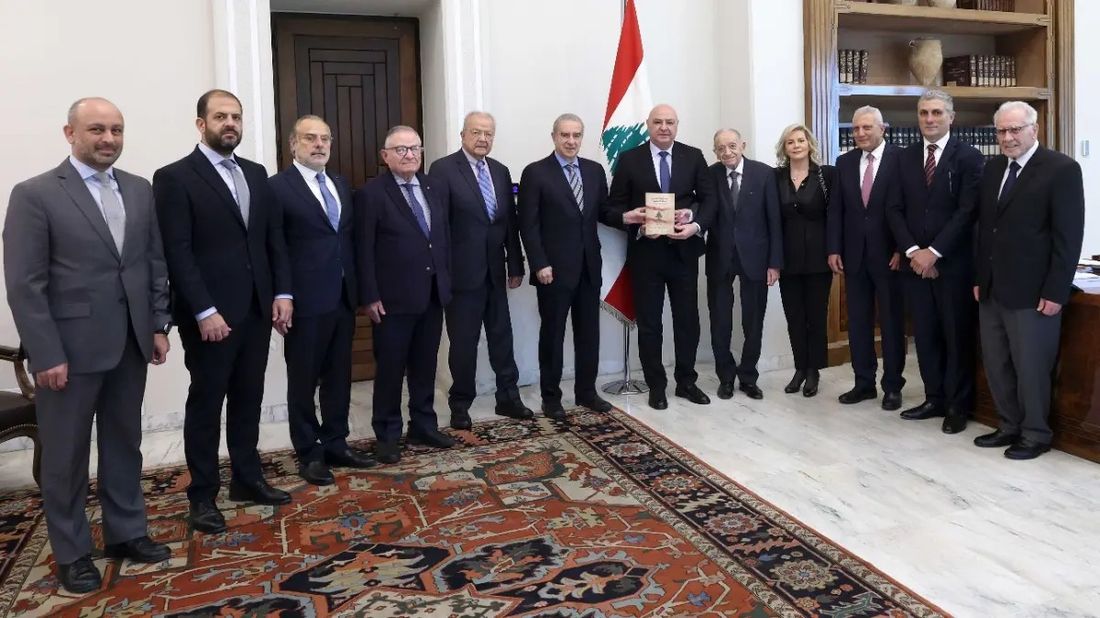
President Aoun's remarks came during his reception at Baabda Palace this afternoon of former Minister and MP Michel Pharaon, who presented him with the second volume of the book "Lebanon’s Official Neutrality and the Neutrality of the Lebanese within the Framework of the Arab League: In Diplomacy, Culture, Memory, and Education". The book was published following a series of meetings on the subject of neutrality organized by the Lebanese Foundation for Permanent Civil Peace (LFPCP) in cooperation with a group of thinkers, researchers, and experts.


