
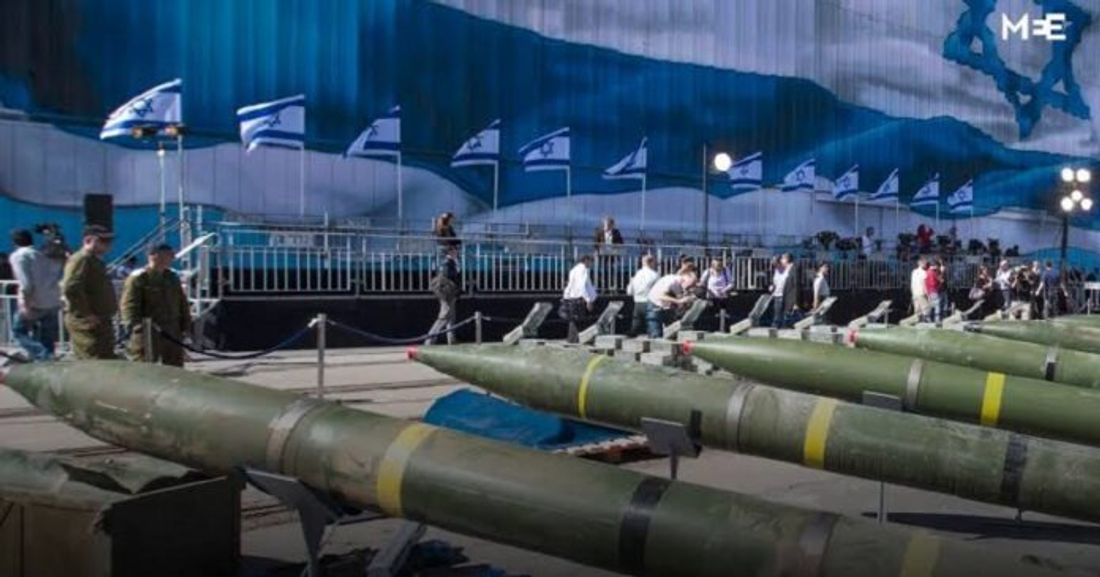
A recent study published by the *Bulletin of the Atomic Scientists* estimates that Israel’s nuclear arsenal consists of approximately 90 warheads, reaffirming the figure reached by researchers in their previous 2021 assessment. However, the study’s significance goes beyond the size of the arsenal, shedding light on its modernization, the development of delivery systems, and the US role in keeping Israel’s nuclear program beyond international scrutiny.
The study was prepared by researchers Hans Kristensen and Mackenzie Knight-Boyle, drawing on satellite imagery, declassified government documents, estimates of Israel’s plutonium stockpile, and an examination of military capabilities associated with the use of nuclear weapons.
The Policy of Nuclear Ambiguity
The study indicates that since the late 1960s, Israel has pursued a deliberate policy of neither confirming nor denying that it possesses nuclear weapons, a policy known as “nuclear ambiguity.”
This approach is based on Israel’s repeated declaration that it will not be the first country to introduce nuclear weapons into the Middle East. However, it relies on a particular definition of what constitutes “introduction,” linking it to conducting a nuclear test or officially declaring possession of such weapons, rather than necessarily to actually having them.
US documents reveal that Washington became increasingly aware of Israel’s nuclear program but, beginning in 1969, chose to reach an understanding with the government of Golda Meir not to exert pressure on Israel to declare its arsenal or subject it to oversight. This understanding was based on Israel continuing to refrain from conducting publicly declared nuclear tests or officially acknowledging its arsenal.
The study argues that this US position created a clear double standard and undermined Washington’s credibility when demanding that other countries, particularly Iran, comply with nuclear non-proliferation rules.
In a notable development in 2026, 30 Democratic members of Congress called on President Donald Trump’s administration to disclose the truth about Israel’s nuclear capabilities. US Secretary of State Marco Rubio also acknowledged, during a congressional hearing last June, that most countries around the world believe Israel possesses nuclear weapons, while noting that Washington does not officially discuss the issue.
Modernization of the Arsenal and Delivery Systems
The study dismisses estimates that put the number of Israeli nuclear warheads at several hundred, maintaining that the figure closest to reality is approximately 90. These warheads could be delivered by aircraft and ballistic missiles, and potentially by submarine-launched missiles.
The study notes that satellite images show extensive construction and expansion work at the Dimona nuclear facility, including new structures and underground tunnels. These efforts are believed to be linked to extending the reactor’s operational lifespan, with Israel seeking to keep it running until 2040.
In terms of air capabilities, Israel operates F-16, F-15, and F-35 aircraft and is working to expand its fleet of advanced combat planes. The study does not establish that all these aircraft are capable of carrying nuclear weapons, but indicates that certain variants may be able to perform this role.
Regarding its missile capabilities, Israel is estimated to possess between 25 and 50 mobile launchers for Jericho missiles. The possible existence of long-range Jericho III missiles is also noted. Their range is believed to exceed 4,000 kilometers, potentially placing Iran and large parts of Europe and Russia within their reach.
At sea, Israel possesses six German-built Dolphin-class submarines, which may be capable of launching missiles equipped with nuclear warheads. If confirmed, this capability would provide Israel with an additional option for deterrence and a nuclear strike from the sea.
A Nuclear Equation Beyond International Oversight
The study concludes that Israel’s nuclear arsenal remains shrouded in extensive secrecy, making it difficult to determine its exact size and the nature of its warheads. However, it stresses that the continued development of nuclear facilities and delivery systems reflects an effort to preserve and strengthen this capability.
The central paradox is that the Middle East faces mounting international pressure to prevent nuclear proliferation, while Israel’s arsenal remains outside the Nuclear Non-Proliferation Treaty and the comprehensive international safeguards system, protected by a US political umbrella that has prevented the issue from being formally addressed for decades.


