
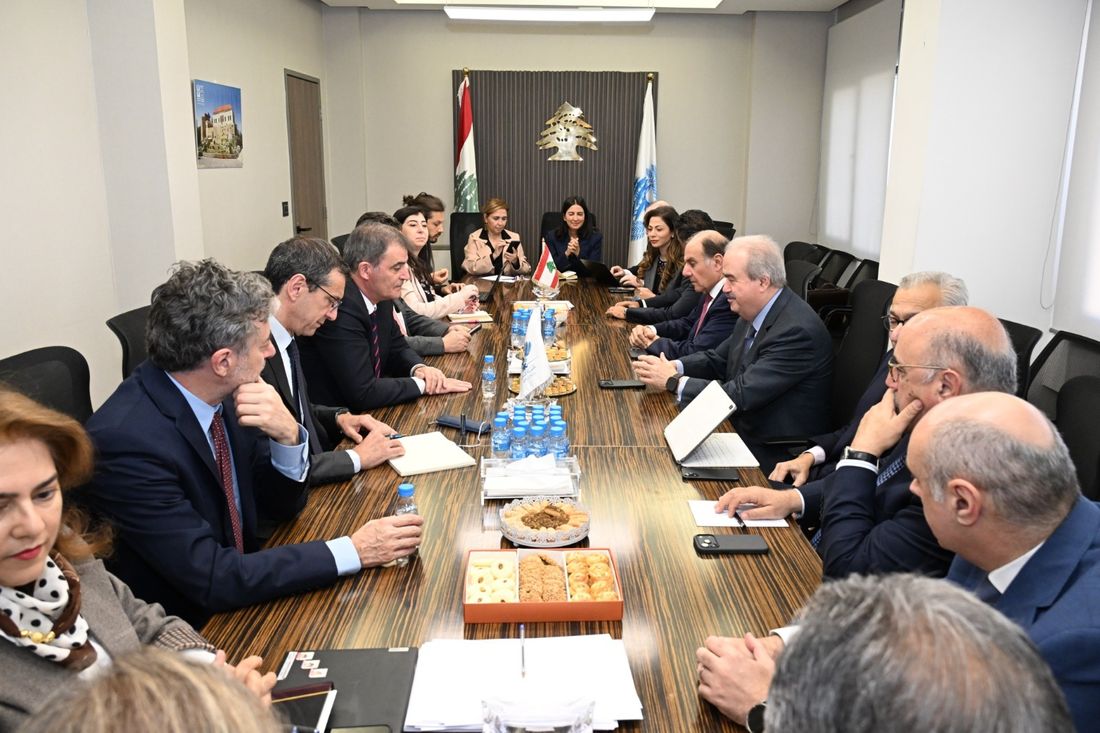
The first round of negotiations with an International Monetary Fund delegation began today at Lebanon’s Ministry of Finance. The IMF delegation arrived in Beirut last night.
The Lebanese side was headed by Finance Minister Yassine Jaber, who serves as head of the Lebanese negotiating delegation. Participants included Economy and Trade Minister Amer Bisat, Central Bank Governor Karim Souaid, representatives of the Presidency and the Prime Minister’s Office, Director General of Finance George Maarrawi, and a team of experts from the Ministry of Finance.
Following the meeting, Minister Jaber welcomed the delegation and explained that the opening session marked the beginning of a series of continuous meetings scheduled to continue through Friday.
He expressed hope that a preliminary agreement with the IMF could be reached this week, placing efforts to resolve Lebanon’s banking crisis on a path toward implementation.
“This government did not cause the banking crisis, but it is working with all its efforts to find a solution,” Jaber said. He stressed that Lebanon urgently needs to end the crisis and restore an effective banking sector capable of providing financing and loans and contributing to the recovery of the national economy.
He added that the country cannot continue relying on a cash-based economy.
Jaber confirmed close coordination between the government and Banque du Liban to unify their position, both in negotiations with the IMF and in discussions over the financial gap law that the government has referred to Parliament.
He said passing the law would be the gateway to beginning the resolution of the banking crisis, adding that its failure to pass is currently preventing Lebanon from moving forward with an IMF program.
Responding to a question about points of disagreement with the IMF and the level of financial responsibility the state may bear, Jaber said there is agreement on applying international principles and standards regarding the hierarchy for absorbing losses.
Under this approach, the state and Banque du Liban would bear losses first, followed by the banking sector, with depositors being the last to bear any losses.
Jaber said the state would contribute what its financial capacity allows, while taking into account the sustainability of public debt and the issue of Eurobond holders, which the government must also address.
He confirmed an understanding regarding Banque du Liban’s responsibility for managing efforts to resolve the banking crisis and the need to support the central bank in carrying out this task.
“There is no fundamental disagreement, but rather calculations are being conducted to determine each party’s capacity to bear the burden,” he said.
Regarding the practical steps depositors can expect to recover their funds, Jaber explained that the process begins with the passage of the law, followed by banking sector reform and implementation of an agreed-upon program for repaying depositors.
He noted that Banque du Liban is doing what it can within the available resources and pointed to a recent increase in payments made to depositors.
“We know that every depositor hopes to recover all of their money, but we are facing a crisis that has gone unresolved for seven years. Our entire effort is focused on finding a solution and bringing Lebanon out of the banking crisis and the reality of an ineffective banking sector,” he said.
Regarding the expected timeframe for approving the financial gap law, Jaber said the Finance and Budget Committee is continuing its review of the state budget and will focus on studying the proposed law once that process is completed.
He expressed hope that the law could be completed as quickly as possible, saying: “The timeframe should not extend beyond next March,” while stressing that the final decision rests with Parliament.
Following the meeting, the two negotiating delegations moved to the Phoenicia Hotel to continue discussions on issues related to the financial gap law, with talks scheduled to continue through Friday.


