
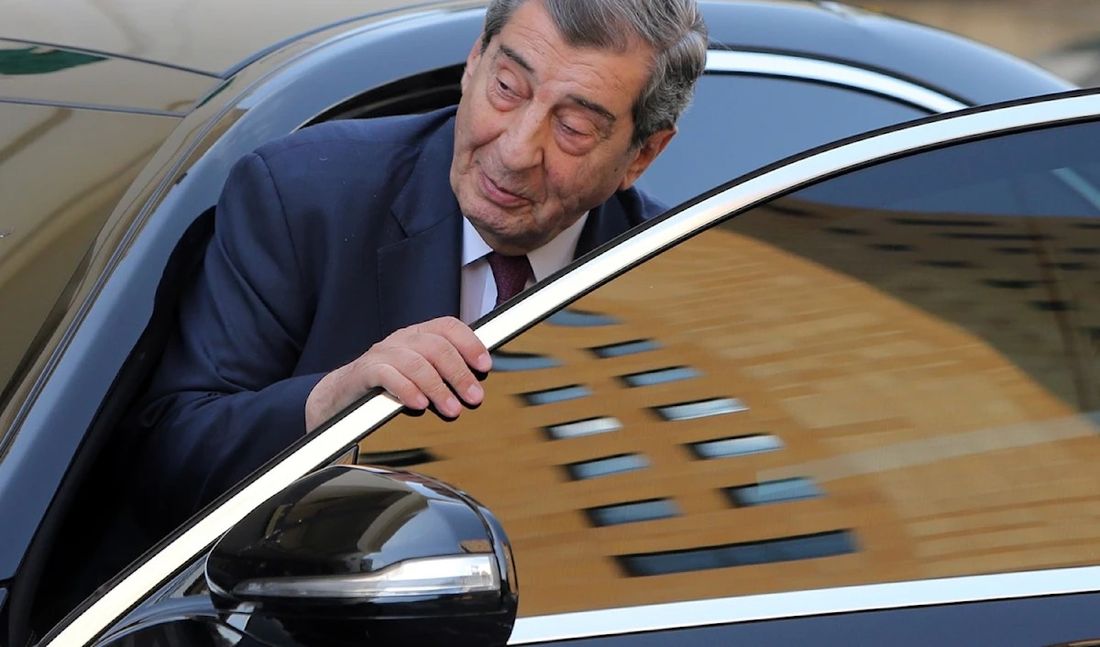
Al-Akhbar newspaper reported that former Deputy Speaker of Parliament Elie Ferzli has opened the battle for a by-election in West Bekaa, despite the matter not yet being placed on the government’s agenda for a decision.
Nevertheless, it was enough for Ferzli to visit Ain el-Tineh, and for Parliament Speaker Nabih Berri to declare that he did not object to holding a by-election to fill the seat of the late MP Ghassan Skaff in West Bekaa, for requests for media interviews to pour in on the former Bekaa lawmaker, who lost his seat in the 2022 elections.
In all these interviews, Ferzli reiterated his intention to run, while denying that he had asked Berri to push for holding the election, which has become necessary following the two-year extension of the current Parliament’s term. Over the past week, Ferzli became the subject of media analysis, calculations and speculation, which naturally concluded that he was the leading candidate.
Afterward, the names of other potential candidates began to emerge. Maysem Skaff, the wife of the late MP Ghassan Skaff, visited Baabda Palace to receive President Joseph Aoun’s blessing. The Lebanese Forces party put forward the name of George Abboud. Meanwhile, MP Wael Abu Faour of the Progressive Socialist Party proposed Terry Sabounji, a Lebanese businessman who divides his time between Beirut and Riyadh.
Thus, in record time, West Bekaa had an electoral battle and a number of candidates, despite there being no political decision to hold the election. President Joseph Aoun and Prime Minister Nawaf Salam have not yet made a final decision on the matter.
West Bekaa falls within the scope of Israeli threats and attacks, and holding a by-election there raises a central question: If it is possible to organize a by-election in such a district, what prevents parliamentary elections from being held throughout Lebanon, particularly since the extension law stipulates that the postponed electoral process must take place as soon as the exceptional circumstances cease?
If the by-election is held, the justifications used by political forces to support extending their own terms may collapse. For this reason, the Lebanese Forces and the Progressive Socialist Party moved beyond their political differences and hastily arranged a meeting between MPs from their two parliamentary blocs earlier this week.
They agreed to end all discussion of the by-election altogether, whether within their local party bases or with prospective candidates, and to inform all concerned parties that they do not support holding it in January, March or at any other date.
This comes despite the Lebanese Forces recently submitting a draft law to shorten Parliament’s term. When Deputy Speaker of Parliament Elias Bou Saab held a session to discuss electoral laws, the Lebanese Forces’ proposal and Foreign Minister Youssef Raggi were present, while MPs from Maarab—including the proposal’s sponsor, George Adwan—were absent.
When Raggi was asked during the session whether he could hold the postponed elections in May 2027, as his party proposes, he replied that this would be impossible. He argued that holding elections at that time would have required preparations for overseas voting to begin two months ago or earlier.
His response surprised those present, who viewed the proposal as part of the populist positions recently adopted by party leader Samir Geagea.
Raggi was also asked what would be required if there were a desire to hold the elections in May 2028, at the end of the extension period. He replied that preparations would need to begin in April 2027, requiring political forces to intensify their meetings and reach an agreement on the shape of the next electoral law or amendments to the proportional representation law within only a few months.
However, all indications point to the absence of agreement even on the most basic contentious issues, as most political forces appear to be waiting to see how the current phase unfolds before making their decisions.
Ultimately, there will be no by-election in West Bekaa, and all the discussion surrounding it amounts to nothing more than temporary commotion that, like previous ones, will eventually fade after public attention is diverted to another issue.


