
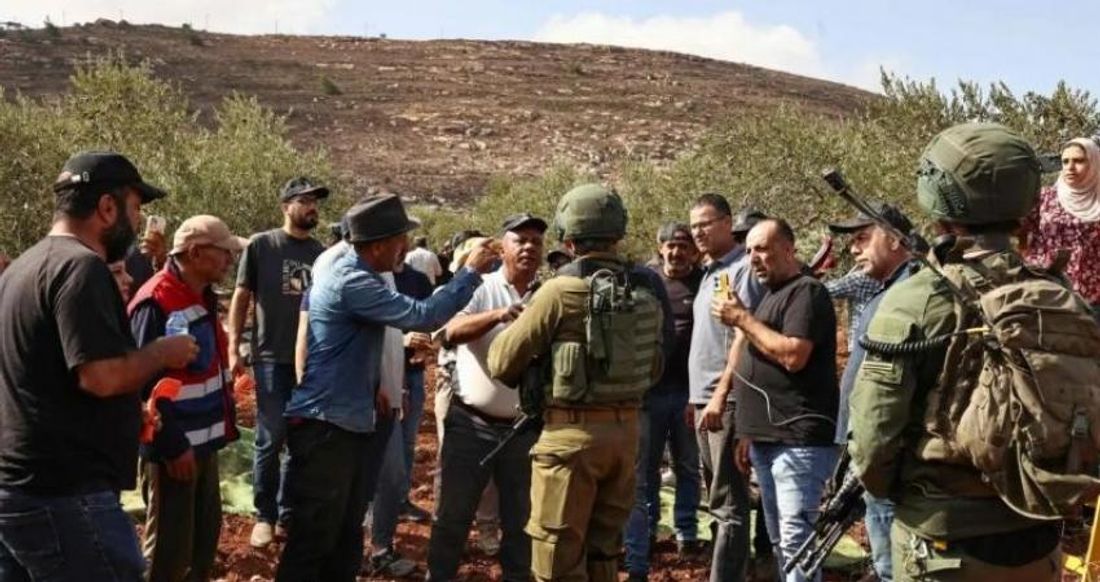
The weekly settlement report issued by the National Bureau for Defending Land and Resisting Settlements explained that the olive harvest season in the West Bank is no longer limited to settler attacks against farmers and their crops. Rather, it has become part of a broader struggle over land, involving military and settlement policies, as well as religious and security rhetoric, aimed at restricting Palestinians' access to their land.
Since the beginning of the season through the end of this month, the National Bureau has documented more than 500 attacks carried out by settlers and Israeli occupation forces across approximately 200 Palestinian communities. Most of the attacks were concentrated in the governorates of Jenin, Nablus, Salfit, and Ramallah and Al-Bireh. Farmers were also completely prevented from harvesting olives at dozens of locations, while more than 150 cases of crop theft were recorded.
The report noted that Nablus Governorate recorded the highest number of direct settler attacks, which included damaging trees and stealing crops. These attacks deprived farmers in dozens of villages of their harvests and removed large areas of land from actual agricultural production.
The report also addressed a religious ruling issued on October 16 by Israeli Rabbi Dov Lior, which authorized settlers to harvest olives from Palestinian land, based on religious interpretations claiming that ownership of those lands belongs to Jews. The ruling considered the harvesting of Palestinian crops to be part of what it described as the "occupation of the land."
It pointed out that this ruling comes within the context of previous religious rulings and positions by Israeli rabbis that legitimized the seizure of Palestinian property and agricultural crops. These include the book *Torat HaMelech* ("The King's Torah"), by Rabbis Yitzhak Shapira and Yosef Elitzur, which contains religious justifications for permitting the seizure of non-Jews' property during times of conflict.
According to estimates by the Ministry of Agriculture, olive oil production this season has declined to between 10,000 and 11,000 tons, compared with initial estimates of approximately 21,000 tons. Meanwhile, attacks and restrictions on access to land, particularly areas behind the separation wall and near settlements, threaten to prevent the harvesting of nearly half of the cultivated areas in several governorates.
The report also highlighted the Israeli army's decision to prevent farmers from entering what it calls "state lands" to harvest olives, a measure being implemented for the first time. This comes alongside requirements for prior coordination before farmers can access their privately owned land, adding further difficulties to the lives of Palestinian farmers.
The report noted that rhetoric has emerged among settlers portraying Palestinian olive harvesting as a form of incitement. This rhetoric has also spread to officials in the Israeli occupation army and government, who use it to justify restrictions imposed on farmers and foreign solidarity activists.
The report added that some Israeli media outlets have described these developments as a reversal in the treatment of those who oppose settler violence, with activists expressing solidarity with farmers now being labeled "anarchists," while attacks against olive harvesters continue.
The losses are not limited to olives being left unharvested. Large quantities of olives have also been stolen and processed at oil presses established in settlements, with the aim of marketing Palestinian olive oil for the benefit of settlers. Meanwhile, cumulative direct losses to the olive sector resulting from the destruction of trees and restrictions on access to land since 2023 have exceeded $157 million.
Escalation of Settlement Activity Across West Bank Governorates
Regarding settlement activities, the report stated that Israeli occupation forces brought mobile homes, or caravans, to the Sanur military camp on the road connecting the towns of Jaba and Sanur, south of Jenin. This coincided with continued land-clearing work at the site, raising concerns that it may once again be used for settlement projects.
The report explained that these measures aim to impose military control over the area and seize additional Palestinian land, while dividing the geography of Jenin Governorate into isolated enclaves by separating Palestinian villages and communities from one another and cutting off their geographical connection with surrounding areas.
These developments follow the Israeli security cabinet's approval on July 15 of a proposal to establish a new settlement adjacent to the evacuated Sanur settlement, currently referred to in planning documents as "Eastern Sanur."
The report noted that settlers established two new outposts last Tuesday: the first in Al-Jiftlik, north of Jericho, and the second at the northern entrance to the city of Al-Bireh. The move aims to impose a new reality on the ground and sever Palestinian geographical continuity in the area.
In Hebron Governorate, settlers established two new outposts over the past week, carried out land-clearing operations, and damaged water pipelines supplying a Bedouin community, as part of ongoing attacks.
In the town of Yatta, south of Hebron, a group of settlers began establishing an outpost in the Khallat Al-Fara area, west of the town. They erected a tent, brought in bulldozers and excavation equipment, and began clearing the land in preparation for construction. They also established another outpost in the Yatta Badia area, on land located between the villages of Al-Zuweidin and Umm Qussa, where they erected several tents and began developing infrastructure, including water and electricity networks.
In the same context, settlers and Israeli occupation forces continued clearing land in the Khallat Al-Fara and Marah Al-Rabiya areas south of Hebron, as part of plans aimed at taking control of additional land. The report noted that the area is undergoing a process of Judaization with the support of the Israeli government, which seeks to establish a project that includes a farm called "Laman Ahai" near the towns of Al-Samu and Yatta.
The Bedouin community of Umm Al-Khair in Masafer Yatta is also facing a series of attacks by residents of the Karmel settlement and nearby outposts, which have escalated significantly in recent weeks.
According to the report, most attacks are concentrated around the Karmel settlement and its nearby outposts, including the Barkai neighborhood, the Shorashim farm, and Mishak Man. Settlers from other outposts have also been involved in acts of violence, including settler Yinon Levi from the Mitzrim outpost, who opened fire and killed Awda Al-Hathaleen, a resident of the village, on July 28 of last year.
In occupied Jerusalem, settlement plans are no longer limited to building new housing units. They have expanded to include reshaping the city's geography and isolating Palestinian neighborhoods from one another, threatening the Palestinian presence around the blessed Al-Aqsa Mosque.
A project to build 122 settlement units in the Kerem Al-Mufti area of the Sheikh Jarrah neighborhood, north of Jerusalem, stands out as a move aimed at encircling Jerusalem's neighborhoods and separating the northern part of the city from its Old City and southern surroundings.
According to the Israeli organization Ir Amim, this is the first settlement project promoted by the settlement movement in Jerusalem after decades of activity expanding settlements in the West Bank.
In a related development, the report referred to a letter sent by former Israeli security officials to Prime Minister Benjamin Netanyahu, calling on him to designate the "Hilltop Youth" group as a terrorist organization and halt its government funding. They warned that the group's attacks aim to spread fear among Palestinians and force them to leave their land and sources of livelihood.
According to the letter, which was sent last Sunday on behalf of the "Commanders for Israel's Security" movement, the group carried out approximately 13,000 attacks between October 7, 2023, and the beginning of this month, resulting in the deaths of 66 Palestinians.
Key violations committed by Israeli occupation forces and settlers during the week
Jerusalem
Settlers damaged water pipelines supplying the Bedouin community of Al-Tibneh near Khan al-Ahmar. Others attacked residents while they were harvesting olives in the village of Beit Iksa, northwest of occupied Jerusalem, under the protection of Israeli occupation forces.
In Beit Hanina, the Israeli occupation municipality forced the family of Jerusalem resident Fawaz Al-Rajabi to demolish its home themselves after issuing a written order, despite having already imposed fines totaling 60,000 shekels. The municipality also forced Jerusalem resident Hanan Al-Rajabi to demolish her home herself, under the pretext that it had been built without a permit.
Hebron
Settlers from the Susya settlement broke into the home of resident Jawdat Ahmad Al-Masri in the Al-Rahniya area south of Yatta and stole 12 sheep.
Other settlers attacked workers on cactus farms in Khirbet Soba, injuring several of them. Israeli occupation forces prevented an ambulance from reaching the injured workers.
In Khirbet Al-Kharaba, east of the town of Al-Samu, two residents, including a woman, were injured in an attack by settlers against local residents.
In the Hamroush area east of Sa'ir, settlers attacked farmers and stole their olive harvest.
Land-clearing work and the construction of a settlement road also continued in the Wadi Al-Magharat area, which belongs to the lands of the town of Al-Shuyukh. Settlers attacked olive harvesters in the Al-Mazabe area of Beit Kahil and attempted to assault several farmers and one homeowner.
In Beit Kahil, settlers placed Israeli flags on land in the Wadi Al-Qaf area, known as the lands of Shaab Mazu.
In the villages of Al-Tuwani and Al-Rakeez, Israeli occupation forces prevented farmers from harvesting olives and forced them to leave, despite their having obtained prior coordination with the occupation forces.
Israeli occupation forces also raided the land of resident Samih Da'na in the village of Bireen. They demolished a 100-square-meter residential structure, uprooted more than 200 fruit-bearing trees, destroyed three water wells, and demolished other agricultural facilities, including retaining walls and a fence surrounding the eight-dunam property.
Bethlehem
Settlers installed a caravan and a tent on land belonging to the town of Za'tara, in the Abu Nazour area, and another tent in the Dababa area east of the town. Settlers also grazed their sheep on residents' land in the Manaqi' Al-Jaradat area near the landfill south of the village, damaging several trees.
Settlers attacked residents' homes in Za'tara and stole sheep before local residents managed to recover them.
Ramallah
Israeli occupation forces cleared extensive areas of land in the Al-Maghayer area northeast of the village of Deir Qaddis and uprooted dozens of olive trees in preparation for the construction of a settlement road. This coincided with continued land-clearing operations in the area to establish a new settlement between Deir Qaddis and the neighboring village of Kharbatha Bani Harith.
Israeli forces also blocked agricultural roads leading to the area with rocks, preventing farmers from reaching their land and threatening their livelihoods, as the targeted lands account for most of the village residents' olive production.
In the village of Umm Safa, settlers drove their vehicles into the eastern area and gathered in large numbers around the home of resident Mohammad Ubayyat. They obstructed the movement of his family members and attempted to assault them as they entered or left the house. Settlers living in the outpost established on Jabal Al-Ras land also installed additional mobile homes in an apparent move to expand the outpost.
Israeli occupation authorities resumed land-clearing operations east of the village of Al-Mughayyir, in the Sahl Al-Rafid area. Nearby, Israeli forces forced farmers harvesting olives in the Wadi Amr area to leave their land and seized their harvest.
Settlers burned dozens of fruit-bearing olive trees and cut down others in the Al-Qibla area south of the village of Burqa.
In the town of Sinjil, settlers attacked olive harvesters and broke branches from several fruit-bearing trees. Meanwhile, a settler released his livestock onto agricultural land in the village of Kafr Malik.
Several residents and foreign solidarity activists suffered from suffocation after inhaling tear gas during an attack by settlers protected by Israeli occupation forces while they were harvesting olives on their mountainous land in the town of Beit Ur al-Tahta.
Settlers also attacked olive harvesters in the village of Ein Yabrud and attempted to force them off their agricultural land. They carried out provocative patrols around the farmers and photographed residents using their mobile phones.
Nablus
Settlers detained and assaulted several olive harvesters and seized an agricultural tractor and the olive harvest on land belonging to the village of Al-Sawiya, east of the village, before taking them into the Rahalim settlement.
Other settlers attacked olive harvesters in the village of Lubban Al-Sharqiya, in the Wadi Yasuf and Wadi Al-Shaer areas between the town and the city of Salfit. They assaulted the farmers by spraying pepper spray and attempted to steal their harvest.
In the town of Burin, three residents were injured in a settler attack. The settlers attempted to set fire to a house by igniting a blaze around it, while Israeli occupation forces provided protection and fired tear gas canisters, causing several residents to suffer from suffocation.
Settlers also detained a Nablus Municipality team while it was working to rehabilitate the road connecting the Askar area with the town of Asira al-Shamaliya.
Salfit
Settlers raided the area surrounding residents' homes in the village of Yasuf, in the Al-Nasba area, and moved between the houses.
Settlers also attacked farmers in the village of Marda while they were harvesting olives in the Wadi Al-Ahmar area. They smashed one farmer's vehicle, forced the farmers to leave their land, and prevented them from continuing the harvest.
In the Wadi Abbas area west of the town of Deir Istiya, settlers attacked olive harvesters. One settler sprayed pepper spray into the face of farmer Azzam Ahmad Diab, while another attempted to run over farmer Mohammad Amin Makhlouf with an agricultural tractor.
Jenin
Israeli occupation forces gave residents of Khirbet Saruj, west of Jenin, one week to evacuate their homes. The community includes more than seven houses belonging to the Abu Al-Hija, Asifeen, and Yahya families, in addition to ten livestock shelters. The measure is intended to facilitate settlement expansion.
In the town of Ajja, settlers smashed a memorial dedicated to journalist Shireen Abu Akleh. Meanwhile, Israeli occupation forces continued clearing land to construct a settlement road connecting the Homesh and Tarsala settlements, cutting off the main road linking the towns of Silat al-Dhahr and Al-Attara south of Jenin.
Southwest of Jenin, settlers attacked farmer Khaled Hamdouni between Khirbet Al-Makhal and the Umm Reha area near the town of Ya'bad.
Israeli occupation forces also began demolishing agricultural and commercial structures near the Haddad Tourist Village south of Jenin. The demolitions included agricultural rooms, a car showroom, a recreational park, and greenhouses.
Israeli occupation forces continued constructing a new road between the villages of Tura and Umm Dar, west of Jenin, as part of land-clearing and road construction operations in various parts of the governorate.
This coincides with the construction of an approximately 11.5-kilometer settlement road south of Jenin, passing through the lands of the towns of Arraba, Marka, Misilyah, and Qabatiya. The project targets land containing ancient olive trees and agricultural areas.
Jordan Valley
Settlers fenced off land in the Al-Himma community in the northern Jordan Valley and surrounded a nearby water spring, located close to residents' homes, with a fence. This restricted residents' movement and prevented them from benefiting from the spring.
Settlers also established an outpost on residents' land in the village of Al-Jiftlik.
Settlers attacked residents' land in the northern Yarza community, east of Tubas Governorate, and released their livestock onto it, damaging crops. Others pursued shepherds at Ein Ghazal spring in Al-Farisiya, in the northern Jordan Valley, and forced them to leave the grazing areas surrounding their tents.


