
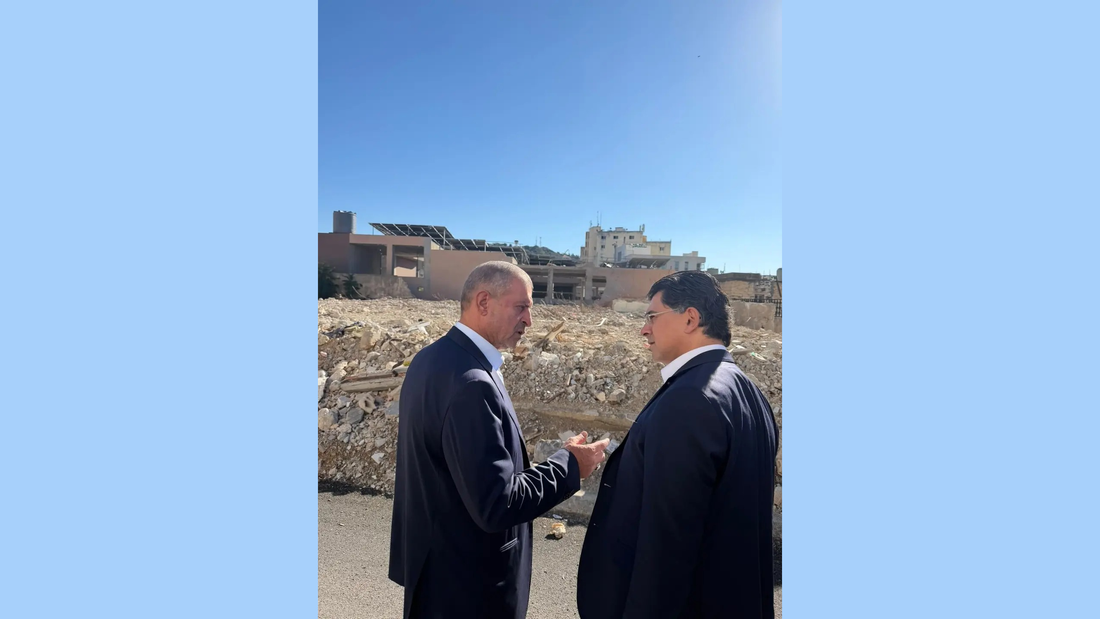
Minister of Information, lawyer Dr. Paul Mourkos, visited the city of Nabatieh as part of an inspection tour of southern Lebanon, following the Israeli aggression that targeted the city and its surrounding areas.
His first stop was at Nabatieh Municipality, where he was received by MPs Hani Qbeissi, Dr. Michel Moussa and Nasser Jaber; Nabatieh Mayor Abbas Fakhr El-Din; Shqeif Union of Municipalities President Khaled Badr El-Din; as well as mayors, mukhtars and social and municipal representatives.
An expanded meeting was held during which Fakhr El-Din paid tribute to the journalists killed in the line of duty, stressing that “the media is the fourth estate and supporting journalists is a national duty and a necessity. They convey a clear and truthful picture of the crimes committed by the barbaric enemy, putting themselves at risk in order to fulfil their mission.”
Speaking on behalf of Nabatieh, which he described as “a city of diverse media,” Fakhr El-Din presented a series of demands and observations concerning the role of the media and its national responsibilities. He called on the Ministry of Information to “expose the Israeli crimes against people and property in southern Lebanon and work towards establishing a specialized committee to document these crimes, ensuring that the truth is preserved and conveyed to public opinion.”
He stressed the importance of ensuring that “the media remains at the service of the nation and its citizens, upholding its national responsibility and steering clear of inciting strife and hatred among the Lebanese or spreading division. It must not become a platform serving the enemy, legitimizing normalization with it, or engaging in disputes and exchanges that have nothing to do with the truth.”
He also called for “strengthening the professional and legal standards governing media work by regulating media platforms on social media in accordance with the law.”
MP Hani Qbeissi also addressed the gathering, speaking about “the enemy’s barbarity in its daily and systematic destruction of towns, homes and villages,” and calling for “official media coverage that exposes the enemy’s crimes.”
Meanwhile, Shqeif Union of Municipalities President Khaled Badr El-Din asked Minister Mourkos to “convey the needs and demands of residents and towns to the Council of Ministers, particularly the need to accelerate reconstruction.”
Minister Mourkos said: “I have come to the steadfast and proud city of Nabatieh not merely out of a sense of duty, but driven by enthusiasm, passion and affection, and above all, out of respect for the martyrs. We make no distinction among our martyrs, but allow me to pay particular tribute to the martyrs of the press and media, as well as the journalists wounded in the repeated and ongoing Israeli attacks.”
He noted that “Nabatieh and the other steadfast areas of the South represent a national model of resilience and a message that the Ministry of Information conveys to every local and international official it meets,” adding that “the resilience and sacrifices of the people of the South give meaning and depth to the demands being raised by the state.”
He continued: “We salute your sacrifices and fully understand the circumstances you are going through. These sentiments are not mere words; they express what we are experiencing alongside you. The South is a constant concern for us and embodies the meaning and symbolism of independence, particularly on the eve of Independence Day.”
Mourkos stressed that “expressions of solidarity and even the return of services, important as they are, are not enough. The state must do more, and this is the right of the people of the South and an obligation incumbent upon it.” He affirmed the need for a strong and just state that not only provides security but also delivers services, in line with the directives of President of the Republic General Joseph Aoun and the government.
The minister recalled a saying attributed to Imam Ali: “The most beloved of children to the heart is the youngest until they grow up, the sick until they recover, and the absent until they return.”
He added: “If we are to add anything to this saying, it would be the South when it returns. And it will return, God willing. Lebanon cannot live without the South and without its heartbeat.”
He pointed out that “Lebanon is currently preoccupied with the situation in the South, with communications, visits and meetings all revolving around it.” He acknowledged that “the results may not always meet expectations, but intensive efforts and personal follow-up confirm that this issue remains at the top of the agenda.”
He outlined the main priorities of these efforts as “liberating the South, stopping Israeli attacks, ensuring the return of residents, rebuilding their villages, completing the liberation of detainees, and establishing appropriate arrangements to address any vacuum that may arise following the withdrawal of UNIFIL forces.” He described these objectives as “a matter of supreme Lebanese national interest.”
Mourkos also called for “strengthening national unity, as demonstrated through solidarity with displaced people, welcoming them and standing by their side.” He considered this humanitarian solidarity a fundamental pillar of resilience, alongside supporting state institutions and ensuring their presence and ability to fulfil their responsibilities.
Regarding the documentation of Israeli attacks and pursuing them through legal channels, Mourkos confirmed that “the ministry is following up on this matter in coordination with national and international bodies, particularly with regard to attacks targeting civilians, journalists and media workers killed or wounded, as well as workers in the healthcare and hospital sectors and emergency response teams.”
He revealed that he had met the previous day with Deputy Prime Minister Dr. Tarek Mitri, who chairs the National Committee for International Humanitarian Law, which has collected the necessary materials and documents to prepare the legal file concerning Israeli attacks.
Following the meeting, Minister Mourkos, accompanied by the MPs, toured the city and inspected the site of the Central Bank building, which was also completely destroyed. He then visited the Government Serail and the State Security Centre, where 13 members of the centre were killed in an Israeli airstrike.
Minister Mourkos subsequently visited the National News Agency’s office, where he met with its director, colleague Samer Wehbe. He heard about the extent of the damage sustained by the office and the ongoing repair work, and asked him to submit a list of all the office’s equipment and requirements to ensure that it continues to serve as a beacon of media coverage in the region, as it has done for the past 35 years.


