
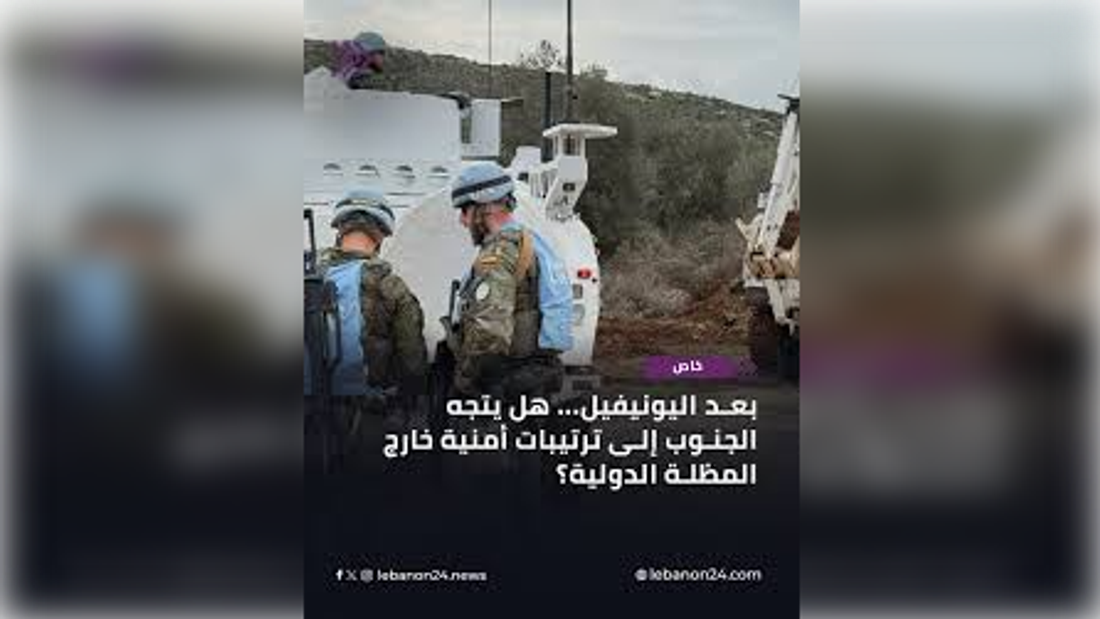
Attention yesterday focused on remarks by French Foreign Minister Jean-Noël Barrot, who said there was an “agreement with U.S. Secretary of State Marco Rubio on the need to avoid a security vacuum” in southern Lebanon following the planned withdrawal of the United Nations Interim Force in Lebanon (UNIFIL) at the end of this year.
Asked about the guarantees France could provide, particularly regarding the new international framework following UNIFIL's departure, Barrot said: “I believe this security structure should be based on existing Security Council resolutions, particularly Resolution 1701, and should also contribute to the success of the trilateral agreement, or Framework Agreement. The success of the trilateral agreement depends on this security structure. If a security vacuum were allowed to emerge, the conditions for success might not be available.”
However, informed sources told An-Nahar that “the convergence of views has not yet produced an agreement. Discussions are ongoing, but no alternative force can move forward without a consensus involving the countries concerned, most notably Lebanon and Israel.”
Al-Anbaa newspaper reported that the issue is receiving international attention amid U.S. and French discussions aimed at finding an alternative security formula without creating a security vacuum in the region. Between Washington's proposal for a monitoring mechanism that may not necessarily be military in nature and the possibility of an alternative security structure, questions remain about the nature of the body that would succeed the international forces, as well as its role and powers. Lebanon's official position stresses the importance of having any alternative operate under the umbrella of the United Nations.
The newspaper added that France and the United States agree on the need to prevent a security vacuum in the south, despite differences in their visions. Washington had previously rejected any French role, which hindered the work and meetings of the “Mechanism” committee, as well as discussions over the countries that could participate in any mission in southern Lebanon after UNIFIL's mandate ends. Some of these reservations stem from Israel's opposition to any French role, amid tensions in relations between Paris and Tel Aviv.
It was also revealed that U.S. Ambassador to the United Nations Mike Waltz, who is scheduled to visit Lebanon on November 16 and 17, will discuss the possibility of establishing a private security institution or entity similar to the American company Blackwater, which operated in Iraq following the 2003 U.S.-led invasion.
Al-Joumhouria said the most significant development is that U.S.-French discussions are no longer limited to UNIFIL's future but have begun to focus on the nature of the monitoring mechanism that could replace it, potentially marking a new phase in the management of the Lebanese file.
Diplomatic sources told the newspaper that Rubio's remarks about a civilian monitoring force instead of UNIFIL carry two highly significant implications for Lebanon. First, they suggest that the Trump administration's approach toward Lebanon will not change following the shifts brought about by the midterm elections, regardless of the future of relations with Iran. Second, they indicate that there is no prospect of deploying alternative forces to replace UNIFIL in southern Lebanon, with the proposal instead potentially involving a civilian monitoring body that would have no ability to deter Israel.
Nidaa Al-Watan reported that, as U.S.-French consultations intensify to find a mechanism to prevent a security vacuum in the south, Washington is maintaining a firm position toward Hezb0llah, considering its weapons and ties to Iran to be the main obstacle to restoring Lebanese sovereignty.
The newspaper added that contacts at the presidential palace have focused on the outcome of U.S.-French consultations regarding upcoming security arrangements. Lebanese officials are optimistic about renewed coordination between the two countries on Lebanon after a period of tension in their relations, given their influence on the course of developments in the country.
While awaiting official notification to Baabda of the results of the consultations, information indicates that several formulas are being discussed. These include extending UNIFIL's mandate for another year or six months, or expanding its mission to include supervising the implementation of the Framework Agreement alongside the implementation of Resolution 1701. Other options include increasing the number of ceasefire monitoring personnel from around 50 to at least 1,500. However, none of these proposals has yet been finalized, pending the emergence of Washington's final position.
Meanwhile, Asharq Al-Awsat reported that French-American discussions revolve around two interconnected issues concerning southern Lebanon. The first is avoiding a security vacuum after UNIFIL, while the second concerns the verification mechanism in the experimental areas from which Israel withdraws.
This diplomatic activity reflects increased engagement amid Israel's occupation of more than 55 towns and villages along the southern border, and following the failure to make progress in expanding the experimental areas in southern Lebanon due to disagreements over the verification mechanism.
Lebanese sources familiar with the previous French proposal told Asharq Al-Awsat that the idea involves “combining Resolution 1701 and the Framework Agreement.” The proposal calls for renewing UNIFIL's mission for at least six months, during which it would be tasked with implementing both Resolution 1701 and the Framework Agreement simultaneously. This would effectively place the Framework Agreement, signed between Lebanon and Israel under U.S. sponsorship in June, under the umbrella of the United Nations.
Under the French proposal, UNIFIL's mission would be specifically focused on overseeing the implementation of Resolution 1701 and the Framework Agreement. Alternatively, the number and responsibilities of the monitoring mission could be expanded to at least 1,500 personnel and tasked with implementing both agreements.
In this context, UN Under-Secretary-General for Peace Operations Jean-Pierre Lacroix announced that the organization had submitted proposals to the Security Council concerning the presence of a new UN force in Lebanon to succeed UNIFIL. Lacroix explained that the proposals were prepared in consultation with Lebanese authorities and include establishing a mission responsible for monitoring, follow-up, and reporting, in addition to providing humanitarian assistance and maintaining certain essential capabilities to support the Lebanese Army.
In the same context, MP Melhem خلف told An-Nahar that the report to be submitted by the UN Secretary-General on Lebanon will open the way for discussions at the Security Council regarding the role of the international force in southern Lebanon. He stressed that the United Nations must not abandon its responsibility to monitor the Blue Line, as stipulated in Article 2 of its Charter. He added that the United Nations is also obligated to uphold the four Geneva Conventions, which call for the protection of civilians and prohibit abandoning them during wartime.


