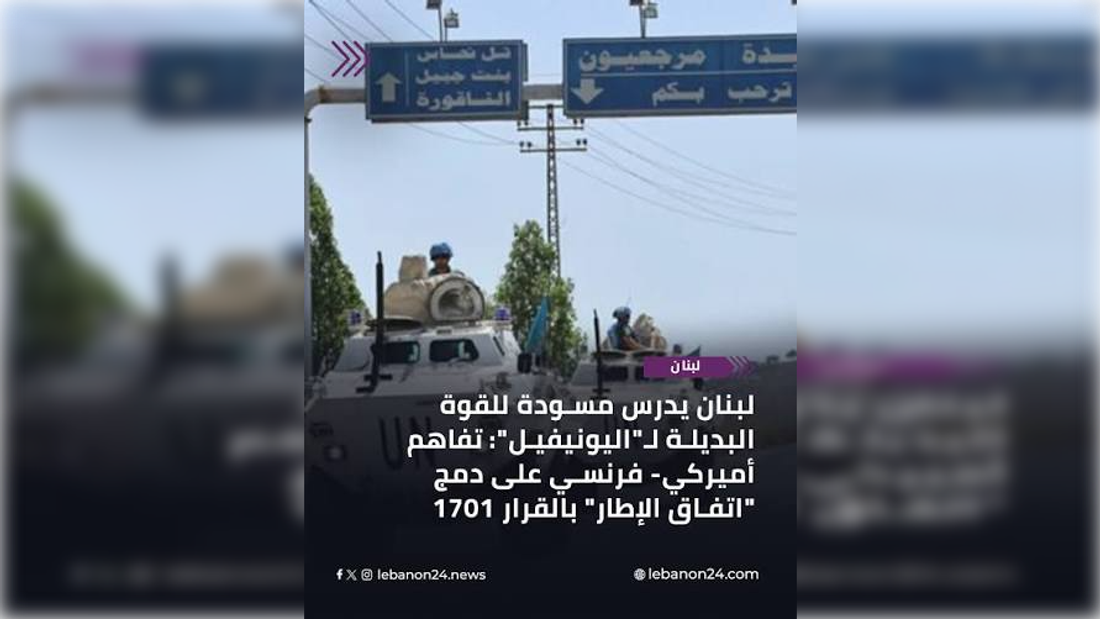
Al-Akhbar newspaper reported that, following information leaked over the past two weeks, particularly in the wake of the visits to Beirut by US Ambassador to the United Nations Mike Waltz and Saudi envoy Prince Yazid bin Farhan, accompanied by external pressure to internationalize the Framework Agreement, growing indications have emerged of a US-French effort to place the agreement under the umbrella of the UN Security Council and transform it from an understanding between the parties concerned into a binding UN reference framework.
Previous reports had indicated that Washington had succeeded in persuading Paris to draft a proposal merging the Framework Agreement with UN Security Council Resolution 1701.
Sources said that, during a Security Council meeting, the French side presented a series of ideas that included a request to extend the deadline for UNIFIL’s withdrawal and amend the date for handing over its final position from next June to the end of 2027. This would allow international forces to remain in place and carry out limited missions in southern Lebanon.
Security Council members asked the French delegation to put its ideas into the form of a draft proposal and submit it to the members and relevant parties.
It was learned that Lebanon’s mission to the United Nations sent a report on the Security Council deliberations to the central administration in Beirut. Presidents Joseph Aoun, Nabih Berri, and Nawaf Salam received copies of the report, as did the relevant UN missions.
According to information obtained by *Al-Akhbar*, France’s approval of the American proposal represented a turning point in perceptions of Paris’s role, particularly within Hezbollah. The party had previously informed French Ambassador to Lebanon Patrick Durel of its rejection of establishing the Framework Agreement as a reference framework, given the serious implications this could have for the future of the occupied areas.
Durel met with a Hezbollah leadership delegation, which conveyed to the French diplomat its rejection of any attempt to legitimize the occupation through the United Nations.
Sources said that France, which usually demonstrates concern for Hezb0llah’s position, does not appear to be acting rationally. They added that the position expressed by the French representative at the Security Council does not reflect the understanding previously conveyed by the French ambassador in Beirut.
This is expected to have a significant impact on attitudes toward France, its political conduct, and its military and security role in Lebanon, amid indications that Paris is moving within a framework aimed at appeasing Israel and the United States. Such a position could have very serious negative consequences for France’s future presence in Lebanon.
In this context, informed sources believe that Parliament Speaker Nabih Berri’s statement two days ago — “We will not accept the arrival of any force unless it operates under the United Nations flag” — was a direct response to proposals currently under discussion and the ambiguity surrounding the nature and mandate of the proposed force.
The sources also revealed that a meeting was held between Hezb0llah and the Amal Movement two days ago to discuss this development and its repercussions, amid concerns that merging the Framework Agreement with Resolution 1701 could serve as a gateway to granting international legitimacy to arrangements that have not secured domestic consensus and have not passed through Lebanon’s constitutional institutions.
These developments are closely linked to the shift in France’s position. Paris, whose participation in any security arrangements in southern Lebanon had previously been rejected by the United States and Israel, now appears poised to become a key partner in shaping the next phase and possibly in establishing the force that will succeed UNIFIL.
However, France taking on this role could open the door to another complication within the Security Council, relating to Russia’s position.
Moscow, which holds veto power, may view Paris’s leadership of this process with sensitivity, particularly given France’s role in the war in Ukraine and its political confrontation with Russia, factors that could influence Moscow’s position on any proposal it submits.
Therefore, the Russian factor cannot be ruled out as a potential obstacle to the proposal’s adoption, particularly if Moscow views it as an attempt to impose an American-French vision of the security and political arrangements in Lebanon.