
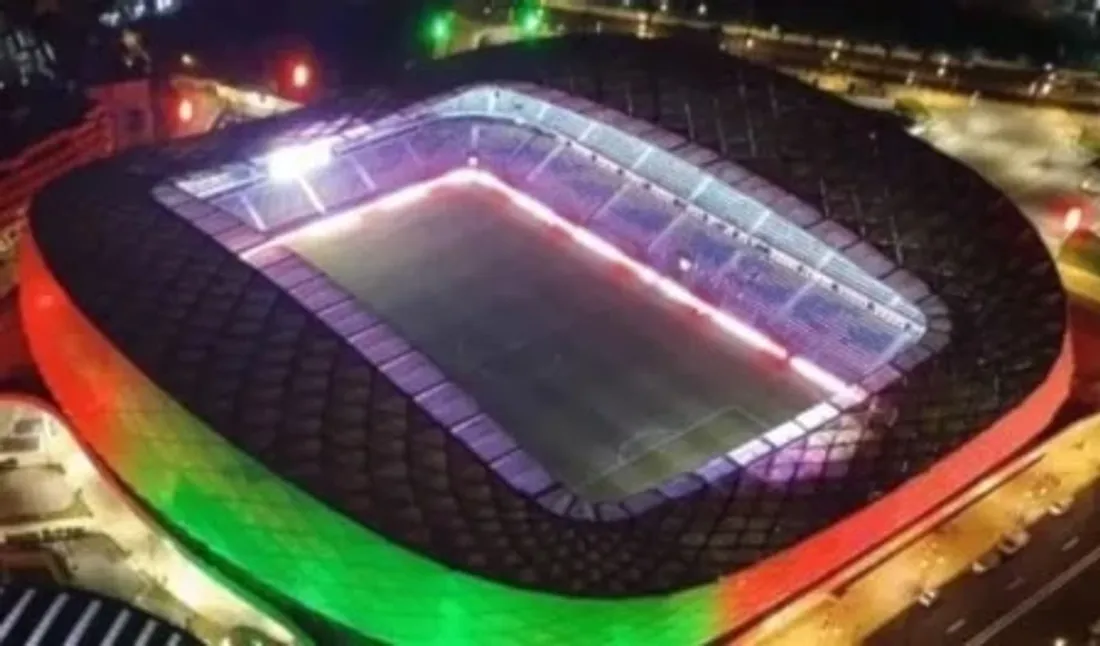
Many football fans assumed that FIFA President Gianni Infantino’s visit to Lebanon last Monday was intended to mark the groundbreaking ceremony for the international stadium that FIFA plans to gift to Lebanon. Some media outlets also mistakenly reported that the ceremony was taking place.
In reality, the international stadium project is still undergoing preparatory work before construction can officially begin. However, there is no doubt that the project has entered a serious phase and that its launch is approaching, following a visit to Morocco last week by a Lebanese Football Association delegation comprising President Hashem Haidar and Secretary-General Jihad Al-Shahaf, accompanied by a representative of the Presidential Palace, Brigadier General Engineer Ghassan Al-Fata.
But why was the visit to Morocco, and what does the country have to do with the international stadium planned for Lebanon?
The story began during Infantino’s previous visit to Lebanon several months ago, when he obtained Lebanese citizenship. At the time, he informed Lebanese Football Association officials of his intention to invite them, along with a representative of the Presidential Palace, to Morocco to inspect stadiums, one of which would serve as a model for the stadium planned in Lebanon.
The stadium's construction cost is estimated at $45 million, funded by FIFA, and it will have a seating capacity of 25,000 spectators.
Infantino made all the necessary arrangements with Moroccan officials and extended an invitation to Lebanese Football Association President Hashem Haidar and Secretary-General Jihad Al-Shahaf, along with a representative of the President of the Republic, given the latter's direct involvement in the project and the need for his efforts to secure the land on which the stadium will be built. Brigadier General Engineer Ghassan Al-Fata was selected for the delegation because of his engineering background and the expertise he could bring to the project.
The Lebanese delegation traveled to Morocco, where the FIFA president was also present. A meeting was held with the president of the Royal Moroccan Football Federation, Morocco's finance minister, and one of the country's most influential sports figures, Fouzi Lekjaa.
The Lebanese delegation toured three stadiums in the Moroccan capital, Rabat, which appeared similar to the proposed stadium in Lebanon. The Al-Madina Stadium and Prince Moulay Abdellah Stadium seem to be the closest matches to what Lebanese officials envision for the project.
𝗪𝗵𝗲𝗿𝗲 𝗪𝗶𝗹𝗹 𝘁𝗵𝗲 𝗦𝘁𝗮𝗱𝗶𝘂𝗺 𝗕𝗲 𝗕𝘂𝗶𝗹𝘁?
Securing the land on which the stadium will be built in Lebanon appears to be the main obstacle facing the project. The Lebanese Football Association remains determined to move forward, backed by strong international support from FIFA President Gianni Infantino, who is equally committed to gifting Lebanon an international stadium capable of hosting matches involving national teams and Lebanese clubs.
The project goes beyond building a stadium, as it requires a plot of land measuring at least 50,000 square meters. It will also include a training center for national teams and a modern headquarters for the Lebanese Football Association.
The stadium will have a seating capacity of approximately 25,000 spectators, with a hybrid grass playing surface. However, it will not include a hotel due to the high operating costs associated with running such a facility.
The project's progress now hinges on securing the land, a responsibility that falls to President Joseph Aoun, who has pledged to provide it, as promised to the presidents of FIFA and the Lebanese Football Association.
The Presidential Palace appears enthusiastic about bringing the project to Lebanon and is making efforts to secure a suitable plot. Two locations have emerged as the main options: the first in Karantina, owned by Beirut Municipality, and the second in Damour, owned by Damour Municipality.
Those overseeing the project would prefer the stadium to be located in Beirut, ideally in a central area such as Karantina. However, what is unfortunate, according to the report, is that Beirut Municipality has been uncooperative and has continued to delay the matter. Damour Municipality, by contrast, has offered all necessary facilities and agreed to hand over the land to the Lebanese Football Association, which would be the sole authority responsible for managing the stadium, without supervision from any other body, such as the municipality or the Ministry of Youth and Sports.
Damour's municipal officials recognize the importance of hosting such a project in their area, unlike those overseeing Beirut Municipality, who, according to the report, have shown little interest in establishing a modern, state-of-the-art stadium within their municipal boundaries.
For now, the project appears more likely to move forward in Damour. The plot offered by the municipality requires some logistical arrangements before it can be prepared for construction. The stadium is expected to take between two and three years to complete, at a cost of $45 million to be provided by FIFA.
Lebanese football officials and their counterparts at FIFA have fulfilled their responsibilities so far, and the matter now rests with the President of the Republic and the Presidential Palace to finalize the land issue.
All indications suggest that the president is enthusiastic about the project and is working hard to bring it to fruition. But when will the project finally become a reality?
𝗦𝗼𝘂𝗿𝗰𝗲: 𝗔𝗹-𝗔𝗸𝗵𝗯𝗮𝗿


