
Unofficial sources in Washington told Al-Liwaa that there is information indicating that the U.S. State and Treasury Departments may indeed impose sanctions on political, military and security figures, on the grounds that they allegedly turned a blind eye to Hezb0llah's activities. Among those figures are army officers, security personnel and judges, following the seizure of shipments of explosives, “because they overlooked other shipments,” in addition to other matters related to Hezb0llah.
However, the sanctions will not be implemented at the present time, pending whether a military strike against Iran takes place first. If such a strike and military escalation occur, the sanctions may be postponed or even abandoned. If no strike takes place, there is reportedly a list of individuals who will be sanctioned, although the nature of the sanctions has not yet been determined.
The information added that the U.S. administration—particularly the State Department—is dissatisfied with the performance of Lebanon's ruling authorities, based on reports it has received from its embassy in Beirut and from Lebanese figures whom President Aoun had previously described as “corrupt.” According to the information, Washington believes that the Lebanese authorities are withholding information, providing inaccurate information and delaying the implementation of certain measures required of them, including those related to restricting weapons and other conditions, until the end of President Trump's term.
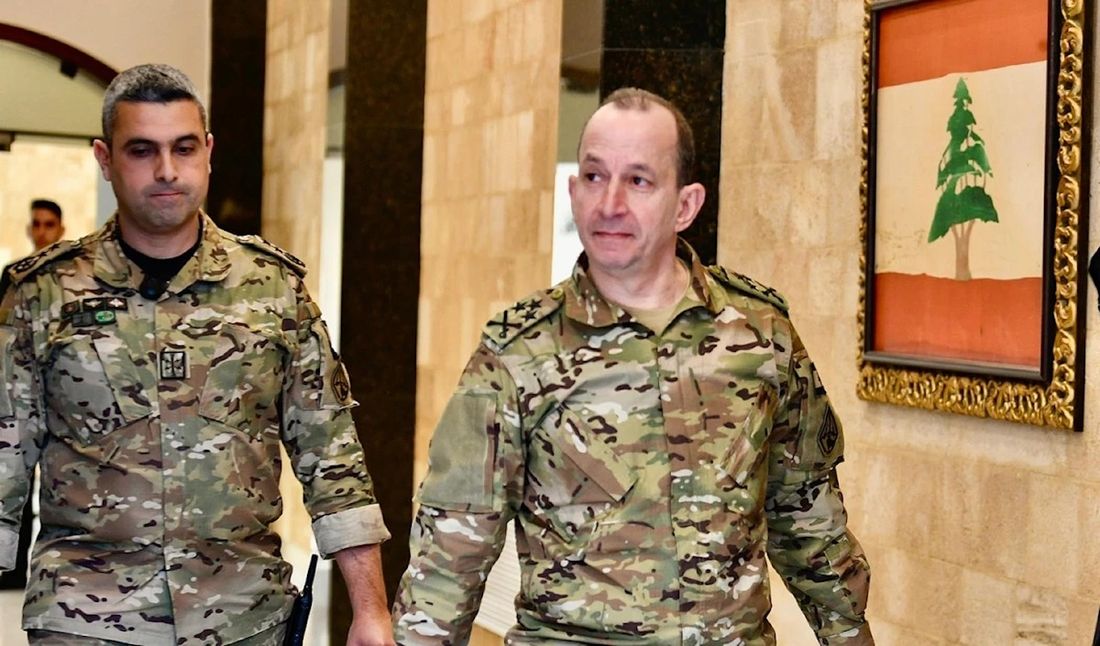
The U.S. State Department also reportedly accuses Army Commander General Rodolphe Haykal of colluding with Hezb0llah and communicating with Qatari intelligence, with considerable anger directed at him.
These circumstances may have prompted the Army Commander to say a few days ago before senior officers of the command and military units: “Some people inside and outside the country are criticizing the army's work and evaluating its performance without having the slightest knowledge of how the military institution operates, and are trying to distort its image. This position runs contrary to national belonging. The army is achieving major accomplishments beyond its capabilities—accomplishments that many armies around the world would not be able to achieve. This is due to the resilience of the military personnel, their faith in their army and the Lebanese people's confidence in it.”
He added: “The army's mission is a national mission, and it has no politics other than national politics. Our fundamental goal is to preserve internal unity, stability and civil peace, safeguard national sovereignty, and work toward the successful implementation of the political authority's decisions.”
A source at the U.S. State Department also spoke of a possible statement to be issued in response to Army Commander General Rodolphe Haykal's recent remarks.
Meanwhile, Al-Akhbar newspaper explained that Haykal's speech before unit commanders and officers of the military institution continues to generate reactions both domestically and internationally. The speech has prompted differing positions and responses within Lebanon, while foreign embassies are following its content to assess the direction of Lebanon's political stance based on the messages it conveyed.
The newspaper said the importance of the speech lies in the fact that it marked a shift from a policy of silence in the face of media attacks and campaigns questioning the army to taking the initiative and expressing what Haykal described as “national politics.”
This comes amid internal and external pressure on the military institution to take military action against Hezb0llah's weapons, regardless of the continued Israeli occupation and daily attacks, and under complex security, political and economic circumstances that are increasing regional instability and threatening Lebanon's stability.
The speech also came after the army's leadership and officers developed a sense that the institution was being subjected to a direct and systematic campaign by individuals and groups whose interests intersect, in one way or another, with parties inside and outside Lebanon. The speech was therefore seen as a message to those affected by the course being pursued by the army and an affirmation that the institution is not anyone's punching bag.
Al-Akhbar added that the peak of the campaign was led by Lebanese Forces leader Samir Geagea, who directly targeted the army and its leadership last week, saying that “it is not on our political line.”
His positions coincided with continuing criticism from figures close to Prime Minister Nawaf Salam, including lawmakers and media figures such as Mark Daou and Waddah Sadek, who intensified their criticism in response to the speech. Their positions appeared to overlap with the campaign by the Lebanese Forces party and many of its lawmakers and officials.
Ironically, Geagea and the two lawmakers, along with others, had previously praised General Joseph Aoun when he was Army Commander during the presidency of Michel Aoun, following his refusal to use the military institution to violently suppress the October 17 protests.
The newspaper also indicated that, before Haykal's speech, the army leadership had received messages of support from several domestic parties, foremost among them President Joseph Aoun and Parliament Speaker Nabih Berri. This support was capped by a visit by former MP Walid Jumblatt to Yarzeh, where they expressed appreciation for the army's role in maintaining stability and their solidarity with its leadership in confronting the campaigns targeting it by Geagea and others.
It added that the domestic campaign against the army coincided with U.S. leaks concerning military talks held at the headquarters of U.S. Central Command in Tampa, Florida. According to the reports, representatives of the Lebanese Army informed the U.S. mediator of their rejection of forming a direct coordination committee between the Lebanese Army and the Israeli army.
The matter was later presented by the Army Commander to President Aoun, who also rejected the idea. The U.S. side, however, insists on the issue, arguing that international forces will soon no longer be present in southern Lebanon and that the role of the U.S. military mediator will decline, making direct coordination necessary.
U.S. Ambassador to Beirut Michel Issa has repeatedly referred to this issue, expressing surprise at what he described as the “bogeyman of direct talks with the Israelis.”
Meanwhile, Ad-Diyar reported that leaked information from Washington points to an expected increase in U.S. pressure on the Lebanese arena, under the premise that the opportunity granted to Lebanon's political authorities to fulfill their commitments has ended and that it is now time to use the “big stick,” according to remarks attributed to U.S. Ambassador Michel Issa by visitors to the embassy.
The ambassador reportedly adopted a tough tone, concluding his remarks by saying, “Maybe they won't allow me to meet with you” in the coming days and weeks. Those visitors are said to be close to Lebanon's official decision-making circles.
The newspaper added that these pressuring developments are part of information that reached Beirut through sources at the U.S. State Department. It remains unclear whether they are merely threats or will become a reality, but they indicate that this time the matter may not be limited to imposing sanctions on security and political figures who are not expected to appear on such a list.
There is reportedly a U.S. tendency to boycott a number of official figures on the grounds that they have failed to honor their commitments to the United States.
Just as the State Department previously issued direct responses concerning the lawsuit against the Lebanese ambassador in Washington and the Dahr al-Baidar explosions, a similar position is expected in response to Haykal's latest remarks.
According to the information, there is clear dissatisfaction among U.S. officials following his comments rejecting criticism that questions the role and professionalism of the military institution. Washington reportedly believes that he was not merely raising the tone against domestic political forces, but was directing public and direct criticism at U.S. decision-making circles.
Al-Joumhouria reported that, while the targeting of the army and its commander was widely condemned by broad popular and political circles, questions were raised about the purpose of this campaign at this particular time and about the domestic or foreign parties supporting and driving it.
Parliament Speaker Nabih Berri rejected the targeting of the army and its commander, stressing that such actions constitute “a major crime and grave mistake.”
Responding to a question from Al-Joumhouria, Berri said: “As I have emphasized on more than one occasion, the army is a red line.”


