
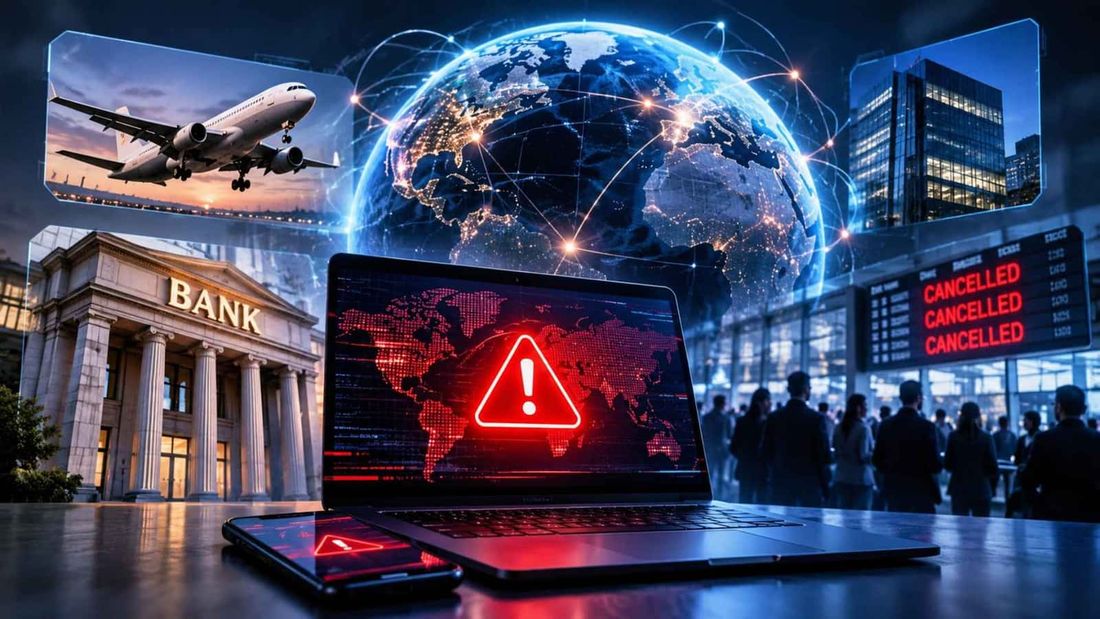
Over the past few days, the United States has witnessed a series of successive technical outages affecting major companies and institutions, including Microsoft, Apple, banks, and airlines, as well as sensitive government systems.
These incidents have raised questions about whether they share a common link and how the rapid advancement of artificial intelligence could affect the security of digital infrastructure.
Widespread Disruptions
The series of disruptions began with a major outage affecting Microsoft's services, including the Outlook email service and the Teams, SharePoint, and OneDrive platforms, as well as its AI assistant, Copilot. The outage disrupted the work of millions of users and businesses around the world.
The problems were not limited to internet services. The telecommunications network operated by the U.S. Federal Aviation Administration (FAA) experienced an outage that halted flight departures nationwide for more than four hours on November 13, in one of the most notable disruptions to U.S. aviation systems in recent years.
On November 16, JPMorgan Chase experienced a software malfunction in one of its internal hardware systems, causing delays in some banking transactions and financial transfers. At the same time, United Airlines suffered a technical outage that delayed departing flights.
The following day, the disruptions extended to Apple after an internal update caused temporary problems affecting services such as the Apple App Store, Apple Music, and AppleCare.
Some of the internal systems of the U.S. National Security Agency (NSA) also experienced an outage during routine maintenance work.
A Common Thread
According to an investigation published by The Wall Street Journal, several of these incidents share a common factor: technical updates and software changes that can sometimes produce unexpected results, rather than necessarily being the result of a coordinated cyberattack.
The newspaper explained that advanced artificial intelligence tools have become increasingly capable of identifying software security vulnerabilities more quickly. This is prompting companies and institutions to accelerate efforts to fix them by updating systems and installing security patches. However, these changes can also introduce new errors if they are not adequately tested.
In Microsoft's case, the company attributed the outage to a technical issue related to a previous network update. An underlying flaw in one of the fixes affected the servers, preventing them from responding normally as pressure on them increased and their operating capacity declined.
The disruption to U.S. aviation systems, meanwhile, was linked to a communications network problem. Initial investigations pointed to the possibility that a new router had flooded the network with connection requests. JPMorgan Chase, for its part, attributed its problems to a software malfunction in its internal hardware systems.
These differences confirm that the outages did not stem from a single technical cause, despite occurring around the same time and having a widespread impact.
Cybersecurity Challenges
Reports indicate that artificial intelligence is creating a new challenge for cybersecurity officials. While it can be used to identify software vulnerabilities, it can also help attackers analyze systems and exploit weaknesses in increasingly sophisticated ways.
At the same time, the faster discovery of vulnerabilities puts greater pressure on institutions to install security updates quickly, increasing the likelihood of operational errors if changes are not properly tested before being deployed across core systems.
The Washington Post quoted officials and experts warning that growing reliance on interconnected digital systems makes individual outages more capable of triggering widespread disruption, particularly when essential services such as communications, payments, and air transportation are affected.


