
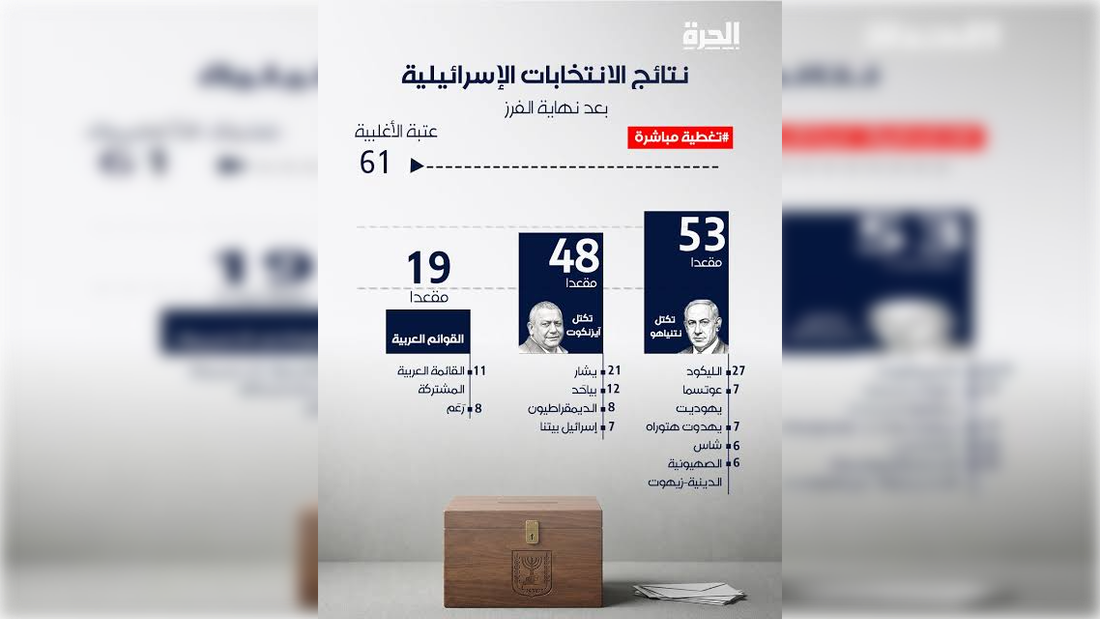
Israel’s Central Elections Committee announced that the counting of all votes had been completed, confirming that the final results did not change the political blocs’ balance of power.
According to the Israeli news channel i24NEWS website on Thursday evening, the bloc led by Prime Minister Benjamin Netanyahu secured 53 seats in the Knesset, compared with 48 seats for the bloc of his main rival, Gadi Eisenkot.
The Arab parties collectively won 19 seats.
The final results leave the political blocs’ balance unchanged, with neither Netanyahu’s nor Eisenkot’s bloc holding an independent majority of 61 seats in the 120-member Knesset. Meanwhile, the Arab parties retain parliamentary weight that could prove influential in political consultations over the formation of the next government.
The final results for the parties were as follows:
Likud, led by Netanyahu: 27 seats.
Yashar, led by Eisenkot: 21 seats.
Ma’an Party: 12 seats.
Joint List: 11 seats.
United Arab List and The Democrats: 8 seats each.
United Torah Judaism, Yisrael Beiteinu, and Otzma Yehudit: 7 seats each.
Shas, Religious Zionism, and Identity Party: 6 seats each.
The Reservists Party and the Economic Party lists failed to cross the electoral threshold, preventing them from entering the Knesset.


