
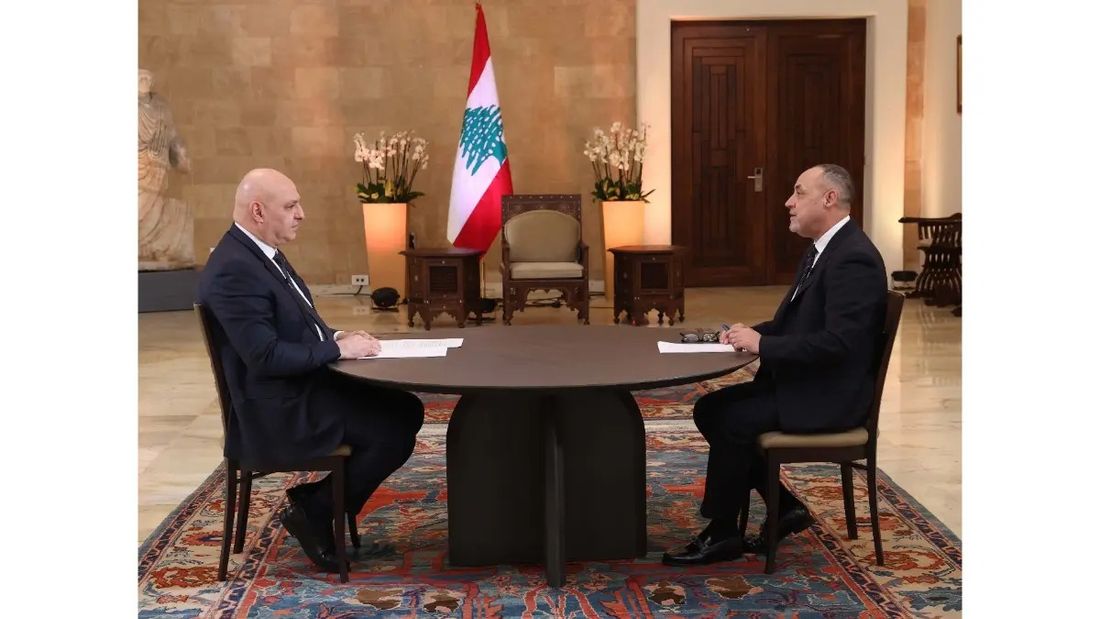
President Joseph Aoun stressed that the state had taken the decision to place all weapons under its authority and to assume control over decisions of war and peace. He said the Lebanese Army and security agencies were carrying out their duties by confiscating weapons and explosives, regardless of which party they belonged to.
In an interview with Iraq’s Dijlah TV channel, Aoun said the state was continuing its direct and indirect contacts with Hezb0llah in an effort to reach a peaceful solution to the issue of its weapons.
Addressing the party, he said: “You are Lebanese, and you are part of the state. Come forward and hand over your weapons so that we can have a strong, centralized state capable of protecting its citizens.”
He pointed out that internal confrontation was not among the state’s options, explaining that the disagreement with Hezb0llah was not over objectives, but rather over the means of achieving them, particularly Israel’s withdrawal, reconstruction, and the return of displaced people.
President Aoun considered that the wars waged in support of other fronts had failed to achieve their intended military results. He noted that the war in support of Gaza had not stopped the fighting there, while support for Iran had brought no gains to Lebanon and had instead resulted in further destruction and losses.
Aoun warned Hezb0llah against dragging the country into a third war in support of another front, stressing that any rocket launched from southern Lebanon could lead to further destruction, displacement, and casualties. He added that the Shiite community could no longer withstand another war.
Aoun also said that Lebanon had no option but to negotiate. During the latest round, the Israeli delegation informed the Lebanese side that it needed to consult its political leadership.
He declared his rejection of any Israeli role in verifying the disarmament process inside Lebanon, pointing to the possibility of relying on a UN, Arab, or European team to carry out this task.
Aoun expected further rounds of negotiations to take place after the formation of the Israeli government, emphasizing that negotiations did not constitute a concession and that the United States’ signature on the Framework Agreement served as a guarantee.


