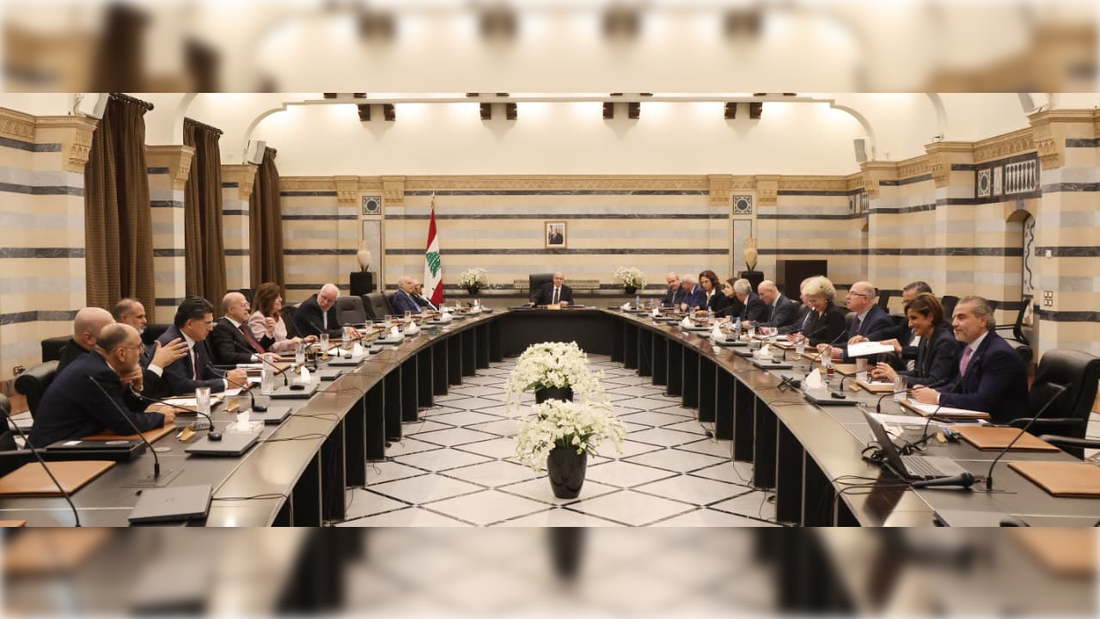
The Cabinet held its weekly session at the Grand Serail, chaired by Prime Minister Dr. Nawaf Salam and attended by the ministers, while the ministers of energy, foreign affairs, industry, and artificial intelligence were absent.
Following the conclusion of the Cabinet session shortly after 6:30 p.m., Information Minister Paul Morcos issued the following official briefing:
The session was devoted exclusively to discussing the waste management file and ways to address it. The Cabinet heard a presentation by the Minister of Environment on the structural reforms required in the sector to improve its management, ensure its sustainability, and attract private-sector investment. These reforms include the cost-recovery law, the appointment of a board of directors for the National Authority for Solid Waste Management, and the approval of the updated solid waste management strategy.
The Cabinet also heard a joint presentation by the head of the Council for Development and Reconstruction and the head of the National Authority for Solid Waste Management. Following these presentations, the Cabinet reaffirmed the fundamental principles that should guide efforts to address the issue in accordance with the strategy.
These principles are:
Reducing and minimizing the amount of waste generated.
Strengthening waste sorting at the source in coordination with municipalities.
Recovering recyclable materials.
Treating organic waste through composting or drying.
Producing alternative fuel.
Disposing of rejected waste and inert residues through landfilling or thermal decomposition, after completing the necessary studies and taking environmental, economic, and financial feasibility into account, particularly regarding the treatment of fly ash and the cost of energy production.
National waste management must follow a decentralized approach that establishes a central role for municipalities, in coordination, consultation, and cooperation with the National Authority for Solid Waste Management.
The Cabinet also stressed the need to encourage waste treatment through public-private partnership arrangements, particularly the build-operate-transfer (BOT) model, as it does not impose investment costs on the state.
The Cabinet asked the relevant ministers, the Council for Development and Reconstruction, and the National Authority for Solid Waste Management to return within a maximum of two weeks with concrete proposals on the matter. This is intended to prepare for further discussions on proposed solutions to the current problems affecting certain areas, during a second session.
Explosives File Remains Under Follow-Up
In response to a question about the Justice Minister’s proposal to refer the explosives case to the Judicial Council, Minister Morcos said:
“The Justice Minister raised the matter during the session. The Prime Minister’s position was clear: this session was devoted exclusively to discussing how to address the waste management file.
“The Prime Minister confirmed that the matter is being followed up and will be decided in accordance with developments in the ongoing investigation. This issue remains under continuous follow-up. It has not been removed from the Cabinet’s agenda, and it remains under consideration pending a decision as the investigation progresses. In light of those developments, the Cabinet will make the appropriate decision.”
Possible Government Crisis Over Ministerial Boycott
Asked about concerns that the Lebanese Forces ministers’ boycott could develop into a government crisis, Morcos said:
“This specific issue was not discussed during today’s session. What I presented were the Cabinet’s decisions, not a personal opinion.”