
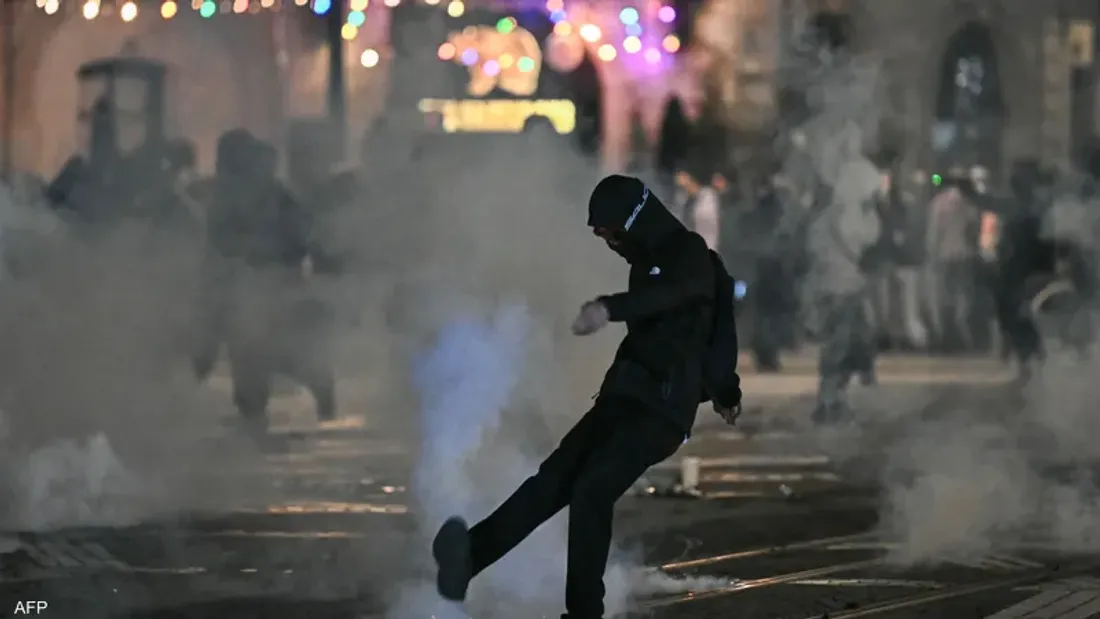
Hundreds of thousands across France are expected to take part on Thursday in strikes and protest actions called for by trade unions, coinciding with new student demonstrations.
For weeks, France has seen protests by high school students opposing deteriorating educational conditions and the university guidance system, alongside widespread protests against the high cost of living and inequality. These culminated on October 17 with the outbreak of the country's worst rioting in years.
Authorities estimated the number of participants in Thursday's mobilizations between 500,000 and 700,000 people across various French regions, with up to 80,000 expected to take part in a march in Paris.
Marylise Léon of the French Democratic Confederation of Labour (CFDT) said that "mobilization will be strong," predicting turnout similar to that seen during the 2023 pension reform protests in France, which drew over one million protesters.
Unions representing public and private education have called for a strike, alongside trade unions representing railway workers, public hospital staff, and postal services.
The unions are demanding that the government and employers raise the minimum wage—which has not been adjusted since 2012—implement general wage increases, enact tax reforms, and improve educational conditions for students.
Interior Minister Laurent Nuñez announced Wednesday the deployment of 70,000 police and security officers across France, warning of a "very firm response" to any "acts of violence" or public disorder.
Although student protests have been largely peaceful, some have seen clashes with police, who used tear gas and water cannons to disperse demonstrators.
An investigation into attempted murder was opened after Molotov cocktails were thrown at security forces in Paris on Saturday.
Conversely, police tactics in handling the protests have drawn criticism, with accusations of excessive force, while authorities are already conducting internal investigations into the matter.
A number of teenage protesters were severely injured, and thousands have been detained.
Authorities acknowledged security and intelligence failures that led to the outbreak of clashes and allowed for widespread looting and destruction of public property on October 17.
Local authorities in Paris refused on Wednesday to permit a major demonstration along a route stretching between Place de la Bastille and Place de la Concorde through the city center, but allowed protesters to take an alternative route away from downtown.
Several unions viewed the route bans as a crackdown on the freedom to protest, with some filing last-minute appeals to reinstate those routes.
Fabrice Fèvre of the General Confederation of Labour (CGT) said that "public sympathy with the high school and university student movement is not waning, and people are questioning the restrictions placed on freedoms, especially the bans on demonstrations."
He added that this served as "an alarm bell for people who do not usually express their views loudly."
Other European countries have witnessed similar protests to those in France in recent weeks, including youth demonstrations in Denmark, Germany, and Italy.


