
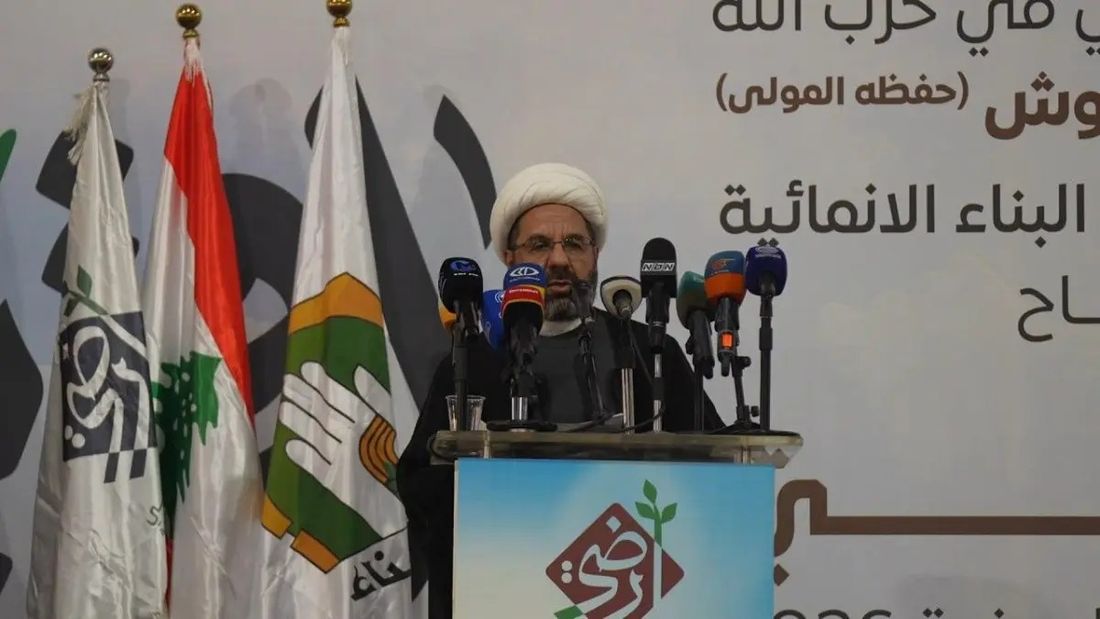
Sheikh Ali Daamoush, head of Hezb0llah’s Executive Council, said the state must assume its responsibilities, assist farmers and industrialists, compensate those affected by Israeli aggression, reduce production costs, and help market their products in domestic and foreign markets.
Speaking during his patronage of the opening of the “Ardi” (My Land) exhibition at the Sayyed al-Shuhada Complex in Beirut’s southern suburbs this afternoon, Sheikh Daamoush said: “Unfortunately, the policies pursued in Lebanon have led to higher production costs and undermined marketing opportunities, not only abroad but also domestically, because of the customs duties, taxes, and fees imposed in this sector.”
Political Developments
On the political front, Sheikh Daamoush said many people had awaited the results of the Israeli elections and treated them as an event on which to base expectations about Israel’s future conduct in Lebanon and the region.
“But when have there ever been differences among the Zionist competitors for power regarding the issues affecting our peoples?” he asked. “They all agree on wars of extermination, occupation, depriving the Palestinian people of their legitimate rights, and continuing the aggression against our country.”
He added: “As far as we are concerned, we see no difference between one camp and another, or between one political direction and another. We have gone through many experiences that have proven that the Zionist entity’s expansionist project is one and the same, and its ambitions toward our country are also the same. What matters to us in Lebanon is ending the occupation of our land, stopping the aggression against our country, securing the release of our prisoners, enabling our people to return to their villages, and rebuilding them.”
Sheikh Daamoush stressed that the decision to wage war in the region had always rested with the United States and Israel. The peoples and countries of the region, he said, were in a defensive position, exercising their legitimate right to self-defense.
“This is also the position of our resistance in Lebanon, which emerged as a popular response to the occupation and has made all these sacrifices in defense of its country and people,” he said.
He considered the resistance’s decision to stem from the will of the people and its assessment of the country’s interests. He added that the resistance benefits from the unconditional support provided by the Islamic Republic of Iran to help liberate Lebanese territory and repel aggression.
Negotiations and the Resistance’s Weapons
Sheikh Daamoush said that after the failure of the political option pursued by Lebanon’s authorities through direct negotiations and the framework agreement, the available path for Lebanon was to strengthen its internal sources of power, return to national understanding, and rely on the regional equation that Iran is working to establish in the region.
He stressed that it was in Lebanon’s interest to join this regional equation and maintain the best possible relations with the Islamic Republic of Iran, calling on everyone to “read the changes taking place in the region and benefit from them in the interests of our country.”
Daamoush continued: “We fully understand that the state has rights, but it also has obligations. No authority governing the state can violate the foundations on which Lebanon is built as a country governed by coexistence and consensus among its people.”
He said that having a strong state that protects its citizens and assumes its responsibilities was a basic requirement and a longstanding demand of Hezbollah.
“Unfortunately, the Lebanese have yet to succeed in building a state that protects and cares for its people. As a result, some of them have been compelled to assume responsibilities that should fall to the state, including resisting the occupation,” he said.
“When land is occupied, sovereignty is violated, and the state is unable to fulfill its duties, it is natural for the people of that land to step forward to defend it and provide the means of strength, foremost among them weapons. Otherwise, how is the resistance supposed to confront this enemy? Its weapons are intended to liberate the land, and no one can prevent it from carrying out this duty as long as the occupation continues.”
Daamoush stressed that it was inconsistent to insist that weapons be exclusively in the hands of the state while Lebanese land remained occupied and the state was unable to end the occupation, noting that all its concessions had failed to liberate even a single span of land.
“This resistance will remain and continue as long as there is an occupation. Once liberation, the return of residents, and reconstruction are achieved, we will be ready for an internal dialogue with everyone who is concerned about the country, to discuss the best national means of protecting Lebanon,” he said.
Criticism of U.S. Intervention
Sheikh Daamoush pointed out that the American administration had gone too far in interfering in Lebanon’s internal affairs.
“It has become clear to the Lebanese that many decisions and measures taken by the authorities are the result of American pressure and are intended to serve the interests of the Zionist entity,” he said.
He called on the Lebanese government to review its performance and choices and return to the provisions of the Constitution, domestic laws, and international treaties governing relations between states and the work of foreign embassies.
He urged the government to “rise up in defense of national sovereignty against American violations of Lebanon, act in accordance with the national interest, and put an end to this blatant American interference in the daily lives of the Lebanese.”
Daamoush affirmed: “We will not accept violations of Lebanese sovereignty or American interference in our internal affairs. We reject attempts to seize control of political life and turn Lebanon into an American protectorate.”
Warning Against Incitement and Threats to National Unity
Daamoush noted that incitement against the resistance and its community had reached entirely unacceptable levels because it had begun to threaten national unity and Lebanon’s model of coexistence.
He said some political forces were disregarding the National Pact, the Constitution, the laws, and the established rules of political discourse, while insisting on stirring up sectarian tensions and making Lebanese people fear one another through rhetoric that promotes hatred and division.
According to Daamoush, these forces are seeking to divide the Lebanese according to their sectarian and religious affiliations and revive their old aspirations for a sectarian mini-state. He said this approach converges with the Israeli project aimed at destroying regional societies and creating sectarian mini-states that fight among themselves.
Sheikh Daamoush concluded by warning of the danger of this convergence and reaffirming Hezbollah’s commitment to Lebanon’s unity, shared national life, and civil peace.
He called on all sincere and patriotic people from every religious community to remain alert to the dangers facing Lebanon as a result of misguided bets and political choices that, he said, have already cost the Lebanese dearly.


