
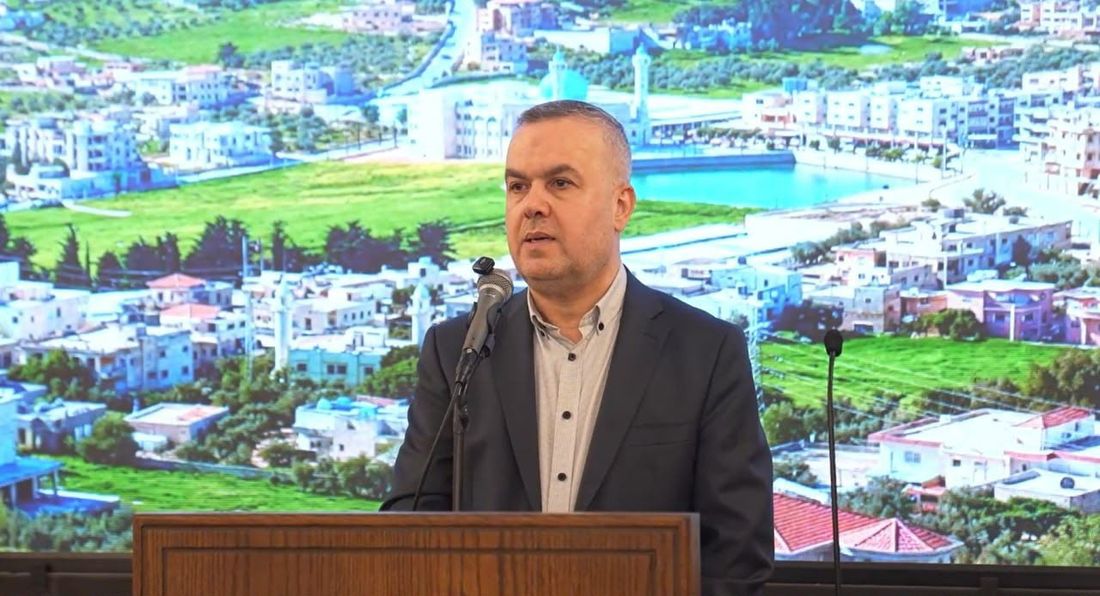
In response to claims that Hezb0llah takes its orders from Iran, MP Hassan Fadlallah, a member of the Loyalty to the Resistance Bloc, affirmed that the resistance in Lebanon is a defensive posture for its country, and its cause today is working to liberate the land, return the displaced, release prisoners, and rebuild. The resistance's decision is a Lebanese decision made by its leadership; no one abroad or domestically dictates it. This was the case previously under the late His Eminence Sayyed Hassan, as well as today under His Eminence Sheikh Naim, and it will continue in the future. He noted that some in Lebanon constantly promote the narrative that the resistance makes decisions regarding the confrontation with the enemy based on external requests, which is an insult to people's intelligence, as well as a distortion and misleading narrative.
He added: "Apart from leaks dealing with our position and what is true or incorrect, this position stems from our will, assessment, and diagnosis of the national interest, and the resistance's leadership announces it in due time. However, it is all under the umbrella of the cause for which we are fighting: the cause of the south, liberating the land, and returning to it. The Islamic Republic of Iran has never asked us in the past nor today to support it in confronting the US-Israeli aggression. On the very contrary, when we meet with Iranian officials, they ask what we want and what serves our interest and Lebanon's interest in order to support us. This means that we are the ones who rely on Iran and its power, and on the equation it wants to establish to help us liberate our country from Israeli occupation."
MP Fadlallah's remarks came during a commemoration ceremony held by Hezb0llah for the martyrs of the resistance in the city of Bint Jbeil, hosted at the Imam al-Kazem Complex in Madi neighborhood, in the presence of several clerics, public figures, notable personalities, families of the martyrs, and a crowd of residents.
MP Fadlallah said that the one who causes war is the occupier, and the decision for war is in the hands of the United States and the enemy entity. There are those who distract the Lebanese by repeating the slogan that the decision of war and peace is in the hands of the state, as if the state possesses it rather than the enemy, or those who now insist on raising the principle of the monopoly of arms in light of the occupation and aggression against our country. Such topics are not discussed while an occupation exists; rather, they require a dialogue on national foundations where we address controversial issues after we liberate the land, return to our villages, rebuild them, and release the prisoners.
MP Fadlallah continued: "There are two essential factors protecting Lebanon today: the presence of the resistance and the national role of the Lebanese army, especially in protecting internal civil peace. Therefore, we witness this continuous targeting of the resistance and also this targeting of the Lebanese army by those accustomed to attacking it and questioning its role, because they consider it one of the national factors preventing the implementation of their partitioning and divisive project in Lebanon."
MP Fadlallah added that confronting this existential danger requires awareness, wisdom, and the assumption of national responsibility by state officials. They should not search for a truckload of weapons and explosives belonging to the resistance used against the Israeli enemy, nor should they go to the wrong place by looking for who protects Lebanon. Instead, they must look for those who carry verbal, political, and inflammatory explosives that threaten civil peace, national unity, the state, and the homeland, and who seek to sabotage Lebanon.
MP Fadlallah stated that the solution at the national level lies in returning to the National Reconciliation Accord (Taif Agreement), the constitution, and laws, all of which criminalize dealing with the enemy, communicating with it, and promoting it, enshrine the right of the Lebanese to resist occupation, and criminalize those who call for sedition and stir up sectarian strife. Consequently, if we want to build a state that exercises its role, it must start from these foundations, rather than heading toward proposals whose time has not yet come.


