
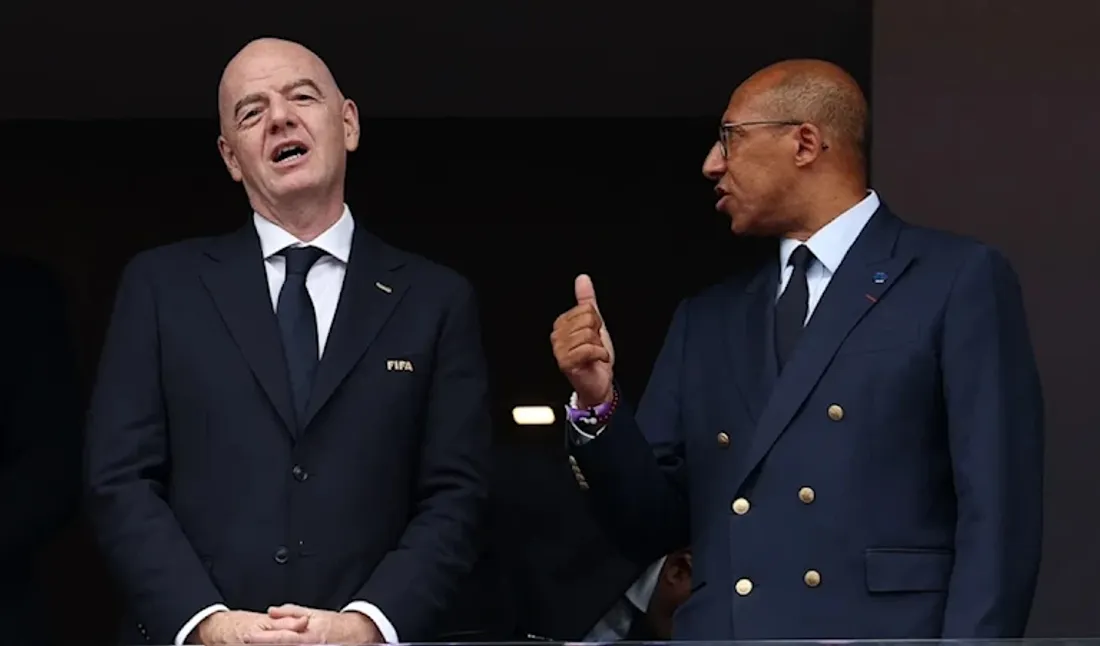
After weeks of intense developments and a series of dramatic events, the race for next year's FIFA presidential election has entered a decisive phase. Current president Gianni Infantino is seeking a fourth term, amid opposition from some football associations, led by the Union of European Football Associations (UEFA), to his re-election. This opposition follows Infantino's now-abandoned plan to sell stakes in future FIFA World Cup finals to private-sector investors.
Over recent months, UEFA has worked to launch an investigation into Gianni Infantino's administration, aiming to uncover any potential irregularities and further weaken his electoral position. The investigation has examined several sensitive issues involving FIFA, including Infantino's personal compensation, FIFA's handling of the disciplinary case involving American striker Folarin Balogun during the 2026 World Cup, and the commercial and political ties involving U.S. President Donald Trump and his family.
According to an earlier report by the British newspaper The Telegraph, Infantino could be summoned to testify before the U.S. Congress as part of investigations into his links with President Donald Trump. This is a sensitive situation that could negatively affect Infantino's re-election campaign, particularly amid growing criticism directed at him.
Meanwhile, UEFA has been working to secure a candidate capable of unseating Infantino, who has been in power since February 2016. Former Arsenal manager and FIFA's Chief of Global Football Development since 2019, Arsène Wenger, emerged as a leading potential candidate before the veteran Frenchman declined the role.
Following Wenger's withdrawal, UEFA announced the candidacy of Philippe Diallo, president of the French Football Federation, for the FIFA presidency. Diallo intends to rely on the support of UEFA and several other football associations in an attempt to pull off an upset.
UEFA has worked over recent months to weaken Infantino's electoral position.
To shift the balance of power in his favor, Diallo will need an experienced and influential campaign team. Kevin Lamour, formerly FIFA's third-highest-ranking official, is strongly rumored to be among those who could join the effort. Lamour was removed from his position by Infantino after criticizing some of his policies. He enjoys a good reputation among international football officials and has extensive knowledge of how the global governing body operates. His potential involvement could therefore provide a significant boost to the French candidate.
Infantino now faces three challengers: French Football Federation president Philippe Diallo, Japanese football official Kozo Tashima, and former Swiss player Ramon Vega.
Voting System
FIFA holds its presidential elections every four years at its congress following the men's World Cup. Following Spain's victory at the 2026 World Cup, the next presidential election is scheduled to take place at the 77th FIFA Congress on March 18, 2027, in Morocco's capital, Rabat.
The winner is generally determined by the support of individual member associations across the six confederations. FIFA has 211 member associations, each of which has equal voting weight and may support only one candidate in each election.
If two candidates compete, a simple majority of more than 50% is required to win, equivalent to the support of 106 member associations.
If there are more than two candidates, as is the case in the upcoming election, a two-thirds majority is required in the first round. Further rounds of voting are then held, with the candidate receiving the fewest votes eliminated each time. This process continues until only two candidates remain, after which the candidate securing a simple majority wins.
Despite the competition, Infantino remains the leading candidate. The current FIFA president continues to enjoy strong support in Africa, the Caribbean, South America, and the Middle East, as well as backing from the Asian Football Confederation.
Nevertheless, his challengers still have several months to build support, rally backing, and capitalize on any setbacks their leading opponent may face.


