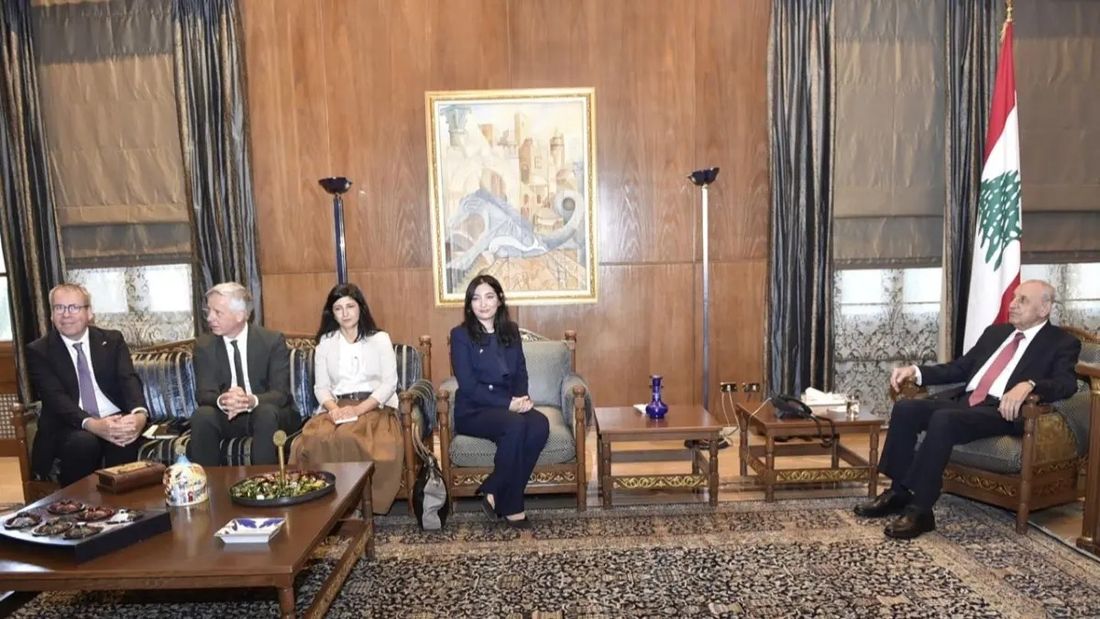
The Federal Minister for Economic Cooperation and Development of the Federal Republic of Germany, Ms. Reem Al-Abali Radovan, held talks today with the heads of state, parliament, and government, addressing the Lebanese situation in all its aspects, particularly the situation in the south and the approaching end of the mandate of the United Nations Interim Force in Lebanon (UNIFIL).
Minister Radovan met with President Joseph Aoun, explaining that her visit comes "as an expression of the German government's solidarity and support for Lebanon under the difficult circumstances it is going through." She stressed her country's "keenness to enhance cooperation with the Lebanese government and keep pace with its reform and development efforts," noting that "the German government is following developments in Lebanon with great interest and perceives progress on the path of reforms despite exceptional challenges." She affirmed "Germany's readiness to continue supporting Lebanon and its institutions, and to work on new cooperation projects in a number of sectors."
President Aoun appreciated "Germany’s supportive positions toward Lebanon," emphasizing "the importance of the European role in backing efforts aimed at consolidating stability in Lebanon and the region." He reviewed regional developments and their repercussions on the Lebanese situation, pointing out that "Lebanon is making continuous efforts to preserve its internal stability and the cohesion of its institutions in the face of surrounding tensions," and that it "adheres to diplomatic and negotiating solutions to resolve conflicts, proceeding from its conviction that wars have not achieved their desired goals, and that lasting stability cannot be achieved by military force alone."
Regarding the situation in the south, President Aoun stressed "the necessity of halting Israeli attacks and abiding by existing understandings," noting that "the continuation of military operations and the targeting of civilian areas and infrastructure increase the suffering of the population and undermine efforts made to achieve stability." He pointed out that "Lebanon has put forward four basic files in contacts and negotiations: a ceasefire, Israeli withdrawal, border demarcation, and the prisoners file, but the required progress has not been achieved yet."
He emphasized that "the continuation of attacks only leads to complicating the situation and reinforcing the logic of confrontation, at a time when the people of the south need security, tranquility, and a return to normal life." He affirmed that "the Lebanese state and the Lebanese army are ready to address any security concerns through official mechanisms and established coordination, rather than resorting to military operations." In this context, President Aoun called for "enhancing European support for the Lebanese army, given the massive responsibilities placed upon it, whether in maintaining internal security and stability, combating terrorism and drug trafficking, or controlling borders and fighting irregular migration." He asserted that "supporting the army and Lebanese security institutions constitutes a direct investment in the stability of Lebanon and the region, and positively reflects on Europe's security as well, given the close interdependence between the two shores of the Mediterranean."
The meeting also touched on the path of economic and financial reforms, where President Aoun noted "the continuation of work with the International Monetary Fund and international financial institutions to complete necessary reforms and restore confidence in the Lebanese economy." The German minister expressed "her country's appreciation for the reform steps taken by Lebanon," stressing "the importance of continuing this path and enhancing cooperation with the relevant Lebanese ministries and institutions."
Discussions also covered the repercussions of regional crises and the burdens of displacement on Lebanon and its host communities, in addition to reconstruction and recovery needs. In this framework, President Aoun expressed "his aspiration for Germany's contribution to international efforts to support reconstruction, particularly within any framework being prepared under the leadership of the World Bank and in coordination with the Lebanese government."
The President of the Republic emphasized "the importance of transitioning gradually from emergency aid to building a sustainable economic and developmental partnership," calling for "encouraging the German private sector to invest in Lebanon and take advantage of available opportunities in various productive sectors and infrastructure, which will contribute to stimulating growth and creating jobs."
At the conclusion of the meeting, the minister renewed "the confirmation of Germany's commitment to standing by Lebanon," stressing that "geographic proximity and close ties between Lebanon and Europe constitute an additional incentive to deepen bilateral relations and expand areas of cooperation, serving the interests of both countries and contributing to stability and development."
Following the meeting with Aoun, Minister Radovan stated: "I came to Lebanon because your country stands at an important crossroads. After months of conflict in the south, following massive destruction and ongoing internal displacement, your country has reached the limit of its endurance. The economic and financial crisis has placed a heavy burden on the state and society. Exactly right now, the direction in which Lebanon will develop is being determined. I came here to form a clear picture myself of what is happening on the ground, of the people's situation, of the consequences of military confrontations in the south, and also of reforms. But most importantly, I came here to say clearly: Germany supports the path of reforms, building effective state institutions, and establishing better living conditions for the people of this country, especially those most affected by the crisis."
She called for strengthening state institutions and implementing reforms, as well as boosting economic growth and providing opportunities for all segments of society. She added: "We support the people in overcoming the consequences of regional conflicts and ongoing crises, especially in the south."
Regarding Germany's readiness to form an alternative European force to "UNIFIL," she said: "Regarding the future of these forces, there are other fully competent authorities responsible for this matter, notably the United Nations Security Council. We are monitoring the situation closely. There must not be a vacuum in this regard. However, in the international community, we want to support the Lebanese army because it is indeed a fundamental pillar for the country's stability, and we will do so now and in the future."
When asked whether Germany intends to pressure Israel to halt attacks on southern Lebanon, she confirmed that "in past months, of course, this issue was important to the German Federal Government—the issue of military confrontations between Hezb0llah and Israel. We also address the Israeli government on this matter directly, especially after the attacks on Beirut. This matter was clear to us, and we will continue this approach and continue addressing Israel on this issue."
Radovan visited the Speaker of the Parliament, Nabih Berri, in the presence of the German Ambassador to Lebanon, Thomas Zanizer, and the Parliament Speaker’s Media Advisor, Ali Hamdan. They discussed the general situation in Lebanon and the region, and field developments resulting from Israel's continued aggression against Lebanon, its systematic destruction of Lebanese villages and towns in the south, and its failure to abide by international legitimacy resolutions—foremost among them Resolution 1701—as well as the agreements concluded in 2024 and recently the Framework Agreement, both under American auspices.
President Berri warned of "the danger of ending the mandate of the international peacekeeping forces operating in southern Lebanon before the full implementation of Resolution 1701 and the complete end of the Israeli occupation." The Speaker of Parliament stressed "the necessity of strengthening the partnership between Lebanon, the Federal Republic of Germany, and the European Union, and continuing to provide support to the Lebanese army."
She also visited Prime Minister Nawaf Salam, who thanked Germany for its continuous support to Lebanon, emphasizing "the importance of continuing this support, particularly with regard to backing recovery and reconstruction efforts in the south, helping residents return to their villages and towns, and enhancing the state's and its institutions' capacities to respond to urgent needs."
For her part, the German minister affirmed "her country's continued support for Lebanon," stressing "the importance of moving forward with the path of financial and economic reforms, and enhancing transparency and governance, in a manner that contributes to restoring confidence in the Lebanese economy, creating a favorable climate for investment, and expanding prospects for economic and developmental cooperation between the two countries."