
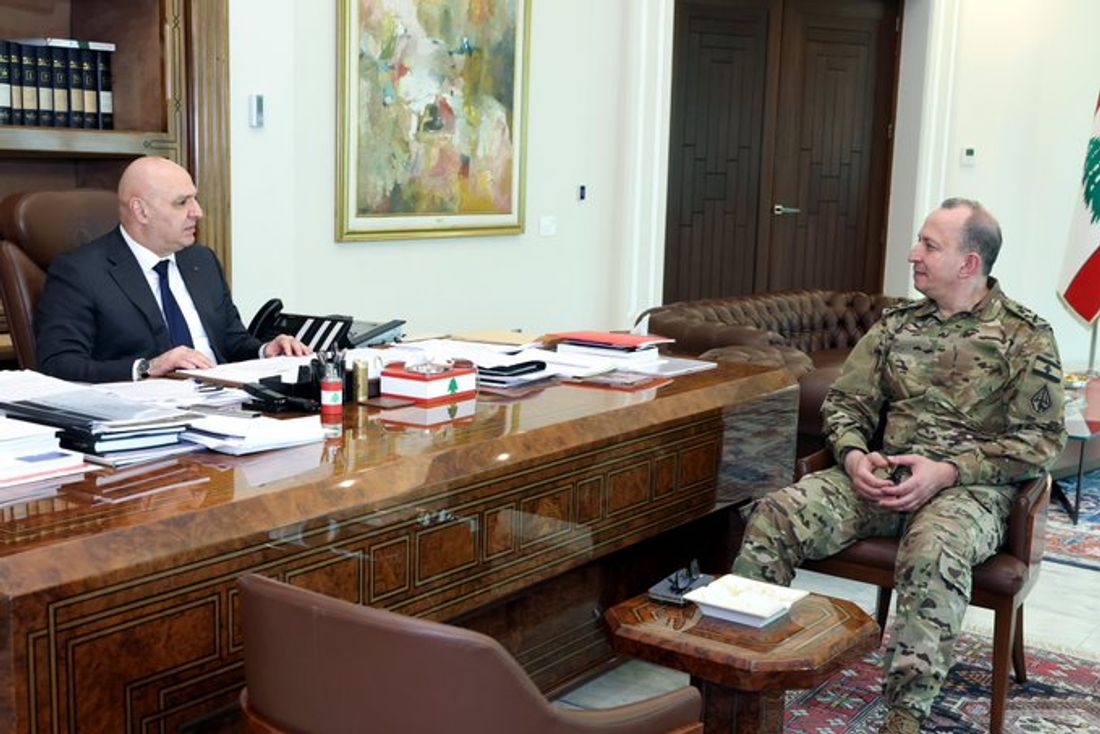
Informed circles in Washington reveal that the US administration, on its political side, has begun treating the respective approaches of President Joseph Aoun and Army Commander General Rodolphe Haykal toward the security and military files as a primary indicator for evaluating the upcoming phase. This comes amid a growing impression of a gap between the "rhetorical" political ceiling that Baabda (the Presidential Palace) is trying to establish, and the operational margins to which Yarze (the Defense Ministry/Army Command) adheres when dealing with on-the-ground developments. However, this does not necessarily signify a dispute as much as it reflects a legitimate division of roles within state institutions—especially since American circles are well aware that the current phase in the relationship between Baabda and Yarze differs from any previous era, owing to the distinct and special relationship binding Aoun and Haykal, contrary to rumors circulating in Lebanese political salons.
Sources indicate that the US administration necessarily places both men in the same political camp, despite recognizing the institutional nature of their relationship and their shared tendency to rely on justifications tied to domestic circumstances and military capabilities. This prompted Ambassador Tom Barrack, during one of the "Mechanism" committee meetings in Tyre, to openly urge the officers present to "rebel" against the existing political authority and "rely" on Washington.
The sources add that what concerns Washington is not the "formal" difference in assessing methods per se, but the possibility that this divergence could turn into a duality of decision-making within official institutions—where the government moves toward cementing political commitments before the international community, while the military establishment remains governed by field and political calculations that could make implementation far slower than desired by the concerned capitals, similar to what transpired at Raouche Rock.
From this perspective, excluding the Army Commander from the meetings of US Ambassador to the United Nations Mike Waltz during his recent visit to Beirut carries implications that go beyond protocol, according to the sources. They believe Washington sought, through this signal, to maintain a level of pressure on Yarze without entering into a direct confrontation with the Presidency. What the US demands—specifically from the military leadership—is not a change of command in Yarze, but rather testing its willingness to adapt to the new phase and its conditions.
The sources point out that the US administration no longer distinguishes between its support for the Presidency as a political authority capable of making pledges, and its evaluation of the Army Command's performance as the entity responsible for execution. This has been reflected in the nature of its relationship with the political authority—at the levels of political, security, and military communication—as well as in the extent of American confidence in the Lebanese leadership's ability to fulfill its required role.
The sources affirm that Washington is pushing to break the vicious cycle of shifting responsibilities or dividing burdens between Baabda and Yarze—where political decision-makers cite implementation difficulties, while the military leadership insists on the impossibility of bypassing internal balances. The American demand is clear: "a specific political decision, an actionable military plan, and a timeline with measurable results." They note that the coming phase will reveal whether the differentiation between Aoun and Haykal is merely a natural divergence in the division of roles, or if it reflects a gap in reading the transformations underway in Lebanon and the region—concluding that the pressing question behind the scenes centers on whether Haykal's absence from Waltz's schedule was merely a passing message to Yarze, or whether Washington has actually begun adopting a policy of pressuring Baabda through the gateway of the Army, in preparation for imposing a new approach in dealing with the Lebanese state.


