
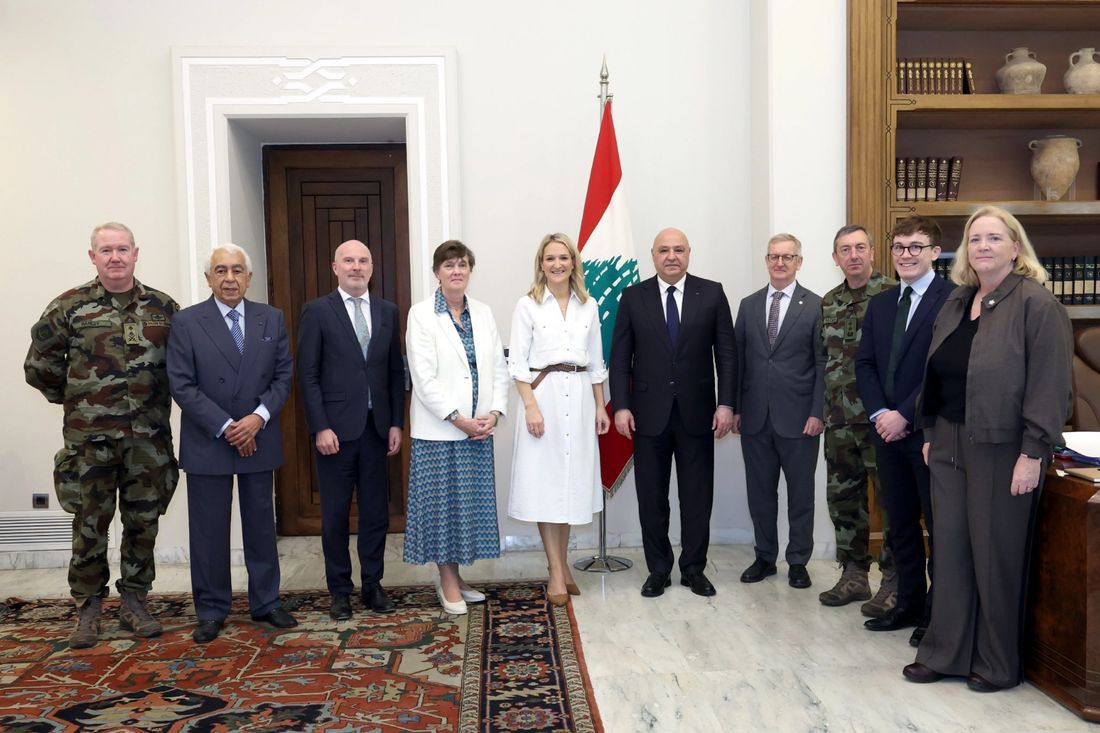
Irish Minister for Foreign Affairs and Defense Helen McEntee has begun an official visit to Lebanon to review the situation in the country and inspect Irish forces serving in southern Lebanon.
At the start of her visit, McEntee met with President Joseph Aoun, who told her that Lebanon hopes the United Nations Interim Force in Lebanon (UNIFIL) will continue its operational mission during the coming year, the period designated for its withdrawal under a UN Security Council resolution.
Aoun stressed the importance of UNIFIL’s presence in southern Lebanon in monitoring developments and assisting the Lebanese Army as it deploys to the international southern border following Israel’s withdrawal. He also highlighted the humanitarian, social, and healthcare services provided by UNIFIL personnel to residents of southern villages, who welcome the peacekeepers’ presence in their communities.
The president told the Irish minister that, if Lebanon’s request to extend UNIFIL’s mandate is not accepted, Lebanon would welcome the participation of any European force under an arrangement agreed upon with the European Union or the countries concerned, in cooperation with the United Nations. He warned that a security vacuum in the south following UNIFIL’s departure could negatively affect regional stability. He added that the logistical and technical support provided by a replacement force could help facilitate the Lebanese Army’s mission and improve conditions for southern communities.
Aoun explained that Israel had failed to honor the agreement reached during negotiations in Washington and continued to attack southern villages and towns through shelling, destruction, and the demolition of homes. He said Lebanon’s contacts with the United States, as the agreement’s sponsor, to halt these attacks had yielded no results. Instead, Israel was obstructing implementation of the agreement, further complicating the situation and preventing the Lebanese Army from extending state sovereignty to the international border, ending armed displays, and restoring stability.
Aoun said Lebanon was looking to friendly countries, including Ireland, to exert pressure on Israel to halt its attacks, withdraw from southern Lebanon, return Lebanese prisoners, and allow the state to rebuild destroyed villages and towns and enable their residents to return.
On domestic affairs, the president told the Irish minister that the government remained committed to economic and financial reforms in cooperation with Parliament, despite the difficult circumstances the country had faced. He welcomed any Irish support for Lebanon in humanitarian, social, military, and educational fields. He also thanked Ireland for contributing to UNIFIL since 1978 and paid tribute to Irish service members who had been killed in southern Lebanon.
For her part, McEntee reaffirmed Ireland’s continued participation in peacekeeping operations in southern Lebanon and its support for the Lebanese Army and civil society. She also pledged continued cooperation with government departments and public institutions to provide the assistance Lebanon needs, despite the difficult circumstances facing the region.
The minister also visited Justice Minister Adel Nassar, accompanied by a delegation that included Irish Ambassador to Lebanon Aidan O’Hara; Irish Department of Defense Secretary General Jacqueline McCrum; Assistant Secretary General at the Department of Foreign Affairs Bernie Maguire; Political Director at the Department of Foreign Affairs and Trade Gerard Keown; Defense Minister’s Special Adviser Evan Henry; Defense Department Private Secretary Andrew Balteran; and Ireland’s Honorary Consul General in Lebanon, George Sian.
Discussions focused on ways to strengthen bilateral relations and on developments in Lebanon and the wider region.
Following the meeting, McEntee was asked about Ireland’s participation in a European mission in Lebanon after UNIFIL’s mandate ends at the close of the current year. She said Ireland had a strong interest in the civilian dimension of the mission and was fully committed to remaining involved as the current phase of its mission concludes and a second phase begins.
She added that Ireland also wanted to work with the United Nations to explore whether another type of mission could be considered. Acknowledging the significant challenges, she said the Peacebuilding Commission (CCP) would form part of this approach and expressed hope that Ireland could participate as extensively as possible.
At the end of the meeting, the two ministers exchanged commemorative gifts.
McEntee also met with Foreign Minister Youssef Rajji, conveying Ireland’s support for stability and security in Lebanon. Their discussions addressed the period following the end of UNIFIL’s mission.
Both McEntee and Rajji expressed concern over the security vacuum that UNIFIL’s departure from southern Lebanon could create. They agreed on the need to maintain an international presence along the border, and McEntee asked what role the European Union—which Ireland currently holds the presidency of—could play.


