
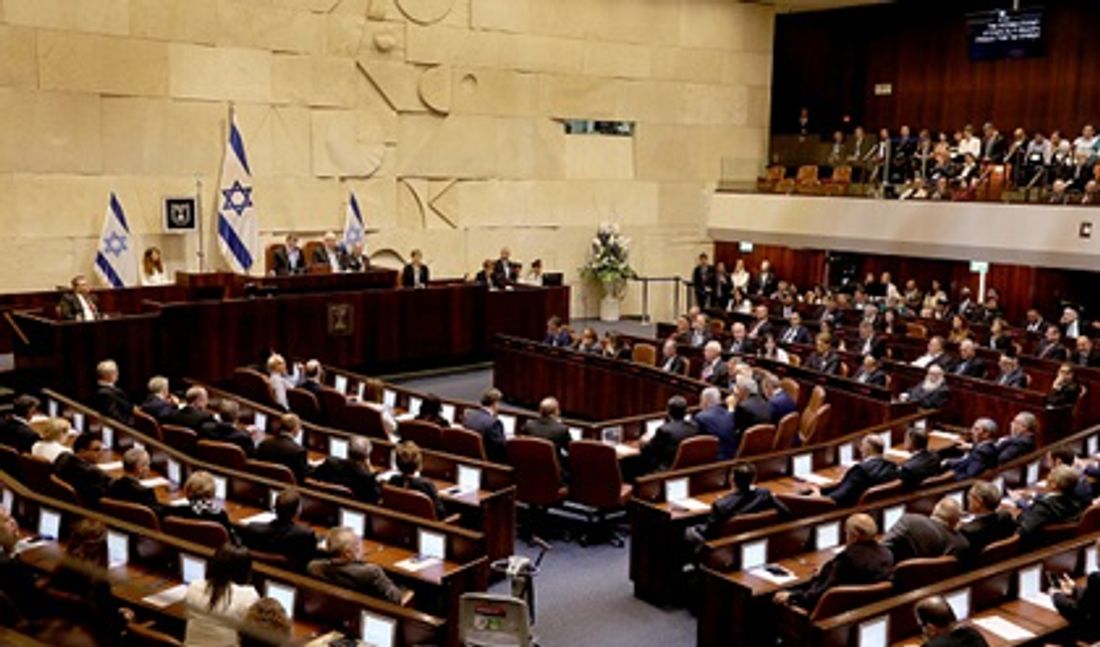
Members of Israel’s 26th Knesset are set to take the oath of office on Tuesday amid political anticipation over the identity of the next Knesset speaker and the outcome of negotiations to form a new Israeli government.
The developments come as Gadi Eisenkot works to broaden support for the so-called “change bloc,” while Avigdor Lieberman seeks to win over the Haredi parties and exclude Arab parties from any coalition or external support for the government. Meanwhile, Benjamin Netanyahu remains committed to his proposal to form a national unity government under his leadership.
Ahead of the swearing-in ceremony, Yashar Party leader Gadi Eisenkot made progress in his political consultations after reaching an understanding with Yisrael Beiteinu leader Avigdor Lieberman that the next Knesset speaker would come from Eisenkot’s party, replacing the current speaker, Amir Ohana. The possibility of Eisenkot himself assuming the position has also been raised.
According to a report by Yedioth Ahronoth, the understanding is part of the change bloc’s efforts to secure control over the Knesset’s administration, allowing it to advance new legislation and repeal laws passed by the previous government even before a new government is formed and its members are sworn in.
The identity of the Knesset speaker is seen as a key step in this process because of the influence the position has over the parliamentary agenda and the management of legislative sessions.
However, the understanding between Eisenkot and Lieberman has not resolved the issue of the potential governing coalition, which remains the most complicated aspect of government formation talks, particularly amid disagreements over whether to rely on support from Arab parties or seek to bring Haredi parties into the coalition.
During their meeting, Lieberman reportedly asked Eisenkot to abandon the option of forming a minority government supported by Arab parties, pledging instead to work toward bringing the Haredi parties into the coalition.
He said that forming such a government would place Netanyahu under continued political pressure, adding that the prime minister understands that such a government could remain in power for four years.
Lieberman also stressed that he does not aspire to become prime minister and believes the position should go to Eisenkot, signaling his willingness to support Eisenkot’s leadership of the next government.
Meanwhile, Naftali Bennett, leader of the “Bennett 2026” party, has remained silent regarding the ongoing developments and negotiations, despite meeting with Eisenkot after he was tasked with forming a government. No official statement was issued regarding the outcome of their meeting.
This caution does not necessarily mean there is no internal discussion within Bennett’s bloc. Its members have agreed to examine the political developments and the implications of the available options, amid concerns that joining a coalition inconsistent with their election promises could damage their credibility with voters.
One particular concern involves commitments to halt the transfer of budgets and government funding to groups whose members do not perform military or civil service.
Government Formation Complications
Attention is also focused on the position of the United Torah Judaism party, which has become a key target of the change bloc’s efforts to persuade it to join the next governing coalition.
There are indications that the party is open to discussing political options with parties that were considered its opponents until recently.
Positions expressed in the Haredi media suggest that the party faces a political dilemma. While it does not wish to abandon its traditional alliances with the religious bloc that has supported it for years, it also believes that its interests are no longer guaranteed following its previous experience with Netanyahu.
In this context, the newspaper Hamodia indicated that the party may be willing to consider alternative options if genuine guarantees are provided to meet its demands, arguing that current circumstances require it to reconsider its political alliances, even if that means moving away from its traditional partners.
Despite these indications, negotiations between the change bloc and United Torah Judaism remain in their early stages, and no formal agreement has yet been reached.
On the other hand, Netanyahu has revived his proposal for a national unity government in an effort to contain the political moves led by Eisenkot and prevent him from successfully forming an alternative governing coalition.
The prime minister called for a unity government under his leadership that would include all parties that participated in his current government, including the Haredi parties.
In a message addressed to parties outside his bloc, Netanyahu said he was prepared to engage in dialogue with any party interested in discussing the possibility of forming a national unity government. However, he did not raise the possibility of rotating the premiership, insisting that the leadership of the government should go to the largest party in the Knesset.
In this context, Netanyahu sent a direct message to Eisenkot, saying that the Likud party, under his leadership, received the largest number of votes, with a margin of 250,000 votes over the next-largest party, which he argued gives him the right to lead the proposed unity government.
Netanyahu also renewed his call to include all Zionist parties and not exclude any party from negotiations, presenting his initiative as a political option capable of uniting different political camps to confront the challenges ahead.


