
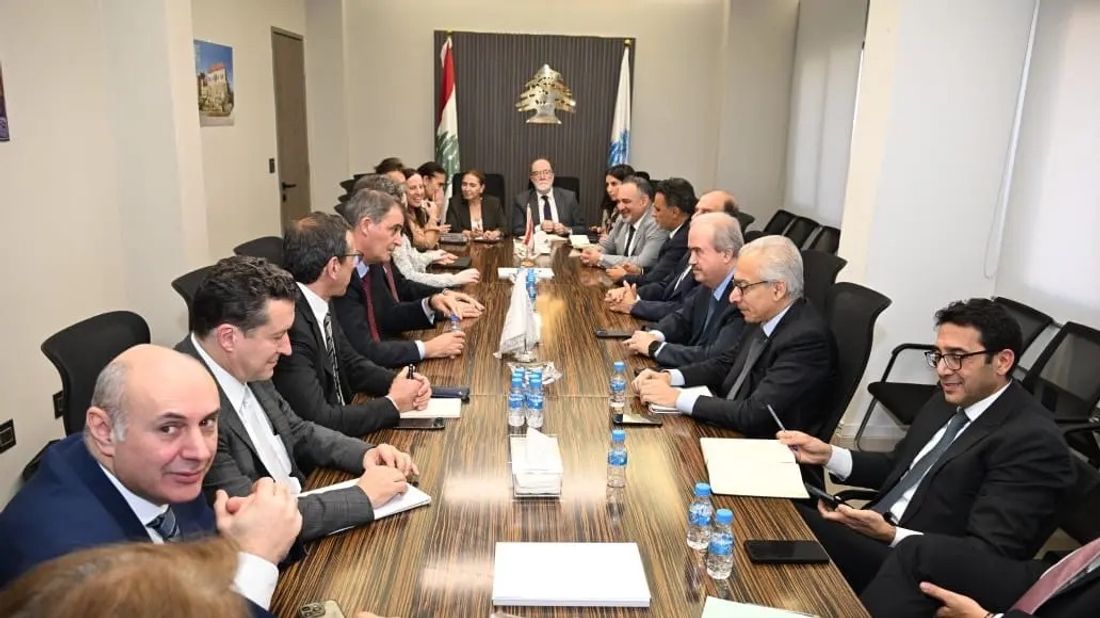
Minister of Finance Yassine Jaber, heading the Lebanese negotiating delegation, concluded a round of talks with the International Monetary Fund (IMF) mission, with the participation of Minister of Economy and Trade Amer Bisat, Banque du Liban (BDL) Governor Karim Souaid, Director General of Finance George Maarawi, and representatives from relevant Lebanese authorities—including the Presidencies of the Republic and the Government—alongside specialized experts. The meetings addressed the draft Financial Gap Law, ways to resolve the banking crisis, and the recovery of depositors' funds.
Following the meeting, Jaber stated that the talks made progress in narrowing differences among the various parties amid discussions marked by candor and mutual understanding, stressing that "efforts are focused on addressing the banking default that has persisted for seven years."
He quoted the head of the IMF mission as describing the Lebanese situation as "an unprecedented case of a banking crisis that has remained unresolved for this entire duration."
Jaber announced an agreement to "form a mini-committee to follow up on the meetings, with the aim of finalizing the required drafts before the end of the year, and heading to Parliament with a unified stance and a unified formula that will help pass the Financial Gap Law," expressing hope "to finalize a law ready for implementation before next March."
He also expressed anticipation of "making progress that allows reaching and signing an agreement on a program with the IMF during the first quarter of next year, and by the end of it at the latest." He noted that "the Fund will issue a statement regarding the results of the talks," suggesting it would be released this afternoon following a technical delay related to electronic correspondence.
Jaber explained that "the Central Bank is providing the core figures and calculations on which the discussions are based, particularly regarding financial capabilities and repayment capacity."
In response to a question about how deposits would be returned, Jaber clarified that "the details are still being worked on," emphasizing that "the resolution is based on two primary objectives: restoring banking operations to support economic development and boost confidence in banks, and beginning the return of depositors' funds."
He said: "An overwhelming majority of depositors, potentially reaching around 90 percent, will be able to receive their funds in cash or in 'fresh' dollars during the first phase, while addressing the remaining deposits will involve bonds issued by Banque du Liban to be repaid in subsequent stages."
He stressed that "the discussion is focused on ensuring the law's feasibility and the availability of the necessary funds for it."
Regarding the distribution of losses, Jaber reiterated the hierarchy he had previously announced, stating: first the State, then Banque du Liban, then the banks, and finally the depositors. He affirmed that "most depositors will recover all their funds, though timelines and repayment mechanisms will vary," pointing out that "paying all funds to all depositors at once is impossible given what Lebanon has witnessed."
In response to a question about amounts previously withdrawn by depositors at exchange rates lower than the actual dollar rate, Jaber noted the "difficulty of addressing all past losses," affirming that "the resolution will be within the limits of the capabilities available to the State and Banque du Liban."
For his part, Minister of Economy and Trade Amer Bisat described the discussions as "very positive," pointing to progress and agreement at the principled level, and a transition to discussing the technical details necessary to complete the resolution.
He explained that "the issues requiring further work have become clear, and the mini-committee will take on finalizing them, in parallel with providing the required data to the IMF, in an effort to wrap up the details before the end of the year and finalize the legislative draft for submission to Parliament."
Bisat noted that the committee comprises three parties: the government represented by its experts with the participation of relevant ministers when needed, Banque du Liban represented by the Governor and his team, and the International Monetary Fund.


