
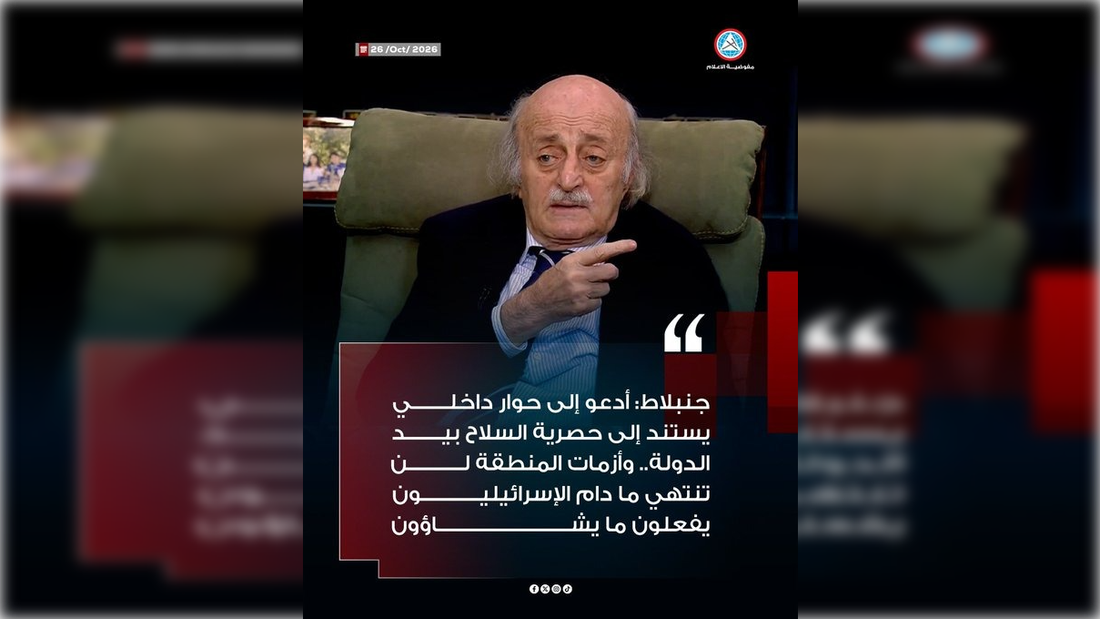
In an extensive and important interview, the former president of the Progressive Socialist Party, Walid Jumblatt, predicted that Israel would remain in the south for decades, considering that Lebanon lacks the power or the necessary political initiative to prevent this. He warned of Israeli attempts to create the conditions for establishing settlements or colonies in southern Lebanon or parts of it, expressing his fear of the repercussions of this, as the Israelis explicitly state that they will expand their lands further.
In an interview with broadcaster Hadley Gamble for the "IMI" media group, Jumblatt said that the south was not completely erased from the ground during the recent Israeli invasions, adding: "Now they are trying to erase all memories of the south." He predicted that Israel would remain in the south for decades, considering that Lebanon lacks the power or the necessary political initiative to prevent this, but "we, unfortunately, are subject to the Israelis."
He considered that the situation in Lebanon will get worse, saying: "I don't know what will happen in Lebanon or in other regions, but in Lebanon nothing will change. Our problems and destruction will increase." He viewed that the withdrawal of the Americans from the region leaves a vacuum filled by Israel, explaining that the presence of so-called American bases was important as it was supposed to protect some Arab countries, but the Americans are withdrawing while Netanyahu is here, controlling and expanding lands, and building his empire, his biblical empire.
Jumblatt considered that Israel's policy, past, present, and future, is based on erasing the Palestinian national identity from Gaza to the West Bank, and on expansion in Syria and Lebanon, emphasizing that this policy will not change regardless of the outcome of Israeli elections.
He said that the Israelis will try, if they can, to drive the displaced people out of Gaza through bombing and killing and push them into the unknown, whether to somewhere in Africa or the Middle East, or to the West Bank, considering that the slogan of old Israeli policy is that Palestine does not exist, and if Palestine exists, let it be on the East Bank.
Regarding the possibility of Israel resuming the bombardment of Lebanon, Jumblatt answered: "Unfortunately, yes," pointing out that the Israeli Defense Minister said a week ago: "We will obliterate a part of Beirut," referring to the southern suburb with its Shiite majority, and stressing that this statement was issued by the minister himself.
Dialogue with Hezb0llah and Iran
Regarding internal Lebanese affairs, Jumblatt considered that the Iranians use and support Hezb0llah, believing that this will achieve stability in Lebanon or weaken Israel, and he viewed this belief as completely wrong. He called for an inevitable internal dialogue based on the principle that the state alone is authorized to keep weapons.
He added that the experience of disarmament in Britain and Ireland could constitute a model that can be applied in Lebanon at some stage, but he stressed that this process cannot succeed without the support of the Iranians and the other party, meaning Israel.
He considered that Hezb0llah still exists because of the way it is dealt with, whether by some Lebanese parties or within the framework of American policy, warning that intransigence could lead to civil war, as some diplomats or local parties desire. He said: "Shiites are part of Lebanon. You cannot eliminate them or tell them: 'Leave,'" stressing that he cannot accept a path that leads to civil war.
He pointed out that Hezb0llah may have weakened after the recent wars, but it still exists, considering that Lebanon made a mistake when it did not choose the Islamabad path, and chose instead the path of (US Secretary of State) Marco Rubio, who said it would not lead anywhere. He explained that the agreement signed in Islamabad was signed by US Vice President JD Vance in Geneva, and that it dealt with the Iranians and the Lebanese.
In his discussion of the negotiations between Lebanon and Israel, Jumblatt said that seven rounds were held under US leadership—or what was supposed to be under its leadership—without reaching a decision, while Israel continues to occupy the south.
He added: "Israel is demanding the disarmament of Hezb0llah," considering that weapons have been removed, to some extent, from most areas of the south, but Israeli demands have moved to north of the Litani. He questioned what is meant by weapons in light of technological developments, including drones, pointing out that Israel might say there is a drone factory in Baalbek and that it wants to reach it. He described this as absurdity, absurdity in every sense of the word, but it is frightening.
Jumblatt criticized the belief of some Lebanese officials that the United States is capable of pressuring Israel to withdraw, saying: "This is a complete illusion... that the United States bears responsibility for the current situation, alongside the current Lebanese government and some Lebanese in the United States, as well as some neoconservatives or evangelical Christians," whom he described as having great importance in American politics.
He stressed the necessity of communicating with Iran, considering that Hezb0llah's actual policy is not decided in Lebanon, but in Tehran. He said: "At some point, during the presence of Hassan Nasrallah, he had influence that allowed him to impose dialogue, and he was able to understand Lebanese issues, yes. Now, he is gone and has been assassinated." He added that the Lebanese must talk to the Iranians and try to communicate with the parties with whom dialogue is possible, saying: "I am not an expert on internal Iranian politics, but we must dialogue with them so that we can influence here, and limit their tendency toward escalation."
Commenting on US President Donald Trump's support for Israeli Prime Minister Benjamin Netanyahu in the Knesset elections, Jumblatt considered that Netanyahu is more important than Trump so far.
Al-Hijri is a "puppet" in the hands of the Israelis
Regarding Syrian affairs, Jumblatt said that Syria was stronger in the past, but former President Bashar al-Assad destroyed it when he used the army against his people, which led to the collapse of the army. He added that the new president, Ahmed al-Sharaa, is trying to build a new army, but this faces restrictions, considering that Israel will never allow him to possess a modern army.
Jumblatt criticized the stance of Syria's Druze, saying that they are taking the wrong path in history after choosing to be a tool in the hands of the Israelis and to be used "as good soldiers." He added: "I will not wish them luck. We will go to hell if we are used by the Israelis, just as they use the Druze in Israel. They have good soldiers, that's all," pointing out that Israeli soldiers fight Palestinians and others.
He considered that the Israeli government is the one that decides the fate of the Druze inside Israel and in Syria, adding: "They do not decide."
He viewed that the Syrian Druze are swimming against the current of their national history and the history of national liberation in which Sultan Pasha al-Atrash once led the liberation of all of Syria from the French Mandate.
Jumblatt criticized Sheikh Al-Hijri, saying that he "is not a clergyman, but merely a puppet in the hands of the Israelis," adding that he is not the revered clergyman he is portrayed to be. He stressed his opposition to his policy and his rejection of his endeavors aimed at detaching the Druze from the Arab and Islamic worlds.
He said that Al-Hijri enjoys the support of some Druze in Suwayda, but not all of them, pointing out that the Druze in Syria are not concentrated only in the southeast of the country, but also live in neighborhoods of Damascus alongside Christians and Muslims. He warned that Al-Hijri's policies threaten these people.
Adding, expressing his feeling that some Druze have abandoned him: "That's fine. I will continue my path alone, even if I remain alone." He stressed the necessity for the Druze to realize that using them, subjecting them to Israeli plans and hegemony, and turning them into soldiers in confrontation with any party or the Arabs will not lead them anywhere.
The decline of Arab influence and US responsibility
In his assessment of the balance of power in the region, Jumblatt said that there is no longer a balance of power, explaining that Syria was an ally of Lebanon at a previous stage, and the presence of the Soviet Union allowed a kind of influence, but the Union no longer exists, while Russia is no longer present in the equation because it is fighting its own war, which is entering its fifth year. He considered that Lebanon and Syria, to some extent, have become powerless.
He questioned the allies of the new Syria, with the exception of what he described as some of Trump's words, considering that the region is witnessing a new order and a new global system, and that nothing will happen in the Middle East as long as American interests are not harmed, whether concerning oil, weapons, stock markets, or others.
In the same context, he considered that Trump has failed so far in his endeavor to impose hegemony on the region using military power, stressing that Iran cannot be wiped off the face of the earth. Commenting on Trump's previous threat to erase Iran, he said: "What a wrong policy."
He also announced his support for Russia's unity, objecting to Europe's support for its disintegration, saying: "The disintegration of a country that possesses, in his words, thousands of nuclear warheads will lead to the end of the world, and I support Russia's unity despite all odds."
Lebanon and dialogue with its Arab surroundings
Regarding the relationship between Lebanon and its surroundings, Jumblatt said that Lebanon cannot isolate itself from the region, and Israel will never accept that. In contrast, he considered that the Arab world today is incapable of helping Lebanon, and the influence of Saudi Arabia and the rest of the Gulf countries is declining in light of these countries' pre-occupation with their own problems.
He called for Saudi Crown Prince Mohammed bin Salman to return to his previous policy and reach a settlement with the "H0uthis" in Yemen, stressing that Saudi stability away from war is of utmost importance.


