
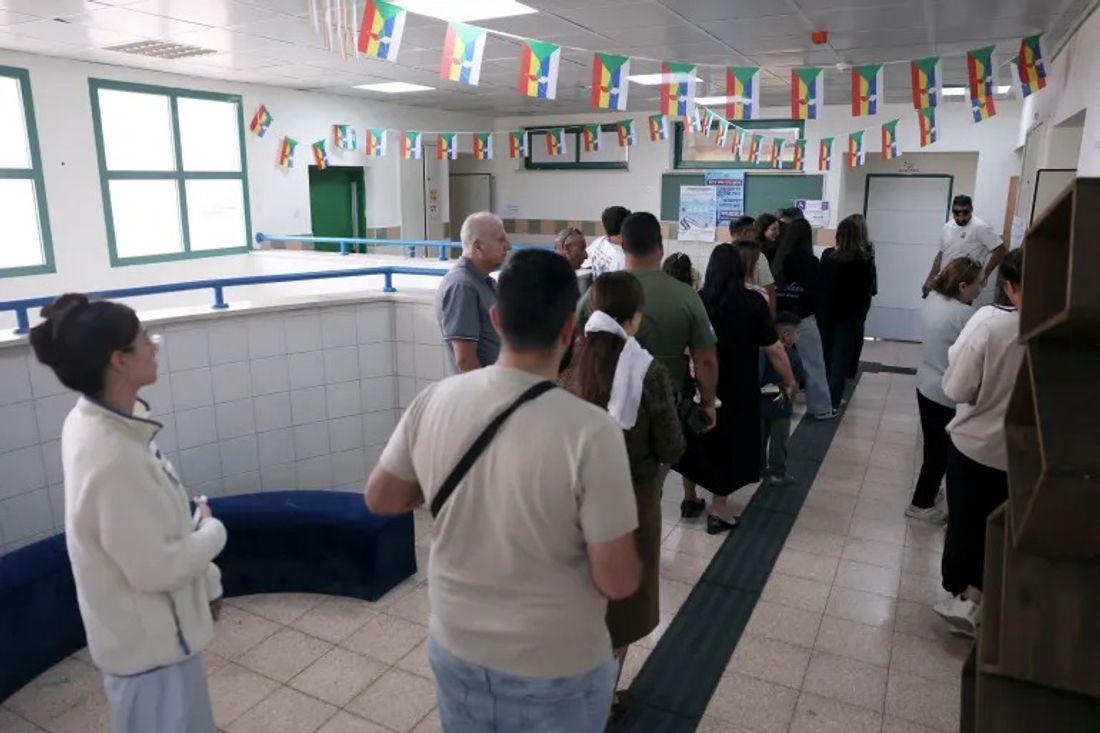
Israelis began voting in Knesset elections on Tuesday, under a complex electoral system in which any political faction can make a difference and play a key role in forming the next government. A total of 36 party lists are competing for 120 seats amid a close contest between the two camps led by Israeli Prime Minister Benjamin Netanyahu and his main rival, former military chief Gadi Eisenkot, who comes from a Moroccan Jewish family that immigrated to Israel.
Polling stations opened at 7 a.m. Jerusalem time (5 a.m. GMT) and are scheduled to remain open until 10 p.m. local time (8 p.m. GMT). The number of registered voters stands at 7,331,981.
Polling stations across Israel have witnessed heavy crowds since voting began this morning, amid incitement campaigns by right-wing parties targeting Arab and left-wing voters.
The Israeli Central Elections Committee announced that voter turnout nationwide had reached 31.5% by noon. The committee said that more than 2,309,000 citizens had cast their ballots, representing an increase of 3.1 percentage points compared with turnout at the same time in the previous election. This marks the highest level of participation since 1973. The committee reiterated that turnout had reached 31.5%.
The deputy head of the Israeli Central Elections Committee said that if queues continued after 10 p.m., voting would be extended. The committee also denied “allegations of systematic tampering with ballot papers.”
Israeli Prime Minister Benjamin Netanyahu cast his ballot alongside his wife, Sara, urging Israelis to vote for “the future of the State of Israel.” Netanyahu said that some parties were “trying to steal the election” and attacked Arab parties, accusing them of seeking to end the Jewish state. He also said that the election campaign could not be left in the hands of the left and Arab parties.
According to the available excerpts, Netanyahu’s statement did not identify the parties or individuals he accused of attempting to steal the election.
Israeli President Isaac Herzog also voted in the Knesset elections at a polling station in Jerusalem, accompanied by his wife, Michal. He said: “This is the story of Israel, an extraordinary country and an extraordinary people who go out to vote, decide their future, and determine the direction they will take.”
Israel has a single nationwide electoral district, and voting takes place under a system of proportional representation with closed party lists. Voters choose a party list rather than voting directly for the prime minister. The electoral threshold—the minimum share of valid votes required for a party to enter the Knesset—is 3.25%. Any coalition needs 61 seats to secure an absolute majority in the 120-member parliament.
When polling stations close at 10 p.m., television exit polls will be released, providing preliminary estimates of seat distribution. These are not official results and are based on voter samples and surveys conducted on election day.
The official vote count begins as polling stations close. Partial results are expected to emerge gradually overnight, before special ballots are fully counted and the results are audited. According to the election timetable provided, the legal deadline for publishing the official results is November 4, although the outcome may become clear earlier.
After the results are announced, the Israeli president will consult with representatives of the political parties before tasking a member of the Knesset with forming a government. The initial mandate lasts 28 days, with the possibility of an additional 14-day extension. The task of forming a government does not automatically go to the leader of the party that wins the largest number of seats.


