
The newspaper Al-Liwaa reported that official attention is focused on prioritizing efforts to prevent any decision concerning southern Lebanon, following the end of the United Nations Interim Force in Lebanon (UNIFIL) mission at the end of this year, that would run counter to Lebanon’s interests.
Lebanon continues to insist, as a priority, on “maintaining UNIFIL’s mission and renewing its mandate, while remaining open to discussing the development of its scope of operations in a manner that takes into account field requirements and changing circumstances,” as President Joseph Aoun informed UN Deputy Secretary-General and Chair of the UN Sustainable Development Group Amina Mohammed.
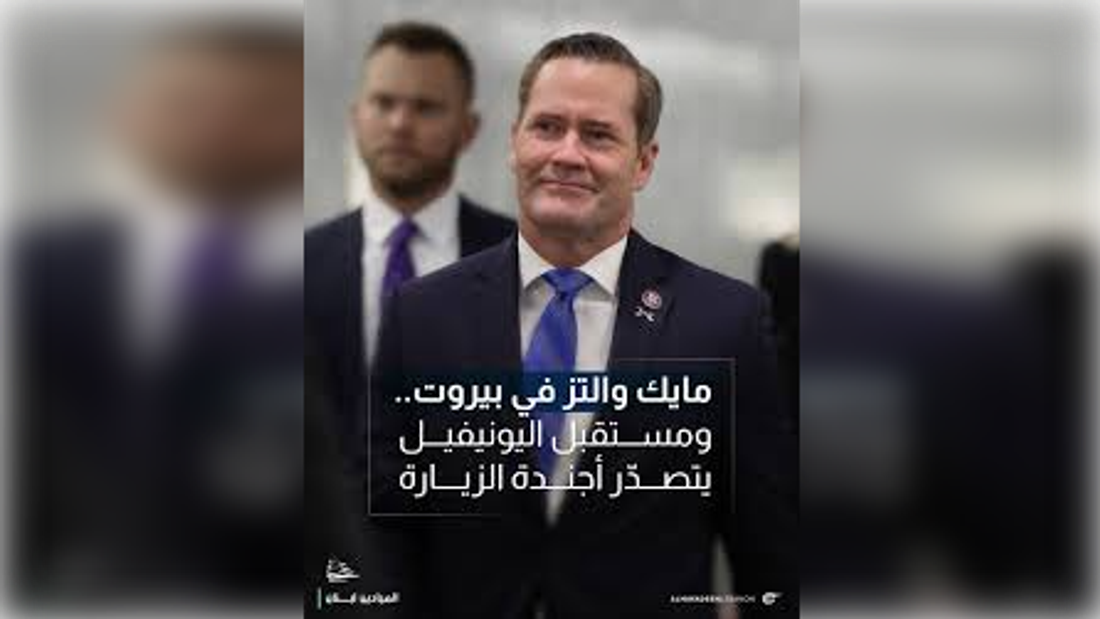
Informed political sources told Al-Liwaa that Lebanese officials will listen to what US Ambassador Mike Waltz brings to his talks with them. They said officials have no predetermined response and will wait for the proposal he presents.
The sources said Waltz would remain within the framework of the US position, emphasizing state sovereignty and the importance of ensuring that weapons are exclusively in the hands of the state.
Regarding the Framework Agreement, the sources said it is now clear that it needs to be developed. They stressed that Lebanon will reiterate the importance of the United States’ role in supporting Lebanon and pressuring Israel to stop violating the Framework Agreement and withdraw from southern Lebanon.
They described the visit as important because it is the first visit by a US official to Beirut in some time. US Ambassador Waltz may also meet Saudi envoy Prince Yazid bin Farhan, who is currently in Lebanon.
Parliament Speaker Nabih Berri is scheduled to receive Ambassador Waltz and hear the US proposal before deciding on the appropriate course of action.
Berri said that the best option would be for UNIFIL to remain, although the Americans and Israelis reject the continuation of its mission.
He described the situation as unclear, saying that Lebanon’s future course cannot be separated from developments in the wider region and is closely linked to the regional picture. He also called for a positive relationship between the president and Hezb0llah.
In this context, Hezb0llah warned against Lebanon agreeing to internationalize the “Framework Agreement” and turn it into a UN Security Council resolution, which, in practice, would mean replacing Resolution 1701.
According to Hezb0llah, the danger of the US initiative lies in the fact that the Framework Agreement was never submitted to the Cabinet or Parliament. Consequently, it is not an agreement that the Security Council can adopt and transform into an international resolution, unlike the November 27 agreement, which was signed by the Lebanese government.
Hezb0llah therefore believes that Lebanon should completely withdraw from the Framework Agreement and return to the November agreement, which effectively represents the implementation of Resolution 1701, enjoys international and UN legitimacy, and preserves the role of the United Nations Interim Force in Lebanon.
According to An-Nahar Waltz is scheduled to hold meetings today and tomorrow with Presidents Joseph Aoun, Nawaf Salam and Nabih Berri, as well as Lebanese Army Commander General Rodolphe Haykal.
Reports suggest that he may propose a model similar to the Multinational Force and Observers (MFO) in Sinai, under US sponsorship. The discussions are also expected to address the exclusive control of weapons by the state and investigations into security-related cases, raising renewed questions about the state's authority and its limits.
Information also indicates that Waltz’s visit is not limited to discussing the post-UNIFIL arrangements but is intended to push for transforming the Framework Agreement into an international resolution.
Al-Joumhouria reported that intensive consultations have taken place at several political and official levels, with the central objective of reaffirming a unified Lebanese position among all official institutions.
This position firmly upholds Resolution 1701 and calls for UNIFIL to remain in its area of operations in southern Lebanon under the UN mandate. Lebanon, in principle, rejects accepting any alternative force, regardless of its nationality or how friendly its contributing countries may be, outside the framework of the United Nations.
A senior official told Al-Joumhouria: “So far, no serious proposal or idea has emerged that would fill the vacuum left by UNIFIL under the UN flag.”
The official stressed that Lebanon’s position is unified in rejecting any alternative to UNIFIL operating outside the UN framework.
He added that this position will be formally communicated to US envoys and other representatives, along with Lebanon’s advance rejection of any proposals that fail to give the UN framework the central role in any alternative force.
Al-Anbaa reported that Waltz’s visit was preceded by leaks and hints about the ideas he might bring forward regarding an alternative to UNIFIL. It remains unclear whether these ideas will receive French approval.
Earlier reports suggested that France was working on an alternative formula for UNIFIL in coordination with the United States, although the details of the proposed project have yet to emerge.
The ideas reportedly being discussed are inspired by the Camp David Agreement in Sinai. They involve dividing southern Lebanon into designated zones in which weapons and military formations would be regulated, relying on small monitoring teams, a multinational force, or technological surveillance and field verification, alongside the deployment of the Lebanese Army.
The newspaper added that the proposal to establish forces similar to the Multinational Force and Observers (MFO) in Sinai must be considered in light of the circumstances under which that force was created.
The MFO was established following the signing of the Camp David peace agreement between Egypt and Israel. Therefore, the Sinai experience cannot simply be applied to Lebanon, where no peace agreement exists with Israel.
Furthermore, the issue currently lacks even a minimum level of national consensus, particularly while Israeli occupation of Lebanese territory continues and bloodshed persists.
Al-Anbaa also revealed that Ambassador Waltz met with UNIFIL leadership in southern Lebanon, saying: “I am here to listen to the facts about the transition period.”
Meanwhile, Al-Diyar quoted ministerial sources as saying that, so far, there is no unified approach between the Americans and Europeans regarding alternative forces.
While Europe supports extending UNIFIL’s mandate, or having French and Italian forces form the backbone of any new force, the United States and Israel categorically reject these proposals.
Instead, Washington and Tel Aviv are pushing for the Framework Agreement to govern the new reality in southern Lebanon, and prefer that it even replace UN Security Council Resolution 1701.
The sources added that it remains unclear what Waltz will propose to Lebanese officials, who have prepared a unified approach to the issue.
They explained that the Lebanese officials are aware that presenting more than one Lebanese proposal to the Americans would effectively allow Washington to impose a ready-made arrangement on Beirut, without leaving Lebanon much room to reject it.
The sources indicated that the three presidents are in agreement on the need to uphold Resolution 1701, considering that the Framework Agreement does not clearly provide for an Israeli withdrawal from occupied Lebanese territories.
However, they remain open to the possibility of having a single force responsible for implementing the international resolution, as well as the tripartite agreement.
According to information obtained by Nidaa Al-Watan, Waltz is carrying a new US proposal to establish a mixed civilian-military monitoring force, similar to the force operating in Sinai, under American supervision.
This comes after Lebanon rejected, during the Tampa negotiations and subsequent talks and contacts, a proposal to rely on observers from non-governmental organizations (NGOs).
The US envoy is expected to discuss this proposal with Lebanese officials, foremost among them President Joseph Aoun.
In response, Lebanon intends to raise a series of questions before providing its final answer. These will concern the proposed force’s nature, composition, size, scope of authority, intervention mechanisms, operational boundaries, and relationship with the Lebanese state and its army.
Although the multinational force in Sinai has been successful in carrying out its mission, comparisons between the two situations face a fundamental difference: Egypt and Israel are bound by a peace treaty, whereas negotiations between Beirut and Tel Aviv are still ongoing, without any final settlement having been reached.
If you wish, I can also prepare a concise English news briefing highlighting the key developments and the differences between the Lebanese, American and European positions.


