
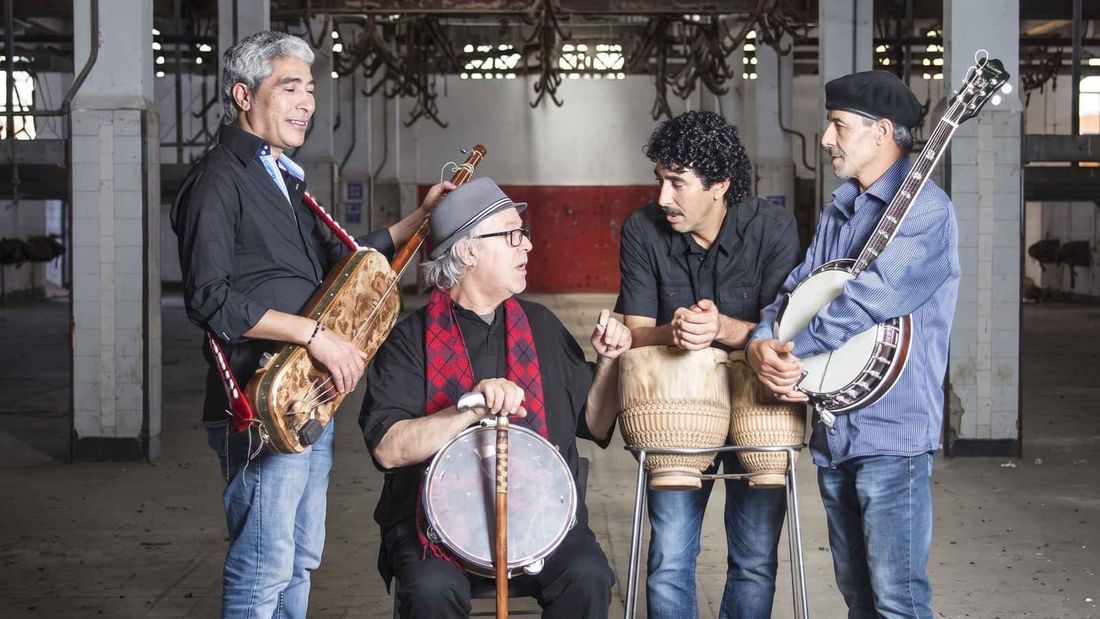
The enduring local and international presence of Morocco’s legendary band “Nas El Ghiwane” over six decades reflects the prestigious artistic position it has secured among audiences in Morocco and around the world.
European audiences are preparing to watch a film about the band’s beginnings. Founded in the 1960s, the group has been selected as part of a cinematic program representing aspects of African culture.
The band’s international presence comes at a time when its classic songs continue to attract younger generations, as reflected in their engagement across various digital streaming platforms.
The band’s ability to evolve and remain active on the music scene by bringing in new members following the deaths of some of its stars is one of the key reasons “Nas El Ghiwane” continues to appear on stages and social media platforms widely used by younger audiences.
With hundreds of thousands of followers and millions of listens and views of its concerts in Morocco and abroad, the band attracts audiences from different generations, including those who witnessed its early days and those who have only recently joined its fan base.
This diversity in the band’s audience, both in terms of age and geography, is evident in the comments left by many new listeners of its famous songs, such as “Al-Siniya.” They often use these comments to greet the band members and mention their own countries, which may be in either the eastern or western Arab world.
One user commented on one of “Nas El Ghiwane’s” songs: “You might be surprised, but I belong to the new generation, the 2000s generation. These songs, along with Andalusian and Malhoun music, are my eternal love. I simply cannot go without listening to them.”
Another user shared a similar sentiment on YouTube: “We did not live in their generation, but they live in the hearts of every generation. That is what timeless art is.”
𝗔 𝗠𝗶𝘅 𝗼𝗳 𝗛𝗲𝗿𝗶𝘁𝗮𝗴𝗲 𝗮𝗻𝗱 𝗠𝗼𝗱𝗲𝗿𝗻𝗶𝘁𝘆
“Nas El Ghiwane” preserves the authenticity of its music by remaining committed to lyrics and melodies rooted in Morocco’s musical heritage, while embracing modernity through its ability to adapt to the tastes of contemporary generations and maintain an active digital presence.
The band’s fame in Morocco and around the world was initially driven by its melodies and lyrical expressions, which draw on Sufi heritage and folk poetry. Its music also delves into the spiritual atmosphere deeply rooted in Moroccan tradition, particularly the art of “Malhoun,” as well as the African musical heritage embodied in “Gnawa.”
The band’s beginnings date back to the working-class neighborhood of Hay Mohammadi in Casablanca, where “Nas El Ghiwane” emerged in the 1960s. Its name can be considered a local alternative to the expression “People of Insight.” The group went on to create a unique chapter in the history of Moroccan and Arab music, distinguished by its melodies, depth, and commitment to addressing the concerns of ordinary people.
Millions of listeners, particularly in Morocco, soon found themselves reflected in the band’s lyrics and rhythms, including songs such as “Allah Ya Moulana,” “Wain Ghadi Bia Ya Khouya,” “Ya Jamal Shadd Jamalak,” and “Mahmouma.” The band drew its musical influences from across Morocco, a country characterized by its rich Arab, Amazigh, African, and Andalusian cultural diversity.
The success of “Nas El Ghiwane” was not limited to the band itself. Its approach to presenting Moroccan musical heritage through a contemporary, youthful spirit inspired other Moroccan artists to establish similar groups and musical projects, including “Jil Jilala” and “Al-Mashahib.”
The band’s popularity also prompted critics and figures from various fields, including poets, writers, researchers, and media professionals writing in different languages, to explore its unique experience. Its success has often been linked to its roots in the deeply embedded traditions of everyday life, which it transformed through a blend of beauty and modernity while reflecting people’s emotions, concerns, and aspirations.
Today, the band continues its journey with Omar El Sayed and Allal Baali, two of its founding members who remain alive, alongside Abdelaziz Tahiri. They carry on following the deaths of Boujemaa Ahkour, known as “Boujemi,” who was regarded as the band’s spiritual father alongside “Larbi Batma,” whose voice was distinctive, as well as Abderrahmane Qirouch, nicknamed “Paco,” and Mahmoud Saadi.
Nevertheless, the band’s presence in recent years cannot be compared with its golden era between the 1960s and 1990s, when it achieved international fame. This was before hip-hop and rap became alternative musical genres for many Moroccan audiences. The band was also affected by the deaths of three of its five founding members, who were subsequently replaced by Rachid Batma and Hamid Batma.


