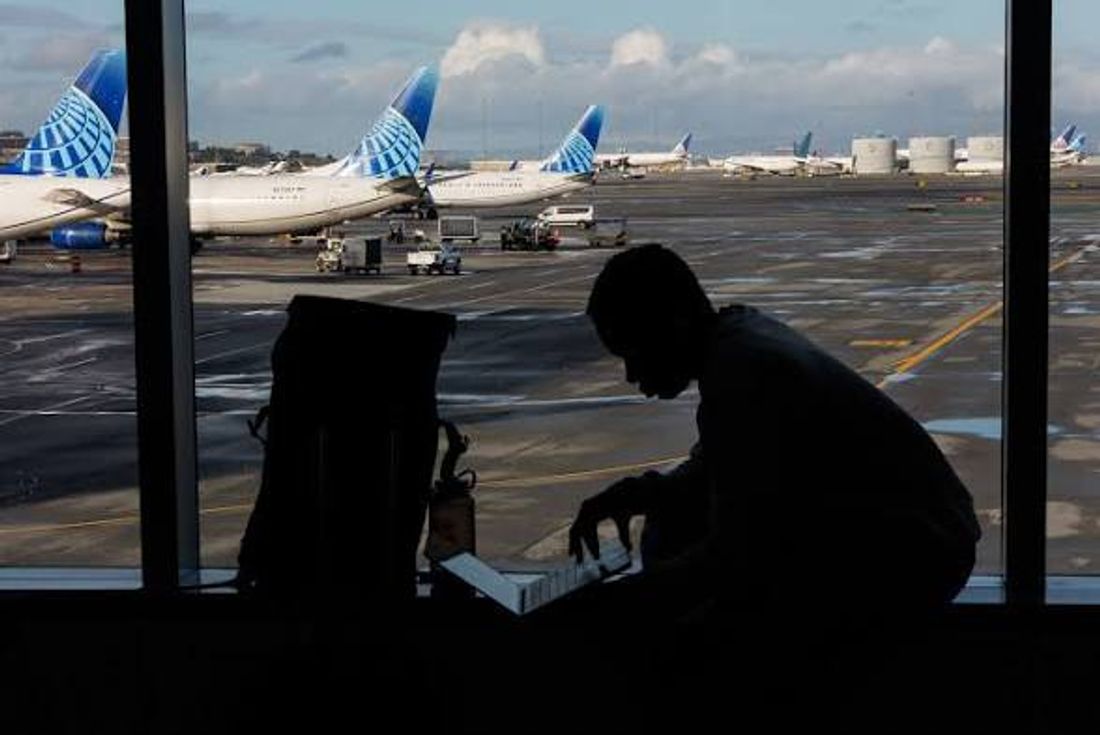
Government officials and the artificial intelligence company behind the technology have confirmed that the decision to halt flights, which has caused widespread travel disruptions since Friday, was not related to the new SMART system, costing $875 million, which the US Federal Aviation Administration (FAA) is rolling out to help predict problems in the nation’s airspace.
However, the timing of the flight ground stop, shortly after the system’s nationwide launch, has raised questions about how it works, its benefits and risks compared with the existing human-based system, and the safeguards in place to address potential problems.
The SMART system operates from a single location near Washington, where a team of experts analyzes flight schedules, weather forecasts and hundreds of other data streams. The center then sends recommendations to the FAA command center, which relays them to air traffic controllers across the country for consideration.
Homeland Security Secretary Markwayne Mullin said on Friday that there was no indication that the communications problems behind the flight ground stop were connected to the new computer system. Senior officials at the Department of Transportation and the FAA reiterated this position on Saturday.
The startup that developed the system, Air Space Intelligence (ASI), also confirmed that the flight ground stop was not caused by “the SMART system, any ASI product, or our integration with the FAA and air traffic control.”
However, members of Congress and outside groups had raised questions about the system even before Friday’s flight ground stop. Last month, House Democrats sent a letter to the US Government Accountability Office (GAO), requesting an audit of the new software and expressing concerns about safety and regulatory safeguards.
The letter, dated October 13, stated:
“Concerningly, the nation’s front-line aviation safety workforce apparently had little to no input into SMART’s development and have received limited training and information during the current deployment process.”
It added: “The use of artificial intelligence within SMART has rightfully raised serious questions about its reliability and safety benefits, particularly regarding its potential to interfere with decision-making by experienced air traffic controllers or to hallucinate safety-critical information.”
However, the SMART system does not, at least for now, allow artificial intelligence to take control of flight operations. Instead, it is limited to providing recommendations to human personnel, who remain responsible for making and implementing decisions.
## **What Is the SMART System?**
Transportation Secretary Sean Duffy and FAA Administrator Bryan Bedford unveiled the system in September, describing it as a “cutting-edge tool that centralizes 200 data streams—including weather patterns, flight paths, traffic flow, and controller staffing metrics—into one platform.”
SMART stands for Strategic Management of Airspace, Routes and Trajectories.
The system uses an AI-powered engine to integrate data from different systems and provide a comprehensive picture of aircraft routes, the volume of air traffic the system can handle, and areas where congestion or weather conditions could cause problems.
According to the announcement, specialists are expected to use the platform to address problems before they occur.
The FAA said that during the system’s initial testing in the Washington area this fall, it helped reroute 180 flights, saving an average of 10 minutes and 80 gallons of fuel per flight by diverting aircraft around adverse weather conditions and other problems.
The agency added that one flight saved 42 minutes on its journey from Tampa, Florida, to Dallas, thanks to the system’s recommendations.
On November 10, the use of SMART was expanded nationwide to cover all 22 air traffic control centers, just three days before the flight ground stop.
According to a government fact sheet on the system, SMART can predict where air traffic is heading and identify alternative routes before an area becomes excessively congested.
It can also help reopen restricted airspace more quickly and improve the management of aircraft arrivals at airports.
The system is also expected to help address weather-related disruptions more efficiently.
Currently, the FAA closes sections of airspace affected by weather by designating “large, rectangular boxes,” according to the fact sheet. This approach does not accurately reflect the actual shape of weather systems, as fast-moving thunderstorms and other weather patterns are often irregular in shape, with narrow gaps or corridors through which aircraft could safely fly.
To address this problem, SMART provides the FAA and airspace operators with a clearer picture of how weather conditions will affect air traffic over time. This allows air traffic controllers to plan around storms and make use of available airspace rather than unnecessarily shutting down large areas.
A former FAA airspace manager and associate professor at Embry-Riddle Aeronautical University said that no other country currently has an operational AI-powered air traffic management tool comparable to SMART.
He noted that Eurocontrol, the European air traffic management authority, has a system undergoing testing, while several manufacturers are developing similar tools.
## **Concerns About Relying on Artificial Intelligence**
Despite assurances from government officials and ASI, the company behind SMART, that the artificial intelligence system was designed to assist humans rather than take control of flight operations, its launch has raised concerns about relying on AI in a field where decisions directly affect human lives.
These concerns stem from the fact that even the most advanced AI models remain vulnerable to what is known as “hallucinations”—the generation of false or fabricated information presented as fact.
Mike O’Donnell, a former senior FAA official who worked for the agency for 17 years and now works as an aviation safety consultant, said:
“The agency has got to make sure that this is just a tool in the toolbox and not the actual machine that’s doing the work.”
He added that the FAA “cannot afford to be wrong on this.”
O’Donnell continued:
“It’s good to use it with the proper guardrails and backstops to ensure that they’re not giving wrong information to controllers based on what AI has come up with.”
He added: “There has to be a way to verify and validate what it is doing to make sure that it is not providing incorrect information.”
He also cautioned against placing too much trust in artificial intelligence “until we know for sure that it has proven itself time and time again,” noting that this would take time.
The launch of the AI system comes amid a longstanding shortage of air traffic controllers across the United States.
The National Air Traffic Controllers Association has been warning about this problem for more than a decade. In 2015, it told Congress that the shortage had reached crisis levels, noting that the FAA had failed to meet its hiring targets for five consecutive years.
The union represents approximately 14,000 air traffic controllers, including around 3,000 trainees.
Nevertheless, experts emphasize that no artificial intelligence system can replace human air traffic controllers, who spend years training to acquire the skills required for this highly demanding and stressful profession.
In an interview with NPR in October, Phillip Buckendorf, co-founder and CEO of ASI, said that the SMART tool was specifically designed for traffic managers responsible for overseeing the entire US airspace.
Buckendorf explained:
“The AI does the math, the AI does the computation,” but the final decision remains with the human operator, who can either accept or reject the system’s recommendations.
“They make the decision; they are the decider, they are the judge,” he added.