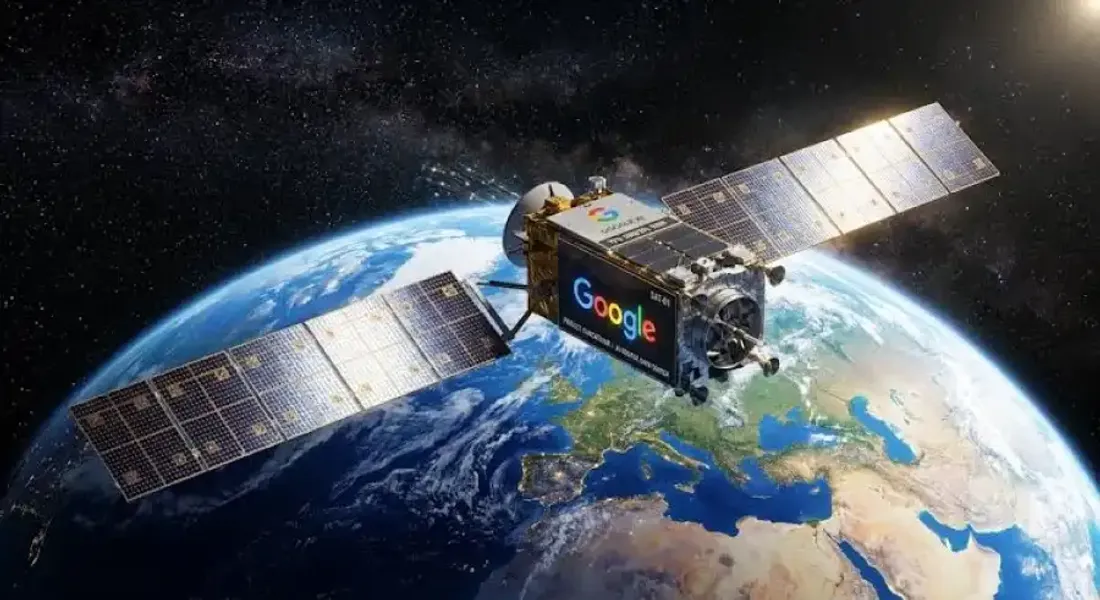
Major technology companies are exploring new frontiers for operating artificial intelligence infrastructure amid rapidly growing demand for processing capabilities and electricity.
In this context, Google is betting on space as a potential location for hosting future data centers through a research project called Project Suncatcher.
The project aims to establish networks of satellites equipped with specialized artificial intelligence processors, powered by solar energy and interconnected through laser links. This would enable advanced computing operations far beyond the limitations facing traditional data centers on Earth.
𝗧𝘂𝗿𝗻𝗶𝗻𝗴 𝘁𝗼 𝗦𝗽𝗮𝗰𝗲
Google's vision is based on a key advantage offered by low Earth orbit: the ability to access sunlight for longer and more consistent periods compared with locations on the ground. According to the company's estimates, solar panels in certain orbits could generate up to eight times more energy annually than their ground-based counterparts.
Google believes that harnessing this advantage could reduce dependence on terrestrial electricity grids and enable the expansion of computing capabilities required to operate and train artificial intelligence models, particularly as data centers continue to consume increasing amounts of energy.
The technical concept involves equipping satellites with processors developed by Google and connecting them through optical communication technologies that use lasers to exchange data at high speeds between satellites positioned close to one another in orbit.
𝗙𝗶𝗿𝘀𝘁 𝗢𝗿𝗯𝗶𝘁𝗮𝗹 𝗧𝗲𝘀𝘁
The project has moved beyond theoretical research into practical testing. On October 1, 2026, Google launched an experimental prototype in collaboration with Planet, aboard a launch mission operated by SpaceX.
The prototype includes four Tensor Processing Units (TPUs) and aims to test the hardware's ability to withstand launch-related vibrations, exposure to cosmic radiation, and extreme temperature fluctuations in space.
According to technology reports, the prototype successfully ran a computing task using the Gemma 4 artificial intelligence model and transmitted the results back to Earth, marking an initial step toward demonstrating the feasibility of operating AI applications in orbit.
Google plans to continue testing, with the launch of two additional experimental satellites targeted for 2027 to test high-speed laser communications between satellites.
𝗧𝗵𝗲 𝗠𝗮𝗷𝗼𝗿 𝗢𝗯𝘀𝘁𝗮𝗰𝗹𝗲
Despite the promising technological potential, the path toward establishing commercial data centers in space is unlikely to be easy. Manufacturing, launch, and maintenance costs remain among the most significant obstacles to turning the concept into an economically viable and scalable project.
Amanda Peterson Corio, Google's Global Head of Energy and Data Centers, estimated that building data centers in space could cost up to 100 times more than constructing comparable facilities on Earth.
Google's research estimates suggest that reducing the cost of launching payloads into low Earth orbit to approximately $200 per kilogram by the mid-2030s could make the project's economics more competitive.
However, this equation remains dependent on advances in launch technologies and the ability to reduce manufacturing and operational costs.
𝗖𝗼𝗺𝗽𝗹𝗲𝘅 𝗘𝗻𝗴𝗶𝗻𝗲𝗲𝗿𝗶𝗻𝗴 𝗖𝗵𝗮𝗹𝗹𝗲𝗻𝗴𝗲𝘀
Beyond the financial burden, the concept faces equally significant technical challenges. Space does not provide the air required for conventional cooling systems, making it necessary to rely on thermal radiators and heat pipes to dissipate the energy generated by processors.
Space radiation can also cause errors in electronic chips, while communications between satellites require high precision and substantial data-transfer capabilities.
Maintenance presents another challenge, as repairing equipment or replacing damaged components in orbit is considerably more complicated and expensive than carrying out the same operations in terrestrial data centers.
𝗧𝗵𝗲 𝗥𝗮𝗰𝗲 𝗳𝗼𝗿 𝘁𝗵𝗲 𝗙𝘂𝘁𝘂𝗿𝗲
Google's project reflects a shift in thinking about the future of artificial intelligence infrastructure, but it does not mean that terrestrial data centers will disappear anytime soon.
While space offers an opportunity to harness solar energy and reduce some of the constraints associated with securing electricity on Earth, economic viability and operational reliability remain decisive factors.
Therefore, the success of Project Suncatcher will depend not only on proving that processors can operate in orbit, but also on demonstrating that running them there can be economically and practically competitive with traditional data centers.
Until then, the project will remain a long-term technological bet rather than a ready-made alternative to Earth's digital infrastructure.
𝗦𝗼𝘂𝗿𝗰𝗲: Erem News