
Democratic Governor Gretchen Whitmer championed them as essential to attracting the facilities fueling the artificial intelligence boom to the state.
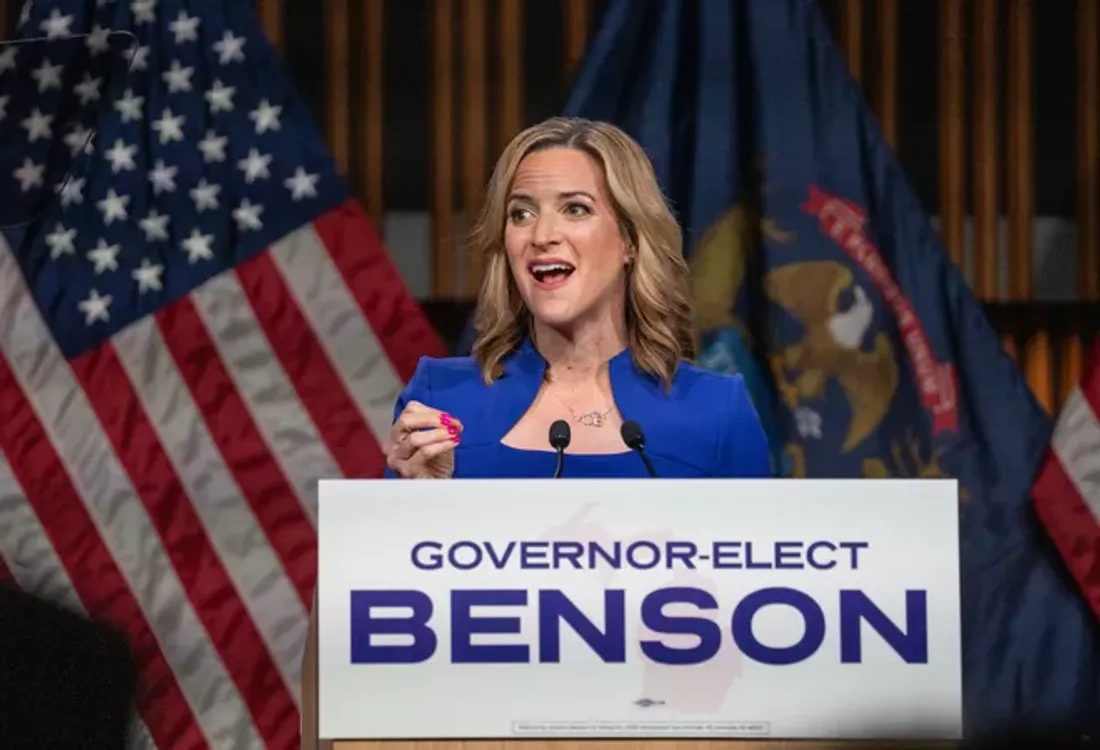
During her campaign, Governor-elect Jocelyn Benson promised guardrails for data centers, calling for greater environmental protections and ensuring that Michigan residents' electricity bills do not rise due to the massive energy demand from these facilities.
She also promised in a video: "We will ban them from getting tax breaks."
Alyssa Bradley, a spokesperson for Benson’s transition team, did not go into the specifics of the tax changes Michigan's incoming governor is eyeing.
Whitmer had signed legislation exempting data center construction and equipment purchases from state sales and use taxes, a law lawmakers passed in 2024 amid widespread controversy. Data centers are also eligible for various property tax benefits in Michigan. Thirty-eight states currently offer some form of tax exemptions for data centers, according to the National Conference of State Legislatures.
Lawmakers have already introduced bills to repeal the data center tax exemptions, though those proposals have stalled in Lansing, and the legislative agenda for the remainder of the year remains unclear.
Benson, a Democrat, will take office at the beginning of 2027 alongside a large Democratic majority in the Michigan Legislature, though public backlash against data centers enjoys bipartisan support.
Supporters: Tax Breaks Attract Data Centers
During the legislative debate over data center tax exemptions two years ago, opponents raised concerns that bringing more of these facilities to Michigan would hinder the state's transition to clean energy and drive up electricity bills. Democrats who initially supported the legislation later reversed their stance. The tax exemptions took effect in April 2025, and several months later, OpenAI, the developer of ChatGPT, announced plans to build a massive data center in Saline Township, near Ann Arbor.
In a press release at the time, Whitmer’s office credited the tax exemptions as a "key factor" in attracting the data center to Michigan.
Since then, public protests against data centers have escalated, and polls throughout the recent election cycle showed strong opposition to data centers in Michigan and support for stricter regulations.
Now, Lansing could witness a highly unusual development: a governor repealing a law signed by her predecessor from the same political party. Whitmer's office did not respond to a request for comment regarding the possibility of Benson repealing the data center tax exemptions. A legislative push to repeal these exemptions could see lawmakers who previously supported them vote to overturn them.
Abby Clark, Michigan Director of Government Affairs for the Natural Resources Defense Council, said the likelihood of this sudden policy reversal partly reflects rapid public opposition to data centers. She explained that in 2024, when data center tax breaks were put to a vote in the Michigan Legislature, most people were unfamiliar with these facilities. Now, however, it has become a "top-tier" political and economic issue after data centers arrived in neighborhoods near Americans' homes, and AI technology has come to shape global financial markets.
Clark added: "Changing policies to adapt to changing circumstances is a core job of our policymakers."
Mixed Views on Repealing the Tax Exemptions
State Senator Kevin Hertel, a Democrat from St. Clair Shores who sponsored the legislation creating the use tax exemption, said the exemptions also include water and energy usage standards.
"If you repeal them, you repeal those requirements too," Hertel explained. He added that policy action on data centers should focus on adding further guardrails rather than pulling back the tax breaks. Hertel was among the co-sponsors of bills introduced earlier this year to set new standards for data centers, including strict caps on how much water a facility can use, construction labor requirements, new rules on electricity consumption and how data centers pay for those costs, among other measures. Those bills have not advanced in the current legislature, though they could get a strong push under full Democratic control of the executive and legislative branches next year.
"I think that is the starting point," Hertel said.
For her part, State Senator Rosemary Bayer, a Democrat from West Bloomfield and a former computer software engineer who voted against the exemptions, welcomed the prospect of banning data center tax breaks, though she will not serve in the next legislative session after declining to run for re-election.
"We desperately need to tax the richest companies in the world," Bayer said.
Conversely, State Representative Joey Andrews, a Democrat from St. Joseph who introduced the data center sales tax exemption bill signed by Whitmer, said he does not support repealing the law, describing it as an effective ban on these facilities and noting they would not set up shop in Michigan without the exemptions. "To me, that is the wrong answer," he said.
Andrews has backed legislation requiring data centers to enter into community benefits agreements, prohibiting local officials from signing non-disclosure agreements related to the projects, as well as other safeguards. However, he still wants these facilities to come to Michigan, describing them as a boon to the construction sector and public coffers. Andrews added that it also shows that "Michigan is open for business" and wants to be home to a fast-growing sector.
Clark pointed to the large deficit in the state budget resulting from federal cuts, highlighting data centers as a source of tax revenue, asking: "But as long as we are giving them massive tax breaks at the state and local levels, what is the point of having them?"
While data centers provide short-term jobs to build the facilities, they do not create a significant number of long-term jobs.
A Look at Data Center Development in Michigan
According to a report by the Michigan Strategic Fund, 2,972 "data center industry jobs or related jobs" were created in Michigan between January 1, 2016, and December 1, 2025. This period does not cover the start of major construction activity on recent hyperscale data center projects.
Construction continues on the $16 billion data center in Saline Township, Michigan, on Thursday, September 10, 2026. Known as "The Barn," the center is being built on former farmland by Related Digital, a division of Related Companies.
Alongside the project in Saline Township, work is underway on other massive data centers at varying stages of progress across Michigan. Initial construction has begun in Van Buren Township for a massive data center to be operated by Google. Microsoft has also purchased land in West Michigan with the goal of opening data centers in Lowell, Dorr Township, and Gaines Township. Verrus is looking to partner with construction firm Walbridge to build a 1.8-million-square-foot data center campus in Lyon Township. Additionally, the University of Michigan and Los Alamos National Laboratory are planning a data center to support research in Ypsilanti Township.
Tyler Theile, Vice President and Chief Operating Officer at the East Lansing-based Anderson Economic Group, echoed Andrews' remarks, noting that the use and sales tax exemptions for data centers make Michigan an attractive destination for developers.
Theile added that Michigan would miss out on investments from major tech companies if it backed away from its current tax structure. Despite sometimes fierce opposition to local data center proposals, Theile said developing a new data center can spur property tax revenues that can be reinvested directly into the local community right now.
"There are only going to be so many major hubs" for data centers, Theile concluded, adding that amid an aging population and stagnant population growth, "Michigan needs more economic development."


