
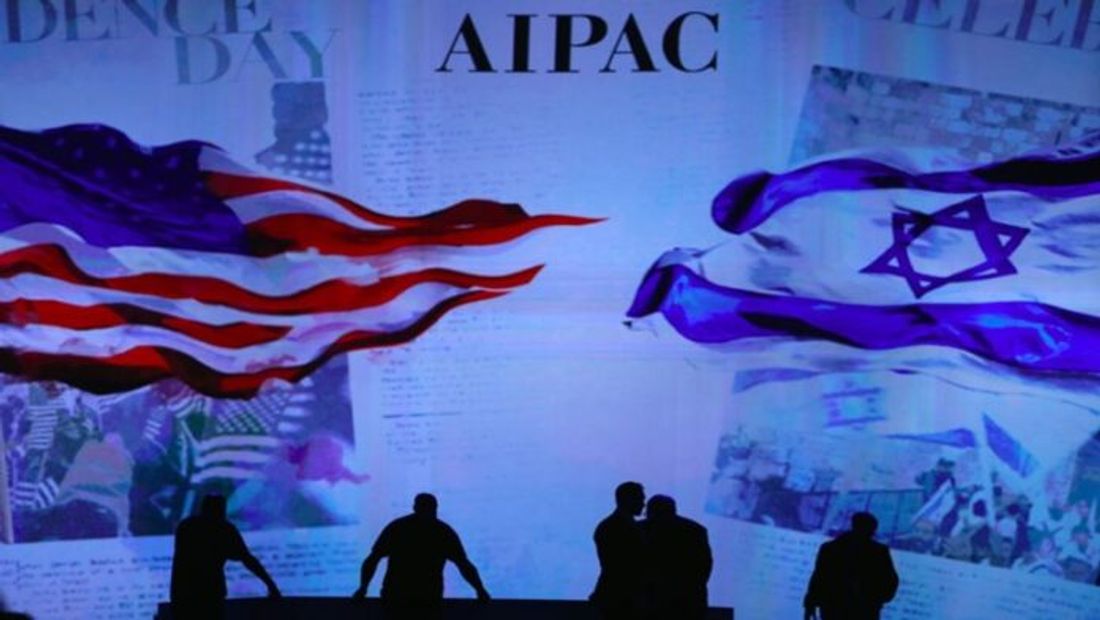
The American news website The Intercept affirmed that the American Israel Public Affairs Committee (AIPAC) has not backed down from interfering in U.S. elections and supporting pro-Israeli occupation candidates in the midterm congressional campaigns, continuing to work behind the scenes to shape the upcoming Congress. The site revealed that hundreds of candidates are receiving financial support from AIPAC, albeit covertly.
Previously, a prominent figure influential in outside electoral spending stated that "supporting Israel is sound policy and winning policy," but in this midterm election cycle, AIPAC's strategy is proving otherwise, it seems.
Contrary to its famous motto, the name "AIPAC" has become toxic among voters across the political spectrum who are disgusted by Israel's genocide in Gaza and frustrated by the influx of military aid from Washington to a foreign government while domestic costs soar.
Consequently, AIPAC is moving underground. As The Intercept reported in December, AIPAC entered the 2026 midterm elections by returning to its strategic roots—funding other groups and unifying donor efforts, rather than focusing on direct spending on candidates, as AIPAC announced it would not officially endorse or contribute directly to candidate campaigns.
Although progressives welcomed this announcement as evidence of AIPAC's decline, it is by no means an indicator of retreat, and the group is expected to continue its massive spending on elections through its super PAC, which has exploited campaign finance loopholes to conceal its involvement in numerous electoral races this cycle even after the elections conclude. The site quoted Lara Friedman, president of the Foundation for Middle East Peace, as saying that AIPAC's choice of ambiguity shows that "its brand has become a political liability."
The site questioned the extent of real change. Even as AIPAC changes its strategy, a new project by The Intercept reveals hundreds of candidates still receiving its funds, as well as how those funds are funneled on their behalf. Data indicates that despite the weakening of this pro-Israel behemoth, it remains dominant. The Intercept tracked the group's spending and that of its political action committee on elections to place pro-Israel candidates on the ballots for this year's midterms, including funds it attempted to conceal from the public.
While AIPAC uses a series of new vehicles, it is still pumping millions of dollars directly into the 2026 midterm elections.
The new data builds on a 2024 project in which The Intercept documented how AIPAC influenced the composition of the previous Congress. At that time, Donald Trump was preparing to return to the presidency, while Kamala Harris was running a campaign marred by public resentment over the Biden administration's steadfast support for Israel's genocide in Gaza.
For critics of Israel who tried hard to stop the violence, both parties seemed equally vague and grim, and the influence of pro-Israel lobbying groups in Congress appeared entrenched and unshakable. However, the situation differed in this election cycle; the primary elections across the U.S. witnessed the victory of candidates after they pledged to cut or restrict military aid to Israel, and incumbents signed legislation blocking arms transfers in an effort to retain their seats.
Nevertheless, the site emphasizes that this shift should not be exaggerated: AIPAC has continued to provide support in about three-quarters of the electoral races, and its candidates still win the majority of the time.
AIPAC or its affiliated political action committee, known as the "United Democracy Project," spent to support 333 out of 473 seats up for election this year.
Expenditures from AIPAC and its PAC constituted the lion's share of known electoral spending by the pro-Israel lobby, at $53.3 million from AIPAC and $66.7 million from its PAC, compared to $53.7 million and $41.4 million in the previous election cycle.
Meanwhile, the two groups adopted another approach: making it harder to determine which elections they participated in supporting. Donors poured money into races where AIPAC did not officially announce any candidate endorsements. The chairman of AIPAC's board hosted a fundraiser for a candidate who swore the group was not supporting her. In a series of races, no one was certain of AIPAC's spending until after the elections were over.
The group also tested different strategies in multiple states, spending directly in the Michigan Senate race, for example, while concealing its spending in several other primaries. In those primaries, its PAC provided funds to other committees, including a series of "pop-up PACs"—groups registered just prior to primary elections, allowing them to delay disclosing their donors until after the election. Many of these groups received funds from AIPAC's super PAC, spent them on ads against candidates critical of Israel, and then vanished.
Pop-up committees and financial transfers represent AIPAC's newest and most controversial tactics, but the lobby group and its main super PAC still spend the bulk of their money in key electoral races and top-priority states.
However, AIPAC's largest investment in the primaries turned into a disappointment. Its PAC spent more than 30 million dollars on ads attacking Democratic candidate Abdulrahman El-Sayed in the Michigan Senate race, or supporting his rival, Representative Haley Stevens. Now, with El-Sayed as the Democratic nominee, the PAC is waging a fierce battle against him in the general election against Republican Mike Rogers, having spent just over $500,000 so far.
Thanks to this massive spending, the race between El-Sayed and Stevens was one of the most prominent primaries of 2026, pitting an outspoken critic of the pro-Israel lobby—who could become the first Muslim U.S. senator—against an enthusiastic recipient of AIPAC donations who once said, "Israel comes to me in my dreams."


