
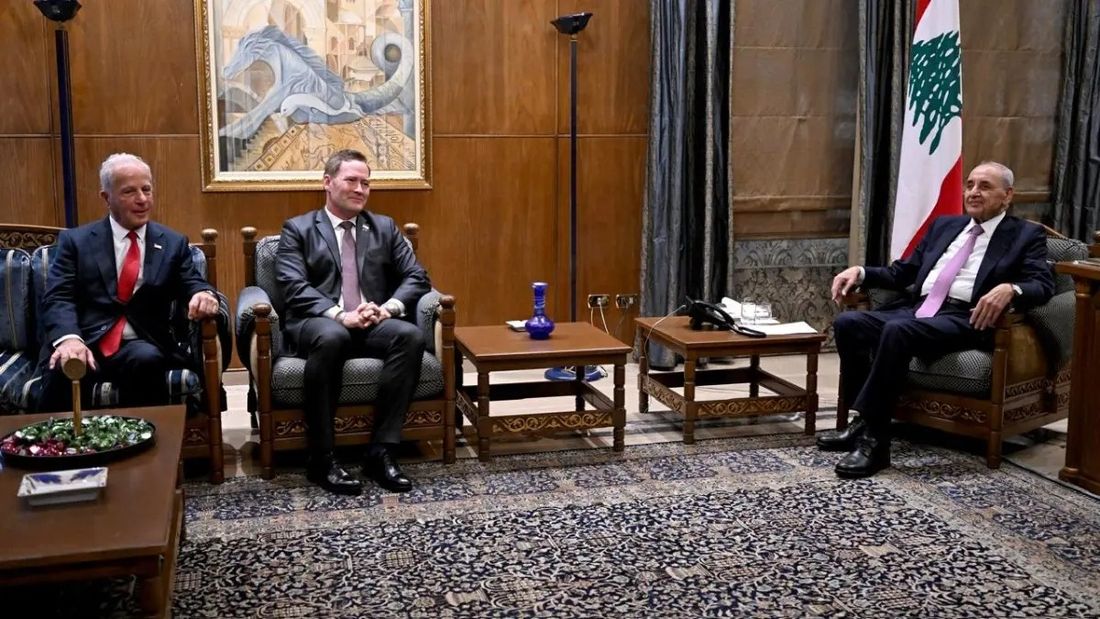
US envoy to Lebanon and Washington’s Ambassador to the United Nations, Michael Waltz, said that amending UN Security Council Resolution 1701 has become inevitable, amid moves to end the mandate of the United Nations Interim Force in Lebanon (UNIFIL) in southern Lebanon and discussions about establishing a new international force with a different composition and mandate.
Alongside this issue, Waltz made his position on Hezb0llah’s weapons clear, stressing that Lebanon cannot have two armies and expressing hope that the group would voluntarily hand over its weapons.
Waltz made these remarks following a series of meetings in Beirut with President Joseph Aoun, Parliament Speaker Nabih Berri, and Prime Minister Nawaf Salam. The discussions focused on the future of the international presence in southern Lebanon, Lebanon’s vision for a force to replace UNIFIL, the Lebanese Army’s role in implementing future security arrangements, the US-sponsored Framework Agreement signed between Lebanon and Israel, and the issue of exclusive state control over weapons.
However, the fact that Lebanese Army Commander General Rodolphe Haykal was not included in Waltz’s schedule of meetings was a notable aspect of the visit, particularly since the military institution will be central to any new security arrangement.
Waltz began his tour in the morning at the Presidential Palace in Baabda, where he was received by President Aoun in the presence of US Ambassador to Lebanon Michel Issa and the accompanying delegation. Former Ambassador Simon Karam, head of the Lebanese delegation to the Lebanese-Israeli negotiations, also attended the meeting.
The talks addressed developments in Lebanon and the region, the period following the end of UNIFIL’s mandate, and the situation in the south in light of continued Israeli attacks and Israel’s failure to comply with the provisions of the Framework Agreement, according to a brief statement issued by the Presidency. The statement outlined the main topics discussed without providing further details.
From Baabda, Waltz headed to the Grand Serail to meet Prime Minister Nawaf Salam. The statement issued by the Prime Minister’s Office was more detailed, indicating that Salam reiterated the need for an ongoing international presence in southern Lebanon under a United Nations Security Council mandate. Such a presence should include monitoring, reporting, coordination and communication, as well as supporting the Lebanese Army in carrying out its responsibilities and extending the authority of the state.
Regarding the tripartite framework, Salam stressed the need to translate the principles of reciprocity and gradual implementation into practical steps and tangible results through a clear timetable that ensures parallel progress on two tracks: Israel’s full withdrawal from Lebanese territory and the extension of state authority, with weapons restricted exclusively to the state.
He also called for establishing a credible mechanism to verify the implementation of commitments by both sides.
Salam further emphasized the importance of the US role in activating this framework in a way that ensures an end to Israeli attacks and achieves a full withdrawal. He stressed that what is required is a sustainable solution that restores Lebanon’s sovereignty, rather than merely managing the conflict.
During his final stop, at a meeting with Parliament Speaker Nabih Berri, Waltz made direct remarks on the main issues discussed during his visit to Beirut. While speaking about support for the peace process and the need to move forward, he noted that UNIFIL had cost a great deal of money over the past 20 years and that there was a need to reform the process.
From Ain al-Tineh, Waltz delivered a direct message to Hezbollah, saying:
"I believe the message should be clear and unequivocal: Lebanese sovereignty must be fully restored, and the mechanism to achieve that will be through the Lebanese Army."
Addressing Hezb0llah and its supporter, Iran, he added:
"No country can have two armies. I hope and urge Hezb0llah to disarm, and it should do so voluntarily."
Waltz said that Resolution 1701, which ended an earlier war between Hezb0llah and Israel in the summer of 2006, had provided the basis for UNIFIL’s mandate after calling for an enhanced international presence in southern Lebanon.
"We expect that to continue, with some amendments and updates, of course," he added.
Meanwhile, the omission of the Lebanese Army commander from the US envoy’s meeting schedule raised questions, particularly since discussions about UNIFIL’s future and an alternative security mechanism are directly linked to the Lebanese Army’s role, deployment and missions.
This is especially significant amid reports of US dissatisfaction with the army’s performance regarding the implementation of the state monopoly on weapons. Sources suggested that the failure to arrange a meeting with the army commander "may have been an American message."
Asked why he had not met with the army commander, Waltz replied:
"I am a diplomat here, and in my capacity as Ambassador to the United Nations, given the limited time during this visit, we felt it was extremely important to prioritize meetings with the various components of the United Nations and the political leadership."
Waltz arrived in Beirut on Sunday and visited the headquarters of the international force in Naqoura to assess the situation on the ground.
He said he had come at the request of President Donald Trump and Secretary of State Marco Rubio, amid discussions about the future of the international force, adding that the field visit had allowed him to see firsthand what was happening on the ground.
Al-Liwaa newspaper reported that Waltz had not presented Lebanese officials with any finalized proposal concerning the force that would replace UNIFIL, despite several ideas being discussed. It noted that the closest proposal under consideration was the deployment of a monitoring force tasked with overseeing implementation of the Framework Agreement and granted a UN mandate, which would require a Security Council resolution.
According to information emerging from Ain al-Tineh, the US envoy listened to an extensive presentation by President Berri on the history and reasons behind the international presence in southern Lebanon, beginning with the 1949 Armistice Agreement, followed by Resolution 425 in 1978, Resolution 1701 in 2006, and what is known as the Tripartite Framework Agreement of 2024.
Berri reportedly stressed that Israel had failed to comply with the agreement and continued its occupation and systematic destruction of homes and villages, uprooting trees, particularly olive trees, and pursuing a scorched-earth policy.
President Berri emphasized that the continued occupation, Israeli policies and airstrikes constituted the sole violation of sovereignty, adding that Israel had never complied with the ceasefire.
Sources familiar with the matter said there appeared to be alignment between Lebanon and the United States on several positions: considering Resolution 1701 the UN framework governing the situation in the south, preventing any security or military vacuum after the international forces end their mission, and continuing support for the Lebanese Army to enable it to extend state authority.
Official Lebanese sources told Asharq Al-Awsat that the US envoy had not brought any specific initiatives and called for waiting until the end of his tour and the issuance of an official statement, which might provide indications of a future initiative.
The sources explained that the Lebanese president and the US envoy had agreed on three principles:
1. There must be no UN vacuum in southern Lebanon following the end of UNIFIL’s mandate.
2. Resolution 1701 must be upheld in all its provisions, regardless of the new circumstances following the end of UNIFIL’s mandate and the introduction of any alternative arrangement.
3. Support for and strengthening of the Lebanese Army must continue so that it can carry out its duties.
For their part, ministerial sources familiar with Waltz’s meetings told Asharq Al-Awsat that the US envoy had not presented a comprehensive proposal. Instead, he asked Lebanese officials about their vision for the force that could replace UNIFIL, while emphasizing that Washington did not want the international force’s mandate to be extended in any form and that the US position on this matter was clear.
In response, the Lebanese president explained the importance of maintaining an international presence in the south. The position of the three Lebanese presidents was to welcome any new arrangement, provided it remained within the framework of Resolution 1701, which Lebanon considers the existing international reference governing the situation in southern Lebanon.
However, the same sources acknowledged that talk of an amended Resolution 1701 did not simply mean introducing technical changes to the existing resolution. Rather, it would involve ending the current structure and working toward an alternative international arrangement combining the framework of Resolution 1701 with the new tasks assigned to the force that would replace UNIFIL.
This is because Resolution 1701 is structurally linked, in a fundamental respect, to UNIFIL’s presence. Therefore, ending the force’s mission and replacing it with a different structure would require addressing the international legal framework governing its presence and responsibilities through a new Security Council resolution.
The sources pointed out that the issue was not merely a matter of changing the force’s name or composition, but of redefining its nature, tasks and powers. Among the proposed responsibilities would be a role in verifying and inspecting the implementation of the Framework Agreement and monitoring reciprocal commitments.
In this context, the sources noted that France, as the penholder on Resolution 1701, would be responsible for working on the new formula within the Security Council, in coordination with the parties concerned.
Lebanon is therefore facing a phase that goes beyond the expiration of UNIFIL’s mandate and could involve a broader restructuring of the international framework governing the security situation in the south.
According to information reported by *An-Nahar*, Waltz did not bring a preemptive US proposal concerning the post-UNIFIL phase, leaving the matter to consultations with France and the Security Council next month.
He also did not raise the possibility of establishing a joint force similar to the Multinational Force and Observers operating in Egypt’s Sinai Peninsula.
Waltz reportedly said he would convey the impressions he had formed after visiting southern Lebanon and meeting senior officials to Washington, in coordination with Secretary of State Marco Rubio, and subsequently to France, in order to develop a formula that takes into account Resolution 1701 and the Framework Agreement and is acceptable to Security Council member states.
While reports had suggested that Waltz was carrying a US proposal for the post-UNIFIL phase, broadly resembling the multinational force operating in Sinai, official information provided to *Al-Joumhouria* newspaper confirmed that this matter had not been formally raised with Lebanese officials.
According to the newspaper, the atmosphere of the meetings indicated that the US envoy had come on an exploratory mission to examine several aspects related to UNIFIL. Discussions were characterized by a notable degree of positivity and frankness.
The information indicated that the US envoy was keen to understand Lebanon’s actual position on the matter. The three presidents — Joseph Aoun, Nabih Berri and Nawaf Salam — reaffirmed Lebanon’s position of upholding Resolution 1701, maintaining the southern region under the UN umbrella and avoiding a security vacuum following the departure of international forces.
They also stressed the importance of providing the Lebanese Army with the necessary support, capabilities and resources to enable it to carry out its mission throughout Lebanon, particularly in the south.
According to the same information, the unified Lebanese position was accompanied by a comprehensive and detailed presentation of the ongoing Israeli attacks against Lebanon, Israel’s disregard for its obligations under the ceasefire agreement, its obstruction of the provisions of the Framework Agreement and its deliberate creation of obstacles to its implementation.
*Al-Diyar* newspaper reported that adherence to Resolution 1701 as the governing framework had become a common position among Lebanon’s three official institutions.
According to informed sources, prior coordination had taken place on this position, particularly between President Joseph Aoun and Parliament Speaker Nabih Berri.
This comes amid concerns over what appears to be a US-French effort to establish a new international framework that could go beyond Resolution 1701 and reorder security and political priorities in southern Lebanon in accordance with developments on the ground.
While official Lebanon awaits French clarification regarding reports of a possible US-French arrangement involving the verification and monitoring committees expected to be established to reorganize the duties of international monitors and alter the UN’s legal and political framework, concerns are focused on the possibility of adopting a resolution that would grant Israel broader monitoring and inspection powers without offering concessions on disputed border points or violations of Lebanese sovereignty.
There are fears that the priority could shift away from ending the Israeli occupation and stopping its violations toward managing the security file in a manner that does not give precedence to Lebanon’s demands for an Israeli withdrawal and an end to violations on land, at sea and in the air — demands that have been fundamental pillars of the approach underpinning Resolution 1701.
The newspaper added that President Berri openly expressed his concerns to Waltz, rejecting the use of the Framework Agreement as a reference for managing the conflict with Israel.
According to informed sources, Berri is concerned about what he considers possible hidden US intentions behind efforts to accelerate the development of proposals that do not take Lebanon’s interests into account.
These concerns are linked to Washington’s broader foreign policy strategy of separating the Lebanese issue from any potential US-Iranian settlement.
Washington, according to these sources, appears to be racing against time to formulate an agreement that would isolate Lebanon from any regional security arrangements emerging from the diplomatic process with Tehran, thereby giving the United States the upper hand in managing Lebanon’s security and political arrangements..


