
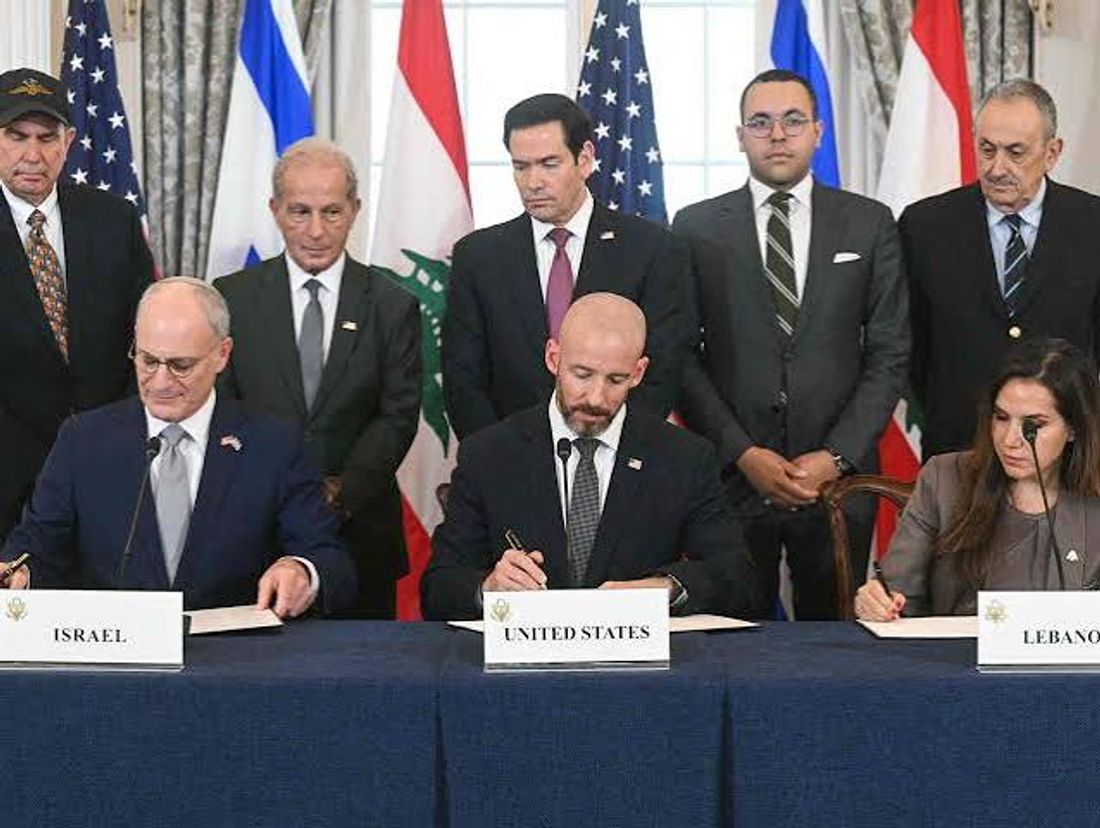
Al-Diyar quoted informed sources as saying that yesterday’s meeting between President Joseph Aoun and the military delegation involved in the negotiations could be considered a foundational step toward reorganizing Lebanon’s negotiating position. The previous round ended without any progress, with disagreements remaining over the mechanism for verifying security measures, the cessation of Israeli attacks, withdrawal from Lebanese territory, and the role of the Lebanese Army in the next phase.
The disagreement is not limited to the verification mechanism, considered the main sticking point, or Israel’s insistence on imposing direct coordination or establishing a joint operations room with the Lebanese Army. The American position appears even more concerning following Washington’s proposal of a roadmap prepared by the head of the Mechanism Committee, U.S. General Joseph Clearfield. The plan calls for imposing new security arrangements, including joint Israeli-Lebanese patrols inside the area known as the “Yellow Line” following UNIFIL’s withdrawal.
The Lebanese Army leadership categorically rejects this proposal because it would give Israel a direct role in monitoring Lebanese territory, rather than relying on international forces to carry out separation and verification duties.
According to the information, General Clearfield had previously promised, during communications with Lebanese officials, to establish an international military committee to verify the Lebanese Army’s measures concerning the disarmament of Hezb0llah. However, he reversed his position and informed the relevant parties that an international military presence was unnecessary. He instead called for preparations to begin bilateral arrangements involving joint patrols, while retaining the designation “Yellow Line.”
In other words, the line would effectively become a de facto deployment line, raising Lebanese concerns that temporary arrangements could turn into long-term security boundaries that entrench the Israeli occupation.
In this context, Lebanon is preparing to inform Washington that it remains firmly opposed to any field-level partnership between the Lebanese and Israeli armies. Beirut will also insist on the presence of the American mediator and a third party responsible for verifying mutual commitments, particularly the withdrawal of Israeli forces.
Diplomatic sources described the situation as highly complicated, saying that no breakthrough can be expected unless the American strategy changes and Washington pressures Israel to engage seriously in the negotiations. So far, the Trump administration appears keen to keep the process formally underway without making substantive progress.
This approach is heightening concerns in Beirut amid political turmoil and a power vacuum in Israel following the elections, a situation expected to last at least 100 days. The result is diplomatic and political paralysis alongside continued military escalation, amid fears of increasing American pressure on Lebanon’s domestic political scene.
National Interest Warns of a Prolonged Israeli Military Presence
In this context, a report published by the American magazine The National Interest warned that Israel could move toward establishing a long-term military presence in parts of southern Lebanon. It noted that the election results could lead to an expansion of military operations rather than their conclusion, particularly amid stalled negotiations and insufficient American pressure.
According to the report, the Israeli military presence could gradually turn into what it described as an “open-ended occupation,” recalling Israel’s occupation of southern Lebanon between 1982 and 2000, but under more complicated regional circumstances.
Al-Jumhuriya: Political Stalemate in Israel Does Not Necessarily Mean Calm on the Border
Al-Jumhuriya newspaper said Lebanon’s problem lies in the fact that political deadlock in Israel does not necessarily translate into calm along the border. Nor does the arrival of new leadership guarantee a reassessment of the security-zone policy or an end to military operations.
Israeli positions, including those expressed by Gadi Eisenkot, have demonstrated a continued focus on preventing Hezb0llah from rebuilding its military capabilities. Meanwhile, Hezb0llah continues to reject linking the issue of its weapons to security arrangements that it views as connected to the continuation of the occupation and Israeli attacks.
Caught between these two positions, Lebanon remains vulnerable to an unresolved situation suspended between war and a settlement, with the south and its residents bearing the cost as the return of displaced residents, reconstruction, and the restoration of stability remain stalled.
According to diplomatic circles, the most sensitive possibility concerns the impact of Israel’s political deadlock on the ongoing negotiations under American sponsorship.
If government formation takes a long time, major political decisions could be delayed, although technical contacts and pressure on the ground would not necessarily stop.
If Netanyahu succeeds in forming a new government, a hard-line position could continue, particularly regarding linking Israel’s withdrawal to security changes inside Lebanon.
However, if power passes to Eisenkot or to another coalition arrangement, the challenge will not simply be a change of names. Rather, it will be whether the new leadership is prepared to make mutual concessions that would allow for the implementation of sustainable understandings.
For this reason, Lebanon cannot base its calculations on the expectation that Netanyahu will fall, nor assume that any future Israeli government will be more willing to reach a settlement.
The source concluded that the decision to reduce escalation in the region rests with the United States, and that the decision to go to war is also an American one. Therefore, any escalation against Lebanon cannot take place without American approval.
This means there will be no change in the current equation or in the rules of engagement currently in force. Washington will not allow those rules to be exceeded if it genuinely seeks to avoid escalation and contain it in line with the ongoing diplomatic efforts.


