
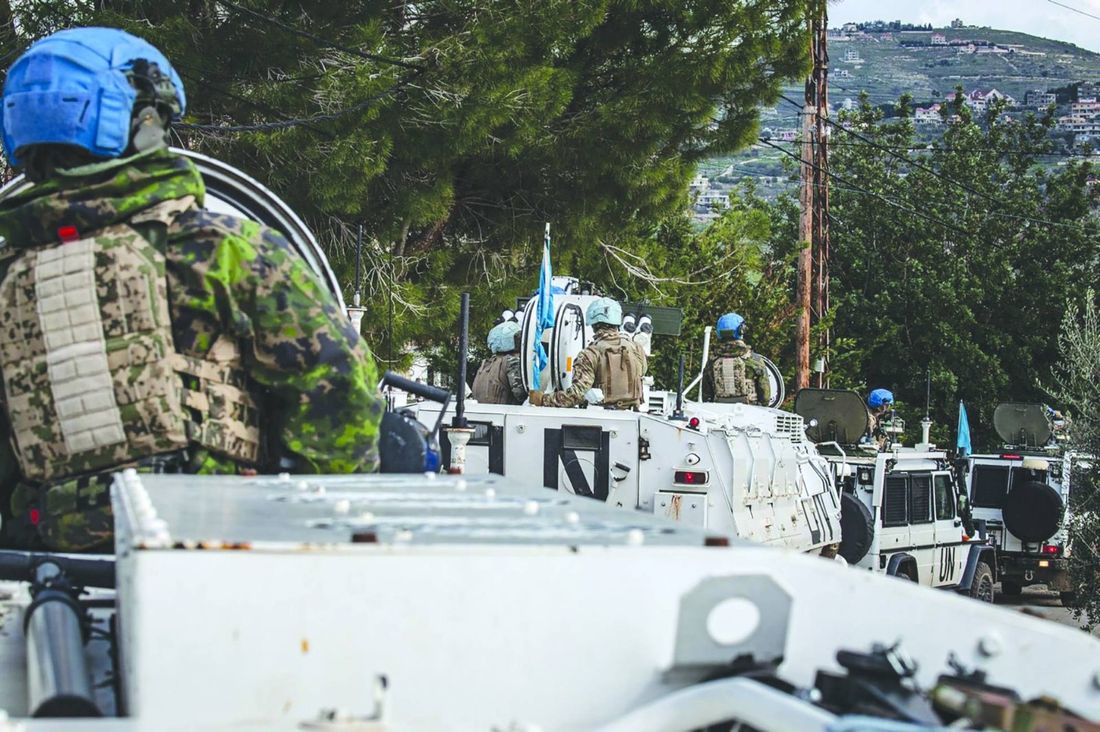
Countries concerned with Lebanon are discussing the need to establish an alternative security force to UNIFIL, whose mandate expires at the end of this year. The proposed force would support the Lebanese Army in implementing international understandings and resolutions in southern Lebanon.
But can an international force implement both UN Security Council Resolution 1701 and the Framework Agreement signed by Lebanon and Israel under US auspices several months ago?
Discussions have resulted in a general consensus on the need for an alternative arrangement. However, no agreement has yet been reached on the nature of this force, its composition, its assigned responsibilities, its operational mechanisms, or the parties that would participate in it.
This situation is underscored by the statement issued by G7 foreign ministers, who met in Paris on November 9 and 10. The statement called for establishing a robust, credible and sustainable security framework in Lebanon to support the Lebanese Armed Forces, in accordance with UN Security Council Resolution 1701, and to facilitate stronger implementation of the trilateral Framework Agreement, without announcing any further understandings.
US Visit to Beirut
Attention is now focused on the visit to Beirut by US Ambassador to the United Nations Michael Waltz, scheduled for Monday, when he is expected to meet President Joseph Aoun.
Media reports in recent hours have revealed that Washington is considering abandoning the UNIFIL mission in southern Lebanon and replacing it with a verification committee tasked with overseeing the implementation of the Framework Agreement, instead of Resolution 1701.
According to information reported by LBCI sources, the administration of President Donald Trump is considering establishing a mechanism similar to the Multinational Force and Observers (MFO), deployed in Egypt, to monitor the trilateral agreement between Lebanon and Israel as a possible arrangement for the post-UNIFIL period.
According to Asharq Al-Awsat it remains unclear whether any new understandings will provide for the establishment of two separate forces: one to replace UNIFIL and another to verify implementation of the Framework Agreement.
Alternatively, Resolution 1701 and the Framework Agreement could be merged, or the former could be discarded in favor of the latter. In that case, a single security force would be established, with clearly defined responsibilities.
International efforts are also reportedly underway to place the Framework Agreement under the umbrella of the United Nations, a move that could effectively displace Resolution 1701.
According to legal expert Yamin, this could happen through registration with the UN Secretariat under Article 102 of the UN Charter, provided the agreement qualifies as a treaty in the strict legal sense. Such registration would not, in itself, provide an actual UN umbrella, but would allow the agreement to be invoked before UN bodies.
Another option would involve identical letters from the parties to the Security Council requesting its endorsement of the agreement, followed by a presidential statement or resolution welcoming it.
A further possibility would be a Security Council resolution formally endorsing the agreement and annexing it, or a resolution establishing a force or expanding the mandate of an existing one to implement the agreement, following the model of UNDOF (the United Nations Disengagement Observer Force).
Al-Liwaa: Washington May Delay Negotiations Until Israel Forms a New Government
Al-Liwaa reported that information circulated yesterday suggesting the US administration would not call for the resumption of negotiations between Lebanon and Israel until a new Israeli government is formed.
This process could take several months if Israeli political parties fail to reach an agreement on forming a government.
Contacts are also continuing in search of the most appropriate formula acceptable to both Lebanon and the United States for establishing an international monitoring force that would oversee the situation in southern Lebanon.
According to the information, discussions are currently focused on a formula combining certain provisions of Resolution 1701 with elements of the Framework Agreement signed between Lebanon and Israel.
However, the proposal has not yet been finalized, particularly regarding its details and how the two instruments could be reconciled.
An-Nahar: Possible UN Alternative or Extension of UNIFIL
An-Nahar reported that recent American and French positions regarding the situation in southern Lebanon after UNIFIL's mandate expires have opened a window of hope for either a UN-backed alternative or some form of agreement to extend UNIFIL's mandate, although no final decision has been reached.
Lebanon is therefore awaiting the visit of US Ambassador to the United Nations Michael Waltz early next week to gain a clearer understanding of Washington's plans for the post-UNIFIL period.
Official sources said Lebanon is waiting to hear from the American diplomat about the alternative to UNIFIL, whose mission ends on December 31.
They indicated that a possible formula could involve renewing the mandate of some UNIFIL personnel in exchange for specific steps to be announced by Lebanon concerning Hezb0llah's weapons.
According to these sources, the issue remains under American-French discussion. France has also conducted preliminary consultations with political forces concerned with southern Lebanon regarding a possible alternative to UNIFIL.
Nothing has yet taken shape, although the coming weeks are expected to be decisive.
Al-Diyar: Washington to Present a New Security Framework and Demand Clear Answers from Beirut
For its part, Al-Diyar reported that neither Beirut nor Washington has clear answers yet regarding the future of negotiations with Israel.
While Paris is attempting to propose arrangements to fill the vacuum that would follow UNIFIL's departure, through a new proposal discussed with US Secretary of State Marco Rubio during his visit to France, diplomatic sources revealed that the US ambassador to the United Nations will bring a series of questions to Beirut.
Waltz hopes to obtain definitive answers from the Lebanese state regarding its readiness to move towards new arrangements that would strengthen the Lebanese Army's authority in the south.
He is expected to ask whether the government is prepared to implement its security decisions, which is considered a fundamental factor in the success of security arrangements that have yet to take shape.
Key issues include:
- The nature of direct cooperation between the Lebanese Army and Israeli forces.
- Which party would verify the disarmament of Hezb0llah.
- The Lebanese state's measures in response to Hezb0llah's refusal to surrender its weapons.
- Which authority would be responsible for dealing with any armed opposition to the movements of the Lebanese Army or international patrols.
While Paris favors maintaining a clear UN umbrella for the new arrangements, Washington is focusing on establishing a limited mechanism capable of operating in direct coordination with the Lebanese Army and the parties involved in monitoring implementation of the security agreement.
In this context, diplomatic sources pointed to what they described as the dangerous proposal the American official is expected to raise: the cancellation of Resolution 1701's effects and the establishment of the Framework Agreement as the main reference point.
Waltz is also expected to discuss the possibility of making use of the United Nations Truce Supervision Organization (UNTSO), by strengthening its technical capabilities and expanding its links to the mechanism overseeing the cessation of hostilities.
Its mandate would be defined to include monitoring violations and exchanging information between the parties concerned.
This proposal is subject to consultations with France and European countries participating in UNIFIL, particularly Italy and France.
The American official will also inform Lebanese officials that military and technical assistance allocated to the Lebanese Army to carry out its missions will be linked to the submission of an implementation plan.
The plan would specify the needs of military units and the stages through which they would assume security responsibilities, particularly with regard to:
- Armored transport vehicles.
- Surveillance and monitoring equipment.
- Engineering equipment used to deal with tunnels and unexploded ordnance.
Al-Anbaa: Washington's Vision for Southern Lebanon After UNIFIL
According to diplomatic sources quoted by Al-Anbaa, US Ambassador to the United Nations Michael Waltz will bring Washington's proposed formula for the future of southern Lebanon after the international force's mandate expires when he visits Beirut early next week.
He is expected to discuss the proposal with Lebanese officials.
Although France and the United States have yet to reach an agreement on their vision for security arrangements in southern Lebanon, the Lebanese state continues to insist on maintaining a United Nations force under an international mandate that provides legitimacy for its operations.
Beirut wants this force to serve, as far as possible, as a deterrent against continued Israeli violations and incursions in southern Lebanon, while primarily acting as a UN body responsible for documenting Israeli violations.


