
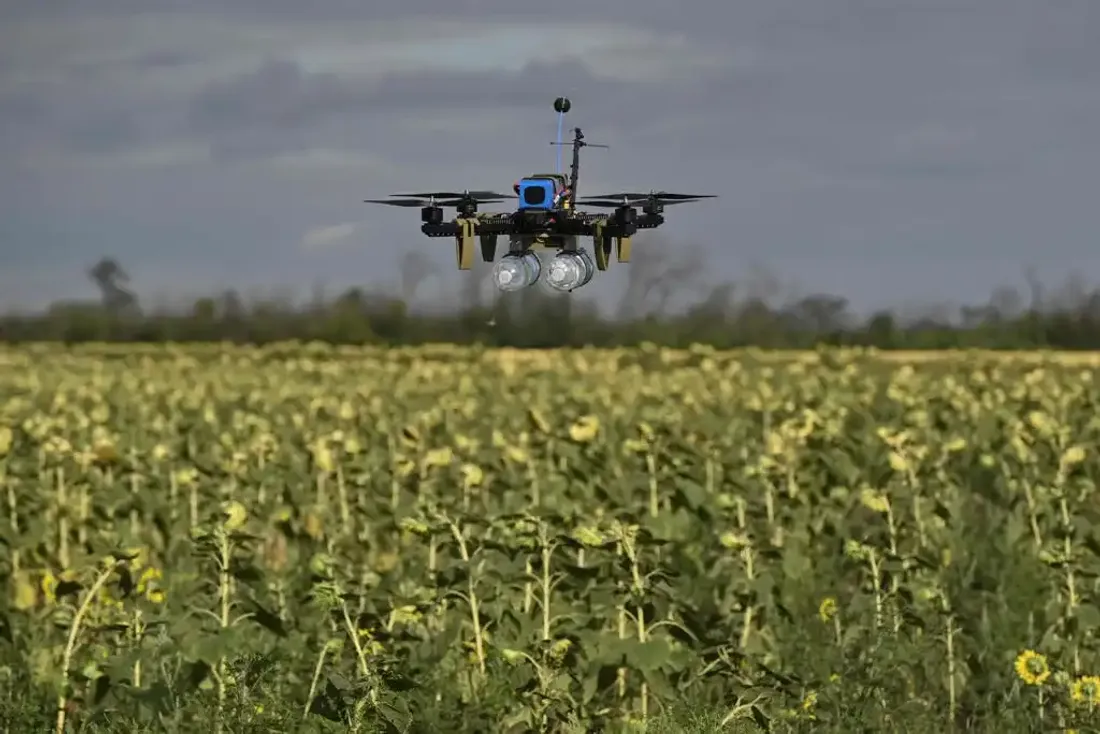
Losing the connection between a drone and its controller does not necessarily mean that the aircraft will immediately crash or completely lose control. Many modern drones are equipped with built-in safety systems that allow them to respond to signal loss in different ways, including automatically returning to their takeoff point, hovering in place, or landing.
However, the situation can become more complicated when the loss of communication coincides with a failure of positioning systems, potentially turning the drone into an object unable to determine its location or return to its starting point.
According to a report published by Interesting Engineering, what happens to a drone after losing its signal depends on the type of connection that has been interrupted, which navigation systems remain operational, and how the aircraft has been programmed to handle emergencies.
Signal and Control
Consumer drones rely on several communication and navigation systems that work together. Among the most impoant is the communication link between the aircraft and its controller, which transmits the pilot's commands regarding direction, altitude, and speed.
Some drones also transmit live video feeds and flight data to the controller. These connections can experience interference or interruptions independently, meaning that the pilot may lose the live camera feed while still being able to control the aircraft.
Navigation, meanwhile, generally relies on global satellite systems, including the Global Positioning System (GPS), alongside internal sensors such as compasses, accelerometers, and gyroscopes. These help the flight controller determine the drone's position, orientation, and movement.
Therefore, losing the connection to the controller does not necessarily mean losing GPS positioning. Similarly, a drone can lose GPS data or compass functionality while maintaining its connection to the pilot.
Automatic Response
Many modern drones feature a safety function known as Return to Home (RTH), which is activated when communication with the controller is interrupted for a predetermined period.
This feature allows the drone to use its stored takeoff-point coordinates and navigation systems to automatically return to the location from which its flight began.
In some models, the drone first climbs to a predetermined altitude to avoid obstacles, then follows a return route before landing automatically.
However, returning to the takeoff point is not the only available option. Some drones can be configured to hover in place or land at their current location when communication is lost. Their behavior varies depending on the model, operating software, and user-defined settings.
DJI drones offer these options in supported models, while the open-source flight control software ArduPilot also provides several emergency procedures, including Return to Launch, Smart Return-to-Route, and landing.
Despite the importance of these systems, they do not guarantee that a drone will return safely under all circumstances. Automatic return requires sufficient battery power, correctly recorded takeoff coordinates, and reliable navigation data. Obstacles, wind, or sensor malfunctions may also prevent the drone from completing its return route safely.
GPS Loss
Losing GPS positioning creates a more complicated situation because the drone may no longer be able to determine its precise location.
In this situation, some multirotor drones can switch to a flight mode known as ATTI mode. This mode relies on internal sensors to help stabilize the aircraft's orientation and maintain its altitude, but it does not provide automatic position stabilization using GPS.
This means that wind can push the drone away from its original position, forcing the pilot to use the controller to manually correct its course. This can be difficult if the aircraft is far away or difficult to see.
The situation becomes even more dangerous if the drone loses its connection to the controller as well as the navigation data required for automatic return. In such cases, it may be unable to receive the pilot's commands or determine a route back to its takeoff point.
Limitations of Safety Systems
Investigations conducted by the United Kingdom's Air Accidents Investigation Branch (AAIB) demonstrate how navigation failures can lead to actual accidents.
In December 2019, a DJI Matrice M600 Pro drone being used to survey a construction site experienced failures in both its GPS and compass systems. This caused it to switch from automatic flight to ATTI mode, which requires manual control.
The pilot repeatedly attempted to activate the Return to Home function, but the drone continued drifting in the wind before colliding with the roof of a house and crashing into its garden.
Investigators concluded that the loss of reliable heading information prevented the drone from carrying out the return maneuver.
In another incident in November 2021, in the English city of Rugby, a DJI Phantom 4 Pro experienced magnetic interference shortly after takeoff. It received warnings indicating a loss of heading reference and an inability to operate in its usual GPS-assisted mode.
Communication between the drone and its controller was subsequently lost, causing the aircraft to drift approximately 630 meters over a populated area before coming to rest in a tree.
Reducing the Risk
Drone operators can reduce the likelihood of losing their aircraft by ensuring strong GPS signal reception and proper compass functionality before takeoff, verifying that the Return to Home point has been correctly recorded, and selecting an appropriate automatic return altitude that allows the drone to clear obstacles.
They should also monitor battery levels, weather conditions, and potential sources of electromagnetic interference, while understanding how their specific drone model responds to communication failures or navigation system malfunctions.
Training in manual flight and emergency procedures remains essential, particularly when automatic flight modes are no longer available.
Ultimately, what happens to a drone after losing its signal does not depend solely on its automatic return system, but also on which systems remain operational. It may successfully return to its takeoff point, hover in place, or land automatically. However, simultaneous communication and navigation failures can result in a complete loss of control.
Source: (Erem News)


