
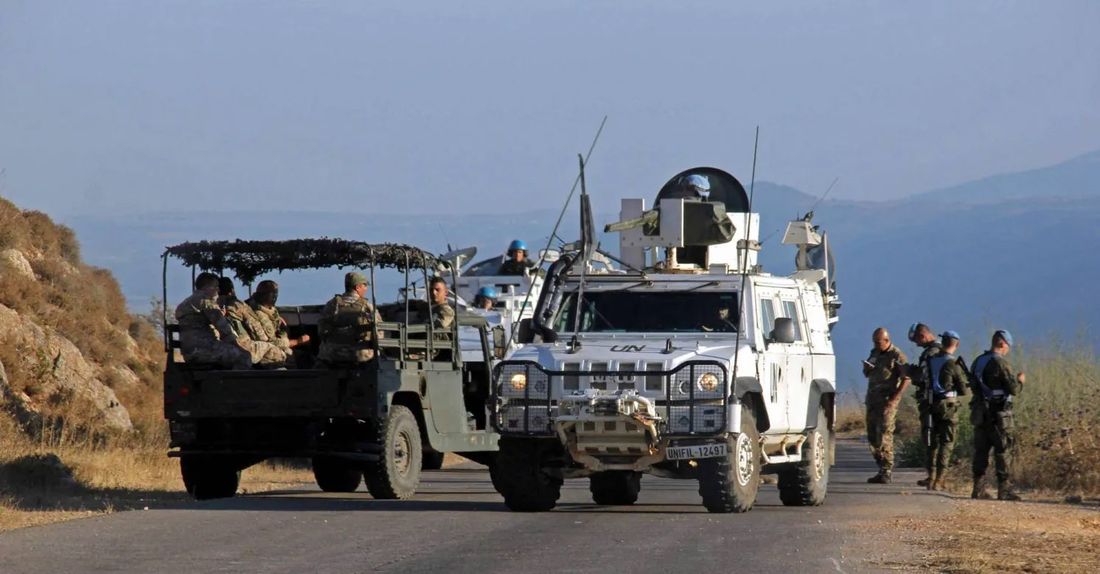
The newspaper Al-Liwaa reported today that what is being cooked up for the South following the departure of the UNIFIL peacekeeping units almost reaches a point that does not reassure Lebanon, the residents of the South, or all those concerned with the South, its liberation, and the return of its people. Quoting informed sources, the paper noted that consultations regarding the alternative force to UNIFIL will intensify soon, without this necessarily meaning that this force will see the light of day this month or that a specific date has been set for this purpose, pointing out that the prevailing phase in Lebanon is one of anticipation regarding the trajectory of external files. Pending the drafting of the new resolution—which incorporates elements of the Framework Agreement into the text of the new Resolution 1701—the plan is being formulated so that UNIFIL is allowed a gradual withdrawal after the deadline expires on December 31, with the process continuing over six months to prevent a vacuum.
Al-Liwaa added: The closed-door UN Security Council consultations on Lebanon concluded after lasting two days without reaching an agreement on a single formula for forming an international force to replace UNIFIL upon the expiration of its mandate on December 31.
Official sources who followed the consultation sessions told Al-Liwaa: Deliberations do not appear likely to settle on a consensual solution anytime soon; they will take their time and may not reach a conclusion by the deadline set for the end of UNIFIL's mandate. Some countries, representing a third of the Council's members—such as Russia, China, and Pakistan—believe that the decision to end UNIFIL's mandate was made under circumstances different from the current ones, which necessitate its continuation, an extension, or the creation of another force.
The sources continued: There is a proposal being adopted based on the idea that as long as UNIFIL forces will remain for a period of time after their mandate officially ends, there is nothing preventing them from remaining during their gradual withdrawal period as an observation and reporting force until an agreement is reached. By doing so, Lebanon would effectively be buying additional time for UNIFIL's core tasks to remain. This is in addition to the fact that UNIFIL holds about 22 positions inside the so-called "Yellow Line" defined by the occupation, which it cannot evacuate and hand over to an occupation force. Meanwhile, the American side is presenting other ideas centered on direct coordination between the Lebanese Army and the occupation army, and merging Resolution 1701 with the Framework Agreement—something categorically rejected by Lebanon because it enshrines the legitimacy of the occupation. Furthermore, this merger is rejected domestically by the Shiite Duo, which has repeatedly stated its negative stance toward the Framework Agreement through Speaker Nabih Berri and Hezb0llah.
According to Al-Liwaa: France is working to market a new resolution that includes dropping the Armistice Agreement from the new resolution and establishing security and economic zones along the border. Information indicates that the new force would assume the task of verifying the implementation of the security arrangements stipulated in the Framework Agreement, with its area of deployment expanded to include north of the Litani River. Discussions are underway to grant it a wider margin of movement so that its operations are not restricted by the presence of the Lebanese Army or tied to its accompaniment, raising fundamental questions about the nature of the relationship that will exist between the new forces and the Lebanese military establishment, and the entity that will determine its movement mechanisms and field missions. Discussions also point to the new force numbering around 500 personnel. Information speaks of placing the new resolution under Chapter VII of the UN Charter, alongside fears that it could turn into a force that fails to provide stability if the local population views it as a hostile force.
As for Ad-Diyar, it stated: The Lebanese face hot weeks ahead until December 31—the expiration date of the international forces' mandate in the South—without reaching a joint international vision or an acceptable formula to manage the next phase on the Lebanese border with occupied Palestine, amid the American refusal to renew the international forces' mandate under Resolution 1701.
According to those following the atmosphere of the contacts, US envoy Waltz heard two completely contradictory viewpoints in Lebanon: Baabda and the Grand Serail (Aoun and Salam) were on the same wavelength, aligned with the US-French proposal based on merging the Framework Agreement and Resolution 1701 and going to the UN Security Council to grant the agreement international legitimacy and UN cover. Conversely, he heard a different message in Ain el-Tineh from Speaker Berri, centered on adhering to Resolution 1701 in all its provisions, rejecting all American proposals for amendments to 1701, and clinging to the agreement signed on November 29, 2024.
According to leaks from Beirut, France will go to the Security Council carrying the joint draft, whose content includes the Framework Agreement, direct communication between the Lebanese and Israeli armies, and the establishment of a joint US-Israeli-Lebanese committee to handle disputes and verification operations, parallel to the formation of an international force of 400 personnel led by a French officer, tasked with monitoring without any executive powers and not subject to UN command.
Ad-Diyar added: US-French contacts are ongoing, and there is an understanding on the main headlines. The contacts included Saudi officials, who gave preliminary approval to the US-French formula; however, information also indicates that the Russian and Chinese positions have not yet been decided, despite American contacts with both sides to avoid a veto, and Washington has not received a final answer in this regard.
Meanwhile, a political authority told Al-Joumhouria that he fears what he termed "December surprises," in a direct reference to next December, at the end of which UNIFIL's mission in southern Lebanon expires. The source of the authority's fear is that before the end of December, a UN Security Council resolution is scheduled to be issued regarding UNIFIL's departure and the post-departure phase. It is known that France is the "penholder" and will handle drafting the resolution. So far, no agreement has been reached on an alternative force to succeed UNIFIL in its mission under the UN flag. According to available data, Israel rejects any force mandated by the United Nations. A few days ago, US envoy Mike Waltz visited Beirut and affirmed that Washington will seek with Paris to incorporate some of the contents of the Framework formula into the resolution to be issued by the Security Council. What is feared, therefore, is that a security situation might be fabricated in the South to heighten tensions prior to the issuance of the Security Council resolution, paving the way for its adoption under heated circumstances.


