
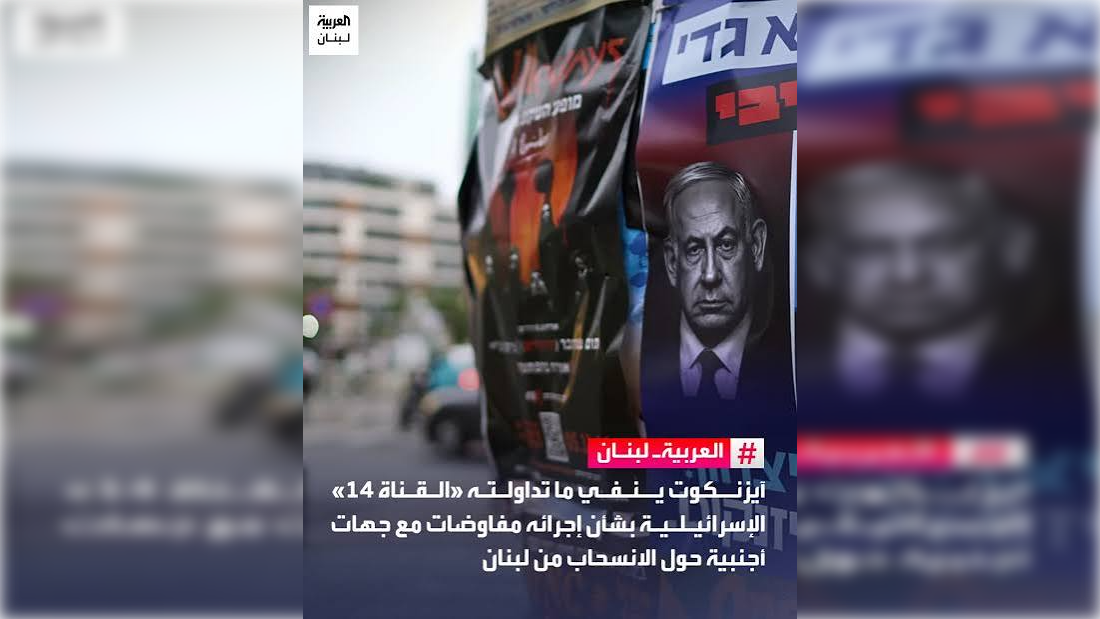
Lebanese newspapers today examined whether assigning Gadi Eisenkot the task of forming a new Israeli government could have a positive impact on Lebanon, or whether the situation will remain unchanged, marked by escalation and pressure.
Al-Liwaa wrote: Questions have begun to arise about how this hardline military figure will deal with the Lebanese situation in general, and the situation in southern Lebanon in particular. Will he continue to embrace the concept of “preemptive deterrence” and the ongoing attacks and various military operations, or will he change the “Dahiya Doctrine” that he devised, along with Israel’s methods of dealing with the situation in the south?
This, of course, depends on whether he succeeds in forming a government within the 24 days stipulated by the constitution, which can be extended by an additional 14 days. Will he continue to adhere to this doctrine, or does he have other plans for dealing with the situation in southern Lebanon?
The newspaper added that available information indicates Eisenkot supports political arrangements and conditional withdrawals based on a conflict-management approach. On the political and diplomatic level, Eisenkot is described as being more inclined toward solutions sponsored by the current U.S. administration and other countries to halt the fighting—but only after Israel achieves its strategic objectives—in order to ease pressure on the Israeli home front and economy.
Reports and diplomatic assessments also indicate that Eisenkot may favor accelerating security arrangements or framework agreements with Lebanon under international sponsorship to organize the situation in southern Lebanon, in exchange for security guarantees for Israel. There are also indications of the possibility of entering negotiations to arrange withdrawals from some Lebanese border areas adjacent to Israel, provided guarantees are made that the Resistance's military infrastructure does not return to the immediate border strip.
However, Eisenkot also supports maintaining the “absolute freedom of military movement and action” adopted by his predecessor, Benjamin Netanyahu. Even if settlements or tactical withdrawals are reached, Eisenkot rejects any agreements that would restrict the Israeli military's ability to carry out preemptive strikes or continue intelligence and air operations inside Lebanese and Syrian territory whenever security considerations require it.
He believes that maintaining “security zones” or the ability to intervene directly is the only guarantee against the strengthening of the opposing side along the northern border.
Meanwhile, Ad-Diyar said that Eisenkot and Benjamin Netanyahu are “two sides of the same coin.” While they may differ in style and political approaches, they share the same strategic objectives, particularly regarding Lebanon and Hezbollah.
Notably, Hezb0llah itself does not appear to be relying on changes in the identities of those who assume power in Israel as much as it is watching the nature of the government that will be formed, the coalitions on which it will be based, and—most importantly—the visions and strategies it will adopt in dealing with regional issues, particularly Lebanon.
For Hezb0llah, the issue is not simply the transfer of power from Netanyahu to Eisenkot, but whether this transition will lead to a genuine change in Israel's security doctrine and its approach to managing the confrontation with Lebanon, or whether the new government will continue along the same path, even if it adopts different political rhetoric and tools.
The newspaper added that, during the period available to Eisenkot to form a government—a maximum of 42 days—sources closely following the matter rule out that Netanyahu, who currently heads a caretaker government, would launch a new war against Hezbollah amid the significant domestic pressures he faces.
Israeli law allows the current government, despite its transition into a caretaker government, to retain broad executive powers, particularly in security, military and foreign policy matters.
The sources told Ad-Diyar that, so far, there is no U.S. green light allowing Netanyahu to undertake such an adventure. This means that fears of a new war are linked exclusively to a possible U.S. decision to launch another war against Iran, which could expand to include the entire region, including Lebanon.
They also noted that U.S. President Donald Trump said yesterday that he was unlikely to order a return to war with Iran if progress continued in the talks.
Ad-Diyar also quoted an official Lebanese source as saying that Eisenkot's arrival could open the door to an Israeli approach that is more responsive to U.S. demands and proposals than was the case under Benjamin Netanyahu, which could be reflected in the course of negotiations.
However, it is still too early to determine this. The coming weeks must be awaited to see whether a new Israeli government can be formed and what its orientation will be, before drawing conclusions about the fate of the negotiations, which, until further notice, remain up in the air.


